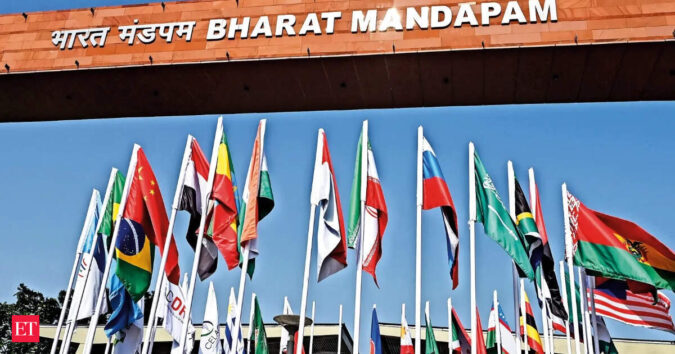
New Delhi has traditionally viewed BRICS as a vehicle to amplify the voice of emerging economies and push for a more representative, multipolar global order.
Also Read: BRICS by BRICS: India’s journey from seeking reforms to shaping global order
But a turbulent global environment, widening differences among members over geopolitical issues and the sheer size of the expanded group have made that balancing act more difficult.
The September 12-13 summit in Delhi, which marks 20 years of the grouping, gives India a chance to bring greater coherence to the grouping and demonstrate whether it can become a more effective force in shaping global economic and diplomatic outcomes.
India’s presidency is built around four pillars, being resilience, innovation, cooperation and sustainability, drawing on Prime Minister Narendra Modi’s “Humanity First” approach.
Much of the year has focused on technical meetings on energy, trade, technology and other areas. But the summit comes at a moment when tariffs, wars and energy disruptions are putting the global economy under unusual pressure.
India, China and Russia: a strategic opportunity
The most immediate strategic opportunity for New Delhi is also the most obvious one. BRICS Summit brings India, China and Russia together again, shortly after the three countries met at the Shanghai Cooperation Organisation summit.
Chinese President Xi Jinping’s expected presence in Delhi will make the India-China engagement particularly important. The summit offers Modi a platform to engage Xi alongside Russian President Vladimir Putin and the leaders of the grouping’s newer members, including Gulf powers.
India’s relationship with China remains complicated by the border dispute, while Russia remains a critical partner for New Delhi in energy, defence and trade. The BRICS platform does not resolve those differences with China or change the nature of India’s partnership with Russia, but will give India a setting in which it can manage several strategic relationships at once.
When India hosted the BRICS summit for the first time in 2012 under the theme “Global Stability, Security and Prosperity”, helped advance the creation of the New Development Bank. New Delhi also pushed to expand cooperation into areas such as counter-terrorism.
On the other hand, Beijing viewed the grouping as a way to build the influence of emerging economies and strengthen its engagement with the wider Global South. The BRICS-Plus and Outreach formats have broadened that reach.
Also Read: India set to host expanded BRICS summit as global trade, finance and governance take centre stage
India found itself trying to pursue two objectives at once, reform global institutions while ensuring BRICS did not become dominated by one country’s strategic agenda.
BRICS is becoming a much bigger economic bloc
The expanded grouping brings together major oil and gas producers, huge energy consumers, large manufacturing economies and fast-growing markets. Collectively, its members account for nearly half the world’s population and a substantial share of global output and trade.
That gives BRICS potential relevance across energy, investment, trade, supply chains and technology. The opportunity is particularly important as US tariffs and geopolitical conflicts push countries to diversify markets and make supply chains more resilient.
New Delhi is looking at mechanisms to increase intra-BRICS trade, reduce transaction costs and make customs procedures easier. The grouping is also working on cooperation in global value chains through an Action Plan for 2026-30, including a technical council and a joint study.
The challenge is that the countries have very different economic structures and interests.
Also Read: India set to host expanded BRICS summit as global trade, finance and governance take centre stage
India and China compete in several areas even as they trade heavily with each other. Gulf members are major energy exporters, while India and China are major importers. Russia’s economy has been reshaped by Western sanctions and the war in Ukraine. BRICS can be useful precisely because these countries do not need to agree on everything to cooperate where their interests overlap.
The dollar question — and why India is being cautious
The question of reducing dependence on the US dollar will inevitably be closely watched in the capital. India, however, has consistently drawn a distinction between making cross-border payments cheaper and launching an explicitly anti-dollar project.
New Delhi supports greater use of national currencies for bilateral trade and wants more efficient payment mechanisms. But it does not favour a common BRICS currency. In August, Commerce and Industry Minister Piyush Goyal said India was not in favour of a separate BRICS currency.
India’s approach is instead focused on local-currency settlement, payment interoperability and reducing the need for costly dollar-based intermediaries.
The Reserve Bank of India has also proposed linking the digital currencies of BRICS countries to facilitate cross-border trade and tourism payments. A high-level meeting is expected to examine mechanisms for using digital currencies and increasing intra-BRICS trade through national currencies.
BRICS countries are at different stages of developing central bank digital currencies, with different technologies, regulatory systems and approaches to monetary policy. Any cross-border system would therefore require substantial coordination.
China’s approach is more directly aimed at increasing the international role of the yuan. Russia’s position, meanwhile, reflects its experience with Western sanctions and restrictions on the dollar-based financial system.
Yet Moscow has sought to distance itself from the formal label of “de-dollarisation”.
Also Read: BRICS Climate Agenda: Focus on Global South as India pushes for sustainable future
“We do not seek ‘de-dollarisation’,” Kremlin spokesperson Dmitry Peskov said on September 8, adding that Russia remained open to acceptable payment methods.
At the same time, Peskov said around 90% of transactions between Russia and BRICS countries are conducted in national currencies.
Energy may offer the clearest common ground
Energy could be where the enlarged BRICS finds some of its strongest common interests. The grouping now includes Russia, Saudi Arabia, the UAE and Iran — major energy powers — alongside India and China, two of the world’s biggest oil-consuming economies.
For Delhi, any prolonged disruption to shipping through the Strait of Hormuz can increase energy costs, inflation and pressure on India’s trade balance.
India’s BRICS energy agenda has therefore focused on energy security alongside sustainability, technology and innovation.
The BRICS Energy Ministers’ Meeting in June discussed energy security, energy access and equity, and new technologies. The meeting also advanced cooperation on smart grids, energy storage and hydrogen.
Energy producers want reliable markets and investment. Consumers want affordable and secure supplies. Developing economies want access to energy without sacrificing growth, while all members face increasing pressure to transition towards cleaner sources.
Can a bigger BRICS still act as one?
The expansion that has made BRICS more consequential has also made consensus harder. India and China have a border dispute. Russia remains at war with Ukraine. Iran and the Gulf states have competing regional interests. The war in West Asia has further complicated the group’s internal dynamics.
The difficulty was visible in May, when the BRICS foreign ministers’ meeting in New Delhi failed to produce a joint statement because members could not agree on the conflict in West Asia. India subsequently issued a chair’s statement and outcome document.
The episode underlined the limits of an expanded grouping in which countries have sharply different geopolitical priorities.
But BRICS does not necessarily have to become a unified geopolitical bloc to matter. Its untapped potential lies in finding areas where members can cooperate despite their differences.
BRICS was created because its founding members believed the global order did not adequately reflect the weight of emerging economies. Twenty years later, that argument has produced a much larger and more diverse grouping.
The challenge now is to ensure that size translates into influence. If New Delhi can bring China, Russia, Gulf energy powers and the wider Global South into a framework focused on practical economic cooperation, it could give the expanded bloc a clearer purpose.
The Delhi summit, then, is not simply another meeting of emerging economies. It is India’s test of whether a much bigger, more divided BRICS can still find enough common ground to matter.