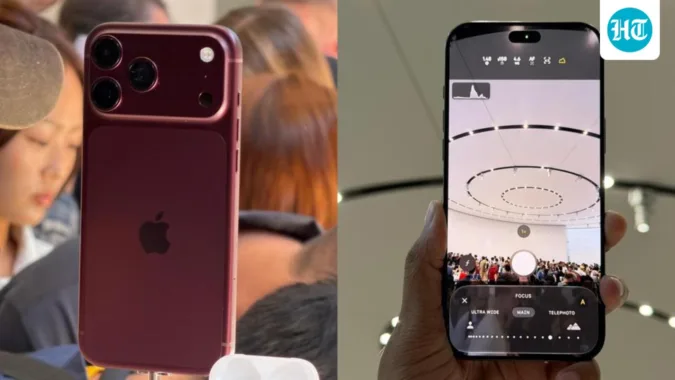
There is a charm in continuity and familiarity. The generation transitions of the iPhone 18 Pro and iPhone 18 Pro Max mark a significant performance leap, with the new A20 Pro silicon making these the most powerful smartphones as well as the most capable AI devices in the ecosystem. There is broad continuity as far as the screen sizes, and overall aesthetics are concerned, but a number of changes have happened under the hood. Faster wired charging, battery stamina improvements, variable aperture on the main camera, and an updated Camera app, mark the new ‘Pro’ phones that are now priced ₹1,64,900 onwards.
That’s aside from the gorgeous new Burgundy colour, which will be the flagship colour for the iPhone 18 Pro series, replacing last year’s Cosmic Orange. Speaking of which, Black and Silver may look familiar, but there’s a second very cool looking shade in the iPhone 18 Pro’s array of colours—Glacier, or a very sophisticated shade of light blue. If Burgundy isn’t your thing for some reason, Glacier might be the ticket to stand out in the crowd. These phones have become more expensive generationally, which is a sign of geopolitical ramifications and supply chain variables.
As far as visually comparing the iPhone 18 Pro Max and the iPhone 18 Pro with the iPhone 17 Pro Max and the iPhone 17 Pro, it all looks mostly at par. However, I have not been able to check of the iPhone 17 Pro series cases will fit the iPhone 18 Pro series—that’s what comes from being someone who uses their phone without a case.
The camera on the ‘Pro’ phones introduces variable aperture (ƒ/1.48, ƒ/1.8, ƒ/2.8, ƒ/4.0) for the main camera, potentially improving optical depth-of-field control and dynamic range across lighting conditions. This will have a bearing on colour reproduction as well. The Camera app has also been updated to reflect what Apple calls ‘Pro Controls’. The broader feature set includes Smart focus tracking, Cinematic mode effects from video, and improved low-light video (Apple says as much as 50% better, in some cases—that should be quite something in overall photography terms).
From a technology standpoint, mechanical variable aperture is a physical, adjustable iris inside a camera lens that alters the size of the opening to control the amount of light reaching the sensor—unlike fixed apertures in which the opening for light input remains largely the same size.
Apple mostly refrains from talking about battery capacity specifics or how much silicon-carbide makes up for the battery chemistry. However, they do say that the iPhone 18 Pro Max can last as much as 6 hours more of video playback, compared with the iPhone 17 Pro Max, which already has very good battery stamina. There will be a similar increment on the iPhone 18 Pro, ratioed by its slightly smaller battery capacity.
The second big change in terms of battery is how fast it’ll charge. Apple has consistently not competed with Android’s fast charging push, maintaining a similar standard over the years that has worked well for battery longevity. The new iPhone 18 Pro series gets faster charging. Apple says both iPhone 18 Pro and iPhone 18 Pro Max will get a 50% charge in around 15 minutes of being plugged in—if you are using a compatible 60-watt power adapter.
The Dynamic Island is now a bit smaller, and can hold three activities simultaneously.
Last but not least, Apple is adding something called the Apple Reference Image support in the Camera app, with which users will be able to prove the authenticity of a photo taken with the iPhone 18 Pro phones. Apple says this works with the new main sensor, and the Camera can, in a way, sign off every pixel it sees in a photo.
“When a photo is taken in the new Reference mode, the camera captures signed sensor data that Private Cloud Compute develops into an unalterable reference image,” says Apple’s technical explanation. Reference images can be viewed in the Photos app alongside the main image, like a digital negative, to visually compare and determine if any edits were made. Apple confirms that the APIs are available in iOS, iPadOS, and macOS 27 for third-party apps to enable viewing of these reference images in their apps.
There is upcoming support for the SynthID format, which will further help users identify images generated with AI or edited using AI tools.