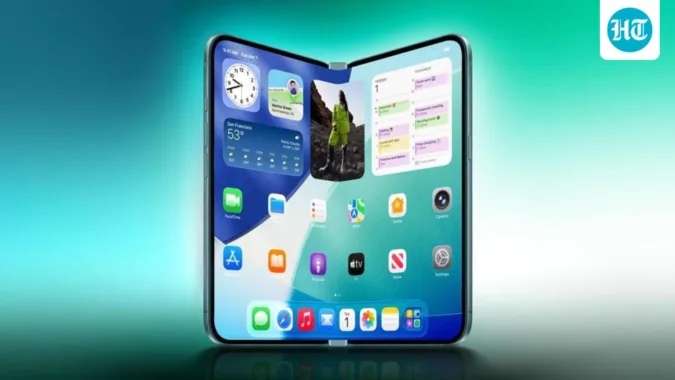
“Three things cannot long stay hidden: the sun, the moon and the truth,” a famous quote attributed to Gautama Buddha. You could add a fourth element to it, or fold this within the point about the greater truth. Apple is expected to announce a foldable iPhone, their first foldable device, next week. A foldable iPhone hasn’t been a secret for many years. It was more a matter of when, not if. With an expected announcement just days away, there is consensus that the foldable iPhone, which might be called the iPhone Ultra, will find immediate sales traction.
Linda Sui, Founder and Principal at Smart Analytics Global, estimates that Apple will corner as much as 25% of the global foldable phone shipments by the time 2026 draws to a close, and that share will surge to 41% in 2027. SAG, in their latest report, notes that global foldable shipments declined 8% year-on-year in the first half of 2026, but are forecast to rebound around 40% in the second half, which will translate to around 24% full-year growth with more than 23 million units shipped. SAG also attributes this momentum to what they say is robust demand for an impressive Samsung Galaxy Z Fold8 passport style foldable.
But it won’t be plain sailing for the foldable iPhone. “Initial supply would likely be the biggest constraint. Given the manufacturing complexity and slower initial capacity ramp for Apple’s first foldable, combined with an expected US$2,000+ price tag, SAG expects the device to initially launch in selected major markets rather than immediately achieve broad global availability,” Sui notes.
Release in some countries in first wave
It is believed that Apple will release the foldable iPhone in some countries in the first wave, with broader availability later. In the US, for instance, Apple has a new Upgrade program that allows users to choose a product and a payment term (such as 12 or 24 month lease for an iPhone or Apple Watch, or a 24 or 26 month lease for an iPad or Mac), make monthly payments, and then upgrade to the next generation device at the end of that lease or earlier for a certain lump-sum payment.
Research firm IDC’s latest Worldwide Quarterly Mobile Phone Tracker, which notes a 16.7% global smartphone shipment decline, believes that with a foldable iPhone, Apple is not only adding a new phone model to its portfolio, but also increasing competition in the foldable phone category. They estimate that the foldable iPhone will transform an otherwise declining product category into the fastest-growing part of the industry.
“Apple’s entry into the foldable market has done more than reignite growth in a category that was losing momentum. It has fundamentally altered the market’s trajectory. Without Apple, foldable shipments would have declined at a double-digit rate year over year. We forecast Apple will ship more than 17 million foldable iPhones by 2027, capturing roughly 40% of the global foldables market,” says Nabila Popal, Senior Research Director, IDC Worldwide Quarterly Mobile Phone Tracker.
IDC’s foldable market share forecast by operating system pegs iOS to corner as much as 31% of the share by the end of 2026, with Android holding on to 54% on the back of foldable phones from Samsung, Vivo and Xiaomi, with Huawei’s HarmonyOS based devices including their Mate XT triple-fold series and the Mate X7 Ultra book style foldable. By the end of 2027, iOS’s share among foldable phones will be as high as 40%, eating into Android (46% share) and HarmonyOS (14%).
“With an average selling price exceeding $2,550, Apple is expected to generate more than $45.7 billion in value and account for over half of the category’s total value. Perhaps most notably, Apple is positioned to challenge Huawei and Samsung for leadership in markets where they have long dominated, an extraordinary outcome for a product expected to be less than two years into its lifecycle,” Popal adds.
The foldable phone category, IDC estimates, will close in 2026 at 22.9 million units marking a growth of 12.6%, and carry that momentum into 2027 with an estimates 27 million units being shipped, to mark an 18% growth.
Taiwanese research firm TrendForce has outlined some device specs for the foldable iPhone, alongside the two more expected releases—the iPhone 18 Pro and the iPhone 18 Pro Max. They say the passport style foldable form factor will have a 5.5-inch cover display, a 7.8-inch foldable main display which will be Flexible AMOLED On-cell technology, TouchID fingerprint recognition, an Apple A20 Pro 2-nanometer architecture chip, and dual 48-megapixel wide and ultra-wide cameras.
But as the well-known idiom goes, “it ain’t over till the fat lady sings.”