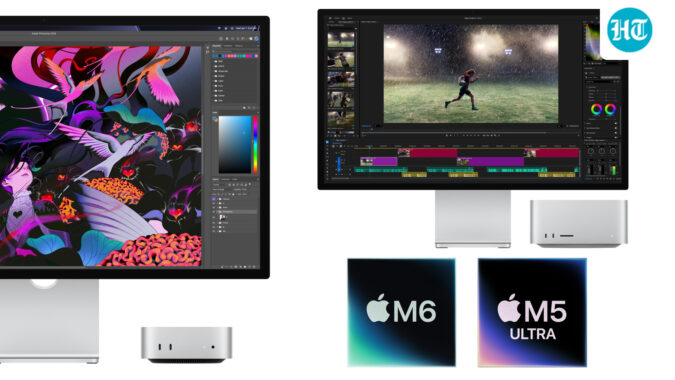
In a move that serves the dual purpose of timely refresh for the Mac lineup, and clears the stage for the iPhone announcement next month, Apple has detailed the refreshed Mac Studio and Mac mini computing devices. This year, Apple’s silicon leap called the M6, is being introduced by the uber-compact Mac mini, which will also get a M5 Pro chip as an option. The substantial Mac Studio adds the M5 Max chip, as well as what Apple calls their most powerful silicon ever, the M5 Ultra. The theme is clear, where hardware upgrades represent a massive step forward in terms of processing power, particularly for on-premise artificial intelligence (AI) workloads.
The new M6 chip, which will steadily span not just the Mac portfolio but also the iPad line-up in the coming months, is Apple’s first 2-nanometer architecture silicon. At its peak spec, the Apple M6 features a 12-core CPU, a 12-core GPU, a new dual 16-core Neural Engine and up to 32GB of unified memory. All this arrives in what remains an unchanged, and a really compact form factor that has defined the Mac mini over the years—5-inches x 5-inches in footprint. The dual 16-core Neural Engine will deliver, Apple says it has up to 4.8x faster AI performance compared with the M4 chip generation, and spreadsheet calculations in Microsoft Excel are 1.5x faster too.
Also Read: Google Pixel 11 Pro XL is iteration done right, with a future subscription bill
Across both Mac mini variants, Apple is upgrading key specs including the arrival of the N1 wireless chip for Wi-Fi 7 and Bluetooth 6, the ethernet port is now 2.5 gigabytes and upgradeable to 10 gigabytes, as well as 2x faster storage. The Mac mini with M6 is priced ₹99,900 onwards while the Mac mini with M5 Pro is priced ₹2,09,900 onwards. Apple had, in June, hiked the prices of the Mac mini, and discontinued the lower storage tier configurations. The price of the refreshed Mac mini with M6 chip stays in the same range. Pre-orders begin now, and the new Mac mini will go on sale September 22, with macOS 27 Golden Gate.
The Mac mini with the M5 Pro chip is meant for the more power intensive workflows such as complex video edits, animation and filmmaking, with more CPU and GPU cores, as well as up to 4x faster AI performance as well as 1.5x faster image processing compared with an M4 Pro. The M5 Pro has an 18-core CPU with an up to 20-core GPU with neural accelerators in each GPU core optimised for AI workflows that include large diffusion models as well as photo and video upscaling. Apple confirms to HT that this variant also adds the Thunderbolt 5 ports. Improvements in overall performance also mean it is very much on the agenda for running larger local large language models (LLMs).
Mac Studio’s gigantic leap
Upgrades to the already incredibly powerful Mac Studio, give it the option of the M5 Max and the M5 Ultra chips. Apple makes it clear that the scope of relevance for the Mac Studio includes ‘pro’ users such as musicians, designers, filmmakers as well as running massive sized LLMs on-device.
The 3-nanometer M5 Max brings what is an up to 30% faster CPU with 18-cores alongside ‘Super Cores’ for performance, a 50% faster GPU with up to 40-cores, a 20% faster Neural Engine and a collective of this delivering a 4x improvement in AI performance. This can be configured with up to 128GB of unified memory, and remains the benchmark for performance-per-watt metrics. The use cases for this sort of performance include higher frame rates and complex geometry for game developers, as well as faster rebuilds for engineers.
The ‘Ultra’ silicon continues to use Apple’s two dual-die architecture, in this case the next generation UltraFusion Architecture bringing together two M5 Max chips to make the M5 Ultra. Generationally, this has a 30% faster CPU with up to 36 cores (that’s 12 supercores and 24 performance cores), an 80% faster GPU with up to 80 cores that brings neural accelerators to the Ultra chip for the first time, with up to 512GB of unified memory. All this comes together for what is an up to 4x faster AI compute performance than the M3 Ultra. This is the most powerful SoC, or system on chip, that Apple has ever created.
Also Read: Elon Musk pitches Starlink for rural India amidst stalled launch
The new UltraFusion Architecture increases this connection density by over 6 times and also increases bandwidth to over 4 terabytes a second. In tandem, these ultra-low-latency, high-bandwidth interconnects allow the four dies to work as a unified processor.
Apple is pitching this for the sort of workloads that involve immersive video editing using Final Cut Pro, or running frontier LLMs with more than 1 trillion parameters locally. The Mac Studio has also always made a case for itself with ‘clustering’, allowing for up to four Mac Studios to work together (key interface here is Thunderbolt 5). Apple’s RDMA, or Remote Direct Memory Access, with frameworks including Apple’s MLX, allow for models to be split across these nodes for faster distributed compute of enormous models on-premise.
The Mac Studio prices start ₹2,79,900 for the M5 Max option while you’ll need to part with at least ₹6,29,900 for the Mac Studio with the M5 Ultra chip. For context, the outgoing M4 Max line-up prices were at ₹2,79,900 onwards while the M3 Ultra variants were priced upwards of ₹5,99,900. Apple says pre-orders begin now, and the new Mac mini options will go on sale September 22, with macOS 27 Golden Gate.
To that point, the Mac mini can also be deployed in the same cluster formation, at a low cost, for higher energy efficiency, memory pooling at the fraction of the cost of a high-end enterprise server, running large LLMs on-premise, and for software engineers to distribute automation servers for compiling complex applications. Video editing suites also utilise clustered nodes for processing power and offloading work from the primary node, in parallel.