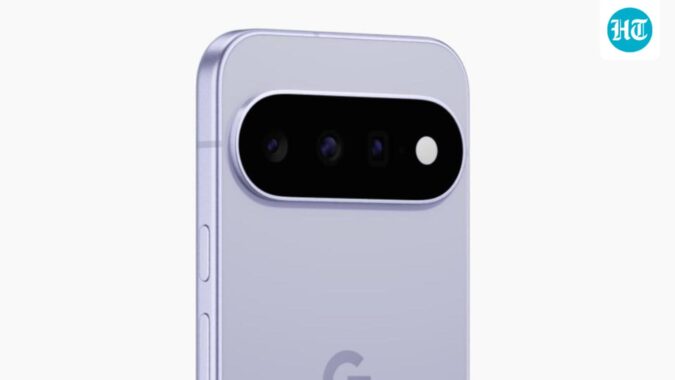
The reality is this. The Google Pixel 11 isn’t battling perceptions of generational upgrades, as much as how it stacks up to the Apple iPhone 17 (for now, and then the iPhone 18), and the Samsung Galaxy S26. I see two key reasons why this troika is more important in the grand scheme of things than ever before. First, smartphone pricing inflation has pushed these otherwise entry-spec flagships to the edge of most budgets. They’re more expensive, and therefore more substance is expected. And secondly, generational spec upgrades have closed the gap between these vanilla flagships, and their ‘pro’ siblings. It’s a battle to see how well that translates into overall experience. Basically, is it enough phone for the money you spend?
To that point, Google has two variants of the Pixel 11 on sale in India. Part with ₹89,999 and you can have the 12GB+256GB spec, or the 12GB+512GB config for ₹1,04,999. The blue-ish tonality of the Frost colour does look good (though incredibly difficult to photograph for realism), and while the black based Obsidian is certainly a reliable, conventional choice, I wouldn’t be too surprised if Google runs out of the lively Hibiscus and Pistachio inventories sooner than their marketing wizards might have suggested. Adding a bit more colour to the world, isn’t at all a bad thing.
As far as the specs go, the trajectory of similarity between the Pixel 11 and the Pixel 11 ‘Pro’ siblings goes just far enough to add substance. That said, the key camera differences are understandably with the camera, and that’ll define whether this, or the similar screen sized but more expensive Pixel 11 Pro is what you’d go for. In a way, the Pixel 11 isn’t entirely dissimilar to the Pixel 10, and that continuity isn’t exactly a bad thing. Perhaps the iterative nature of upgrades may not drive a slew of Pixel 10 users rushing to buy the Pixel 11, but there’s enough happening to consider the jump at some point down the line—a better display, the Tensor G6 chip, more base storage and an improved main sensor.
The 6.3-inch Actua display remains largely the same as its predecessor. It performs equally well in brightness (up to 3,000 nits), crispness, and vividness, making it a very good screen for this price bracket. In fact, this display has a higher pixel density than the Galaxy S26. While this is mostly unnoticeable, it becomes apparent for specific use cases such as editing in Adobe Lightroom. That’s when the fine details make all the difference. I really do believe that Google shouldn’t have kept the 1Hz refresh rate capability (its 60Hz to 120Hz variable) from the Pixel 11’s display though, because it’s not just about the spec, but also battery frugality advantages.
It is good to see parity between the Pixel 11 and the Pixel 11 Pro in terms of how the Tensor G6 has been configured, and also 12GB memory as standard. The 256GB storage is now the entry spec, which, to be fair, is very good value. The higher spec 512GB storage, much like on the Pixel 11 Pro phones, is the Zoned UFS for faster performance—this organises data into specific zones on the storage, with advantages in terms of faster app loading, smoother multitasking, and likely reduced long-term storage wear. Again, a good to have feature for those opting for 512GB storage. Robust overall battery life too, lasting typical workdays from 100% at 8am to around 40% charge remaining at 6pm.
For the camera trio introduced with the Pixel 10, the Pixel 11 features iterations, including a new main sensor and updated computational photography algorithms, which I noted in my Pixel 11 Pro XL review as a much-welcome humanisation of AI processing photos that we finally see in the Google Photos app. That said, Google’s tiered system approach means different optical hardware. The main 48-megapixel sensor is larger than before, while the 13-megapixel ultra wide and the 10.8-megapixel telephoto have been carried over. They do return different, and in my book, more natural results, because of the computational differences.
An improvement that would be very handy with photography over time is the improved 30x super zoom, up from 20x earlier. The difference compared with the Pixel 11 Pro phones is that while there is use of computational algorithms to improve detailing that is invariably lost at these zoom lengths, there is no generative fill to add in any sort of gaps. The approach is to take multiple photos at different exposures and blend them together to find the details. While 30x zoom will be used rarely, the versatility is welcome.
While Super Zoom is a good to have feature, the structural advantage for the Pixel 11 stems from the 5x telephoto lens, while the Galaxy S26 makes do with a 3x telephoto while the iPhone 17 doesn’t have a telephoto lens at all. That has to be a big positive for the more serious photographers, and a definitive advantage the Pixel 11 has ticked off for itself. In my book, a telephoto is more useful as a second camera alongside the primary wide, simply because it’s just an inferior experience to be relying on the main sensor’s digital zoom for serious photos otherwise.
Good to have parity in terms of some camera capabilities between the Pixel 11 and the Pixel 11 Pro XL. As I had noted in the latter’s review regarding the new Camera Looks that add a dash of photography styles, similar observations hold true in case of the Pixel 11 as well— Natural camera look is the definitive favourite, while the Vanilla style happens to work very well for certain photos. It is all up to experimentation.
There much more AI defining the Pixel phone experience this year, including Proactive Intelligence that adds context at different points in the experience—such as a calendar overlay in a Messages conversation, or Rambler as a voice-to-text tool. The one area where Google has saved on costs this time around is that the Pixel 11 doesn’t bundle any Google AI Pro subscription (the tenure has been halved with the Pixel 11 Pro phones too, to 6 months).
There are two parts to what works and what doesn’t, if you don’t pay for a monthly subscription. All offline photography tools including Camera Looks, offline Rambler , context cards as long as the data is on-device, Live Translate, Circle to Search and standard Gemini access, will work without an AI Plus or AI Pro subscription.
A Google AI Plus plan will unlock the versatile online Rambler option, allowing tone edits as well as process heavily corrected speech by going server-side. The pricier AI Pro plan unlocks Gemini 3 Pro in Search (that’s has a broader consequence, across your Search interactions irrespective of device), 4x higher usage limits in the Gemini app, deeper Gemini integration across Docs and Gmail, 5x higher usage limits on Gemini Notebook and 1000 monthly credits for Google’s creative studio generation platform called Flow. Depends on how much value you need AI to generate.
There is, without doubt, a certain joy to using a Pixel 11 even though the likes of the Samsung Galaxy S26 may have a few things to say about that. Some of that has to do with how well Google has integrated a lot of the Gemini functionality across Android. Add to that, the updated camera approach to a less aggressive AI influence, certainly adds credence to that argument. This may well be a refinement rather than a wholesale generational refresh, but Google has done more than enough to make this an upgrade in the ways that really matter. That age-old logic of Pixel phones delivering the slickest Android experience still mostly holds true.