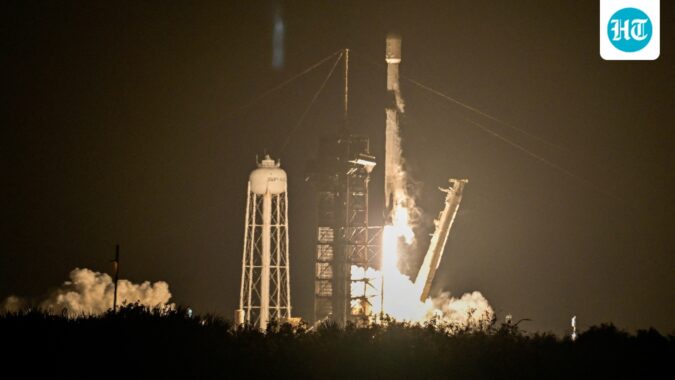
A part of a SpaceX Falcon 9 rocket is believed to have crashed into the Moon after travelling through space for months. The crash appears to have been accidental. The rocket part was the upper section of a Falcon 9 that SpaceX launched in January 2025.
The part that hit the Moon was not the reusable booster. It was the upper part of the rocket, which stayed in space after the launch.
SpaceX rocket hits Moon
The object was estimated to be about 14 metres long and travelled roughly 385,000 kilometres before reaching the Moon. Specialist telescopes were monitoring the Moon to confirm whether the rocket part had hit the lunar surface.
NASA said the collision poses no danger to Earth. Scientists are instead looking at the event as a chance to learn more about the Moon and improve the way objects travelling through space are tracked. Scientists believe the dust plume created by the impact could be easier to detect than the actual flash. This is why scientists are still waiting for clear images of the impact and its aftermath.
Also read: Why is the US planning to ban new Chinese data center models? Trump targets AI security risks
Scientists look for crater
The first major task for scientists will be to compare images of the Moon taken before and after the suspected crash. This should help them identify a new crater or scar created by the rocket impact. Scientists need to carefully process the pictures and confirm that any new mark on the Moon was actually caused by the Falcon 9 rocket part.
The clearest early evidence is expected to come from powerful ground-based telescopes in the Americas, where the Moon was still visible under dark skies when the collision occurred, according to the BBC.
Moon space debris grows
The suspected collision also highlights the growing amount of human-made material around the Moon. With this impact, the Moon is now estimated to have about 3,000 human-made objects associated with it, with a combined weight of around 190 tonnes.
The key question now is whether scientists can confirm the exact impact site and identify the new mark left on the Moon. Images from telescopes and lunar spacecraft will be important in establishing what happened.
If confirmed, the event would add another example of human-made space hardware reaching the Moon unintentionally, while also giving scientists a rare chance to study what happens when an object strikes the lunar surface. For now, the collision is considered a suspected impact rather than a fully confirmed event, with scientists waiting for telescope observations and before-and-after lunar images to provide clear proof.