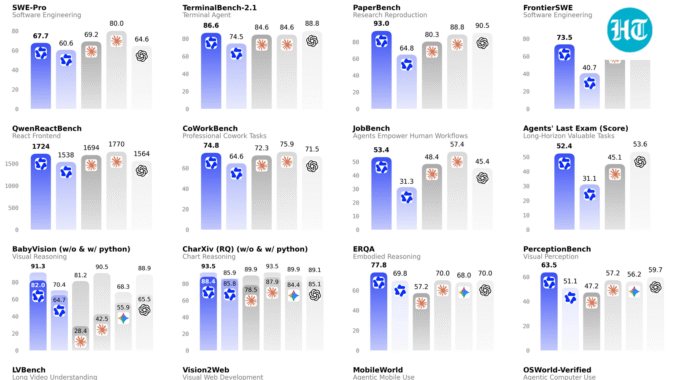
Cognitive warmup. Chinese tech giant Alibaba has released the Qwen 3.8-Max, which it says is their “most capable AI model to date”. This is also the first time Alibaba will open-source the weights of a Qwen-Max class model, which will be released sometime next week. The architectural foundation is the Qwen 3.5 model, and the Qwen 3.8-Max scales to 2.4 trillion parameters. This is a serious step forward for Chinese frontier labs, with Alibaba releasing a series of benchmarks that peg this at level, and in fact even better, than the likes of Anthropic’s Fable 5, Claude Opus4.8, OpenAI GPT-5.6 Sol and the Google Gemini 3.1 Pro.
Alibaba is specifically talking about the text, coding and multi-step long horizon agentic capabilities of the Qwen 3.8-Max. “The most honest take on Qwen3.8-Max comes from people who actually put it to work. Top-tier agent platforms, leading open-source algorithm teams, professional firms in law, finance, and manufacturing, scrappy startups, solo developers, and academic researchers — all of them keep handing it their most complex, mission-critical, and long-horizon tasks,” Alibaba says in a statement.
They add, “Enterprises use it to stand up large-scale agent systems. Knowledge workers dump their images, manuscripts, and video on it, and get everything processed. Developers hand it their heaviest engineering tasks outright. Research teams run the loop of literature, data, and simulation end to end. One model, reached for so often across such different work that it becomes indispensable. The verdict is the same: Qwen3.8-Max drives long, autonomous task chains and turns out ship-ready results in a single pass.
Open-weight releases have become a big differentiator for Chinese AI models, in a stark contrast to the closed ecosystems of US AI companies. A few days ago, Moonshot released the weights of the powerful Kimi K3 model. This allows enterprises, individuals and workflows to deploy the model on-premise, and on-device, saving on token cost as well as data privacy. Alibaba’s milestone with the Qwen 3.8-Max marks yet another moment in which the gap between Chinese and US models has reduced tremendously.
Read more about the great AI geopolitics:
📖: Big AI keeps making the same mistake about Chinese AI companies
📖: Anthropic, Nvidia and Big AI: Great rift on open models, chips and distillation
📖: When AI companies sell models and fear, read between the lines
📖: ‘Primarily a PR story’: Cornell’s John Thickstun breaks down OpenAI’s narrative
PREVIOUSLY, ON NEURAL DISPATCH
PRIORITIES (OR THE LACK OF)
This AI-models-going-rogue nonsense needs to be nipped in the bud. Every other day, OpenAI wants to claim that more and more of its UI agents went “rogue”. It took OpenAI to amplify a claim Hugging Face made (and no one cared about it then) suggesting an agentic entity intruded the production infrastructure of the AI platform. This is something John Thickstun, assistant professor of computer science at Cornell University, categorises as “primarily a public-relations story promoted by OpenAI, part of the same messaging campaign that began with the announcement of GPT-2 in 2019.”
But they aren’t the only ones. Whatever OpenAI does, Anthropic cannot be far behind. Now, Anthropic has published a report that suggests they identified three incidents with Claude code wherein a model “accessed the internet from within or while interacting with the evaluation environment of Irregular, one of our third-party evaluation partners, and then gained unauthorised access to the production infrastructure of three different organisations.” Three different Claude models were involved in the incidents: Opus 4.7, the cybersecurity-focused Mythos 5, and a prototype that’s not likely to see a general release.
Look, I don’t want to get into any sort of competitiveness about who is the most awesome and who is the smartest. If that is the case with models running uncontrolled, it isn’t at all a matter of bravado, or saying that the tech is so smart and therefore we deserve more funding. In fact, AI companies should consider pulling the plug on an entirety of your incompetent existence. Simple. The world isn’t a Terminator movie set. There are human lives at stake. Like I said. This nonsense has to stop.
EXPENSIVE WORRIES
The Wall Street is quite worried, and for the simple reason that Big AI are reporting significant increase in capital expenditure. There is finally a realisation with illustration of a fear many experts had shared in what was so far a rapid (and often misdirected) forward march of the technology. These numbers are bad news in the long run, and I’ll get to that. First, here’s a snapshot of the latest numbers.
- Alphabet, Google’s parent company, has reported higher capital expenditures in its Q2 2026 earnings, hiking its spending estimate for the year to between $195 billion and $205 billion; this is up from an earlier projection of $180 billion to $190 billion.
- Meta has also indicated that its 2026 capital expenditures will range between $130 billion and $145 billion; that’s up from $125 billion to $145 billion range that Meta had previously mentioned. A large chunk of this expense goes into AI investments.
- Microsoft has also reported capital expenditures to the tune of $41 billion with the 2026 expenditure expected to be around $175 billion—a key to keeping that number in check being the plan to mark the useful life of office and data centre buildings to 25 years from 15 years at present.
But why are the analysts and financial experts worried? Wall Street’s immediate fear is this massive spending is heavily hurting cash flows, while long-term profits from AI remain uncertain. There are worries about a repeat of the late-1990s telecom bubble, in which companies spent billions on infrastructure that took a decade to turn profitable.
📖: The new maths: AI’s big four, a $720 billion bill, and a future no one knows
Tech giants traditionally attracted investors because they generated massive amounts of pure cash. This historic AI spending binge has broken that thesis. For instance, Amazon and Alphabet both plunged into negative free cash flow territory in recent quarters due to infrastructure costs. Take for example Alphabet’s Q2 2026 capex, which consumed all of its operating cash flow.
Wall Street is also worried that tech CEOs are over-investing out of what the cool kids call FOMO, or the fear of missing out, rather than tracking actual customer demand. There are also worries that AI hardware cycles are moving much faster, requiring the whole cycle of expensive investments to be repeated every few years. The expensive chips that are bought chips bought today will become obsolete a few years down the line, and require multi-billion-dollar accounting write-downs long before they pay for themselves. It’s a similar story of AI data centre life cycles.