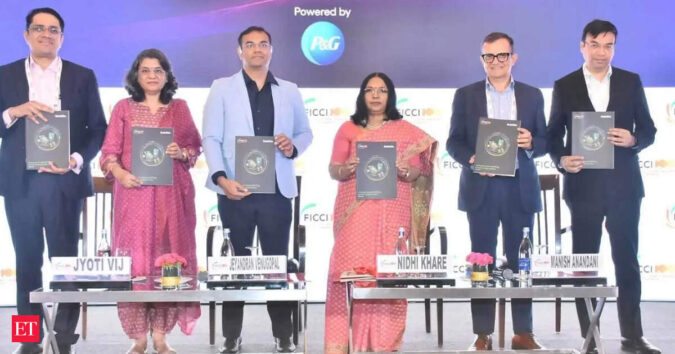
The report, ‘Consumer Trends: IGNITEing Growth and Governance’, was released during the inaugural session of FICCI MASSMERIZE 2026 on Tuesday. It said demographic shifts, rising incomes and changing consumer expectations are reshaping India’s consumption landscape. The report also highlighted that the country has over one billion internet subscribers and recorded 228 billion UPI transactions worth around $3.6 trillion in 2025.
It noted that Indian consumers are no longer driven solely by price but are becoming more discerning, conscious of health and wellness, and increasingly vocal about issues affecting society. As consumption patterns evolve, businesses across FMCG, retail and e-commerce will have to navigate a complex regulatory environment covering product quality, safety, labelling, consumer protection, environmental compliance, digital commerce and data governance.
Launching the report, Nidhi Khare, Secretary, Department of Consumer Affairs, Ministry of Consumer Affairs, Food & Public Distribution, underscored the need to strengthen quality standards.
“The time has come for us to realise that we cannot grow unless we address quality concerns in our manufacturing processes and in the way we sell products to consumers. There has been an increase in the number of consumer complaints,” Khare said.
She said the government was working with industry to reduce consumer grievances through updated regulatory mechanisms.
“This is the first time that, under the Legal Metrology Act, we will be issuing Improvement Notices to manufacturers and retailers, giving them time to rectify minor mistakes before the case is taken up for compounding,” she added.Khare also said the department was working to introduce ‘Smart Standards’, with the aim of rolling them out on World Standards Day on October 14.
“We are trying to complete the process by World Standards Day on October 14. This will bring India into the club of developed countries where standards are becoming smart standards,” she noted.
She added that the government plans to deploy artificial intelligence and robotics to modernise testing infrastructure, improve accuracy and reduce costs for MSMEs.
“We need to scale up our testing infrastructure to test more samples with greater accuracy and less human intervention. We are going to start using AI and robotics to enhance the testing infrastructure. This will also help bring down testing costs for MSMEs and enhance the accuracy and traceability of tests,” she stated.
Speaking on changing consumption patterns, Jeyandran Venugopal, Chair of the FICCI Retail and Internal Trade Committee and President & CEO of Reliance Retail Ventures Ltd., said businesses must adapt to evolving demographics.
“The way Gen Z consumes products today is very different from how other generations consume products. Understanding and aligning products with the needs of different generations is important,” Venugopal said.
Manish Anandani, Co-Chair of the FICCI FMCG Committee and Managing Director of Kenvue India, said the sector would continue to play a central role in India’s growth story.
“India’s consumer economy remains one of the most compelling growth stories globally, with the FMCG sector serving as a key driver of inclusive development, job creation, as well as shaping the future of everyday health and well-being for millions of consumers. Powered by rising consumer aspirations, rapid digital adoption, and a vibrant innovation ecosystem, the sector continues to play a pivotal role in advancing India’s vision of Viksit Bharat 2047,” Anandani noted.
FICCI Secretary General Jyoti Vij said consumer preferences were increasingly centred on quality, convenience and sustainability.
“India today stands at the cusp of a remarkable transformation. Consumers today seek not only quality products but also personalised experiences, convenience, transparency, trust, and sustainable choices. Businesses, in turn, are leveraging technology, omnichannel strategies, and innovation to remain competitive,” Vij said.
(With inputs from ANI)