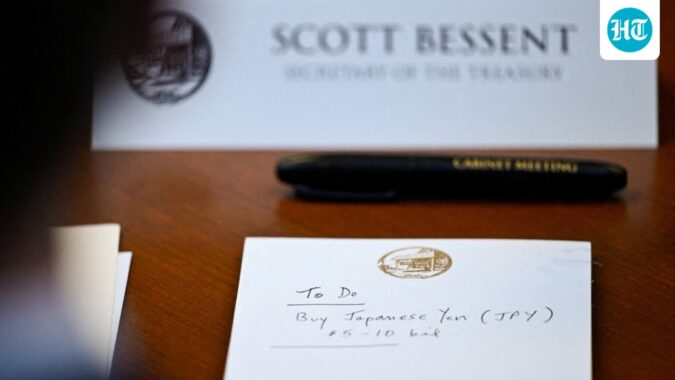
A little-used Federal Reserve backstop built for the 2020 dollar shortage is being put to a use it was never designed for: bankrolling Japan’s defense of the yen. Treasury Secretary Scott Bessent wants the backstop made bigger.
Japan said Monday it planned to draw on the facility, a day after Bessent publicly encouraged the Fed to expand it. The arrangement would let Tokyo raise dollars to halt the yen’s slide without selling the U.S. government debt that would otherwise pay for it.
At issue is a lending program created when the Treasury market faced severe strains at the onset of the Covid pandemic. Banks and companies outside the U.S. that had borrowed heavily in dollars found that funding drying up and turned to their own central banks for help. Those without access to the Fed’s dollar-lending network for close allies had one obvious source: selling Treasurys into a market that was already struggling to absorb them. The Fed facility let them borrow dollars against those holdings instead.
Japanese officials have indicated they will use the program to raise the dollars they sell for yen without liquidating the Treasury portfolio that would otherwise pay for the intervention.
Bessent said the Fed could help by raising the $60 billion limit on how much any one counterparty can borrow. “We would encourage it to be upsized in the coming months,” Bessent wrote in a social-media post.
Japan held roughly $1.1 trillion in Treasurys at the end of May, so the cap, not the size of its portfolio, is what currently limits how much it can raise this way. Lifting it would let Tokyo turn more of its holdings into dollars quickly, and without selling them.
Bessent’s request represents an early test of how Fed Chairman Kevin Warsh, who took office in May, intends to draw the line between the central bank and the administration that installed him. Raising the cap is subject to approval by at least a subset of the Federal Open Market Committee, the 12-person body that sets interest rates and oversees monetary policy. A Fed spokesman declined to comment.
The committee typically engages such tools if a clear market-functioning or financial-stability risk threatens to impair monetary policy, a bar that current conditions don’t appear to meet.
The ask can be read two ways. As a signal to markets that Tokyo’s limited tools are less limited than they look, it is shrewd posturing at no cost. As pressure on the central bank, it invites scrutiny of where Treasury’s authority ends and the Fed’s begins—a boundary made more delicate by the change in Fed leadership.
Bessent, who speaks regularly with Warsh, made the request publicly Sunday on X. “There are a few things that are odd about it,” said Derek Tang, an economist at Monetary Policy Analytics, a Washington-based consulting firm. “One, that it’s being done in public,” which could be “a way to exert pressure on the rest of the FOMC.”
Bessent can raise dollars on his own, by issuing Treasury bills and routing the proceeds through the roughly $200 billion Exchange Stabilization Fund. But a defense funded that way is more visible and finite in a way that a Fed backstop isn’t.
“If Bessent doesn’t have the Fed on board, then his rhetorical power—the credibility of this threat—is lessened,” Tang said.
It comes days after Friday’s joint action, the first time since 1998 that the U.S. bought yen alongside Tokyo to strengthen the currency. President Trump described the operation as a signal of friendship. The value of the yen had recently fallen to a 40-year low.
Bessent’s Japanese counterpart, Satsuki Katayama, said Monday that Tokyo planned to use the Fed’s Foreign and International Monetary Authorities Repo Facility, or FIMA, to finance future intervention.
The operation is designed to avoid the one thing Washington wants to prevent—Japan selling U.S. government debt to pay for the intervention. Currency interventions that aren’t backed by a shift in central bank policy or fiscal policy historically buy weeks but can fizzle out after that. The prospect of greater firepower from the Fed facility could make it more costly to short the yen.
Washington’s stake in the yen runs through the Treasury market. When a country defends its currency, it buys its own currency and sells foreign reserves. Japan’s reserves are overwhelmingly U.S. Treasurys. A sustained defense financed the conventional way would mean Tokyo unloading them at a moment when the yield on the 30-year U.S. bond has risen to its highest level since 2007.
Behind that is a slower-moving problem. A weak yen feeds expectations by investors of higher Japanese inflation, leading them to demand more compensation to hold Japanese government bonds. The 10-year yield is up 0.75-percentage point this year.
Because Japanese institutions are the world’s largest cross-border creditors, rising yields at home weaken the case for owning foreign debt and give capital parked in U.S. Treasurys, German bunds and British gilts a reason to come home.
The Fed’s insulation from the White House is conventionally understood to cover interest rates because those decisions are most vulnerable to political pressure and most consequential if politicized. It has never been as clearly drawn around the Fed’s other work, including loans offered to foreign central banks.
“The Fed is very cautious when it comes to doing things that look like they’re veering into foreign policy or fiscal policy,” Tang said. The coordinated intervention with Japan “does seem to be a very political project by the administration, and the question is: Is it the Fed’s role to enable that?”
In written answers to senators before he was confirmed, Warsh said the Fed is most independent when it is setting interest rates, and less so everywhere else. On questions touching international finance, he wrote, Fed officials get no special deference, and the central bank would work with the administration and Congress.
Asked a version of the same question at a Capitol Hill hearing last month, he gave a different answer. He said the Fed’s standing dollar-borrowing lines with central banks were part of its monetary policy. No one asked Warsh which side of the line this latest operation would fall on.
Write to Nick Timiraos at Nick.Timiraos@wsj.com