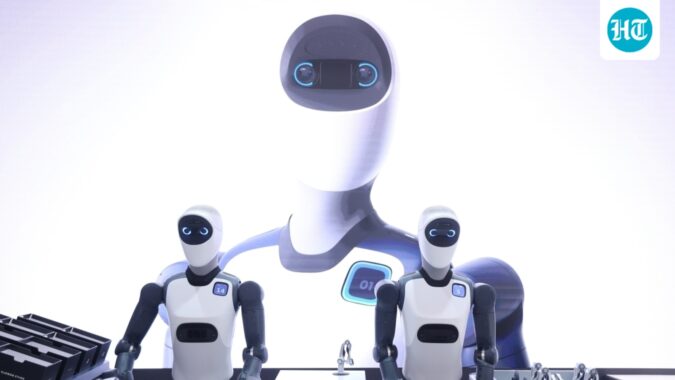
MUNICH—German robotics startup Agile Robots is betting that its manufacturing expertise, not just advances in artificial intelligence, will lead to a surge in revenue and produce profits.
The company’s revenue last year was 300 million euros, equivalent to $345.9 million, and is set to double this year, helping it turn profitable in two to three years, Chief Executive Zhaopeng Chen said in an interview.
“If you look at the numbers, it’s actually not ambitious,” Chen said.
He added that Agile has signed customer contracts underpinning this year’s projected revenue and has so far raised about $1.5 billion from investors led by SoftBank Group.
Although its humanoid robot have only been deployed in pilot projects, Chen believes today’s industrial business is laying the foundation for a broader robotics market. He expects future physical AI systems to be able to understand and interact with complex environments.
Eventually, he said, robots will become consumer products, occupying a place somewhere between smartphones and automobiles.
“In 10 to 15 years,” Chen said, “seeing humanoids on the street will be like seeing cars today.”
Rather than racing to build a humanoid capable of doing everything from day one, Agile Robots has spent years embedding its industrial robots inside factories to solve problems for their clients.
One of Agile Robots’ biggest advantages is the relationships with major manufacturers enjoyed by some of the companies it has acquired.
Since it was founded in 2018, Agile Robots has acquired more than a dozen companies ranging from idealworks to thyssenkrupp Automation Engineering. Its acquisition of Germany’s thyssenkrupp Automation Engineering, for example, added engineering expertise from the international automotive industry and new core regions to its portfolio.
Chen said around 10% to 15% of new contracts this year are expected to come through acquired companies.
But the acquisitions were less about adding revenue than gaining something many robotics startups lack: decades of factory-floor expertise and trusted relationships with manufacturers.
Any industrial robotics company “with substantial existing revenue and delivered automation projects starts from a different position than a new humanoid startup,” said Poe Zhao, the founder of technology newsletter Hello China Tech. Such a company would already have “paying customers, factory access and integration experience.”
Chen recalled a time when the company worked with one of the world’s largest crankshaft manufacturers in India. When the company set up its robotics system in the factory, they realized that its uneven floor was a huge challenge for its robotics system. But rather than asking the customer to rebuild its production line, Agile redesigned its robotic system to operate under real factory conditions.
Those experiences, Chen said, explain why many robotics startups remain stuck in pilot deployments.
“There are too many layers between the software, down to the earth, to the shop floor,” Chen said.
“Trust is not built by bringing in new technology and saying, ‘I can do everything,’” Chen said. “You have to be a trusted supplier.”
Backed by growing revenue from the industrial automation business, Agile Robots has continued to invest heavily in research and development.
For companies with a strong industrial robotics business, a key question is “whether its humanoid product generates disclosed, recurring revenue from real deployments, and how much of the business continues to come from traditional automation,” Zhao said.
This year, the Agile Robots partnered with Google DeepMind to bring Gemini Robotics foundation models to its robots, giving its hardware more advanced reasoning and decision-making capabilities while using data from real-world deployments to continuously improve the models.
Write to Jiahui Huang at Jiahui.Huang@wsj.com