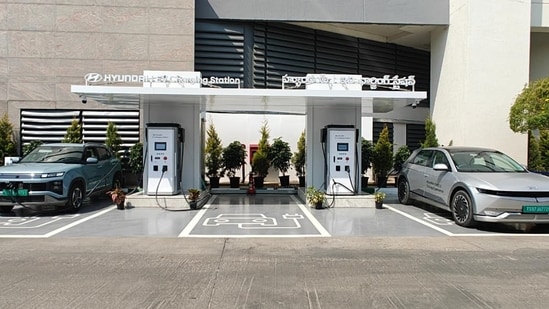
Opening thoughts. There is still a conversation to be had about public EV charging infrastructure in India. Though the situation is far better than perhaps 12 months ago, actual availability of EV fast charging infrastructure (and one that’s working) particularly on highways and expressways, remains a concern. Auto makers are playing a role in sorting that out. Hyundai Motor India Limited (HMIL) tells me that they’re now locked in with a 30,000+ charging point network across the country, and they’re keen to emphasise this has been achieved through “strong partnerships with multiple charge point operators” and accessible via the myHyundai app. That number is only going to increase.
Alongside, Hyundai says they’re expanding charging infrastructure, with 183 DC fast-charging stations already operational across 105 cities and plans to scale this network to 600 stations by 2030 at key cities, highways and at dealerships.
“Through the integration of over 30,000 charging points on the myHyundai app, we are empowering EV users with one of India’s largest charging networks accessible through a single platform. Importantly, the platform is open to EV owners across brands, reinforcing HMIL’s commitment to developing India’s broader EV ecosystem,” says Tarun Garg, MD & CEO, HMIL, adding, “HMIL will more than triple its proprietary DC fast public charging network from 183 stations today to 600 stations by 2030, bringing India’s charging infrastructure closer to global benchmarks.”
Why this conversation now? Hyundai confirms plans to introduce a new electric SUV in India, within this financial year. This should sit beside the Creta EV and the more expensive Ioniq 5 in product line-up.
EDITOR’S MARGIN
GOOGLE PLAY IN INDIA
I’d like to have a conversation about the perceived economic impact of Google Play and Android in India, through last year. At the Google I/O Connect India keynote last week, the tech giant noted that the Google Play and Android ecosystems helped contribute ₹5.3 lakh crore (or $60 billion) revenue for India’s app publishers and digital economy through 2025. Estimates are bullish. From close to nil, to this number now, and the trajectory estimates peg this figure to be close to $103 billion by the year 2030.
Read: Google bets on India’s agentic AI future with new education, health push
“In 2025, there were 1,080 crore app downloads from the Play Store for Indian developers, with 230 crores from overseas users and 850 crores from domestic users, marking the highest domestic download rate in the APAC region,” indicates data by research firm Public First, which Google has shared. It also seems to suggest a growing global appetite for apps and games from Indian developers. Google notes that overseas downloads (in terms of geographical definition) has grown 92% since 2024. Indian app publishers’ earnings from overseas consumers is over 2x their domestic earnings with ₹690 crores in 2025.
The surge in overseas downloads for Indian app developers, leads us to a clear and essential economic truth: foreign markets are yielding higher-value monetisation for app developers. 2x, totalling to ₹690 crores, is a huge difference. The advantage, close to home, resides in this number— ₹39 lakhs. That is the number signifying direct, indirect and spillover jobs created by the Google Play app ecosystem in India in 2025.
At this point, I must note that Google’s $103 billion estimate for the year 2030 does find itself anchored in an expectation of monetising of AI tools as well. Data does say that 91% of Play app developers suggest Google AI tools in India have directly or indirectly helped them generate more revenue. That is a good foundation to build with. And goes on to show the importance of not just India as a market for Google and Android, but also how much India needs Android.
THE LATEST, ON NEURAL DISPATCH
CAR CORNER
MODULARITY AND MOTOR VEHICLES
Modularity is the way forward. JSW MG Motor India, in what is a clear intention to focus on new energy vehicles in the country in the coming years, has made what it calls the MG ADAPT. That’s short for Advance Drive Architecture Platform Technology), and is credited as India’s first Multi New Energy Vehicle (NEV) platform. Rather than building separate foundations for different powertrain types, what MG has done here is made an architecture that’s modular enough to work with Electric Vehicles (EVs), Hybrid Electric Vehicles (HEVs), Plug-in Hybrid Electric Vehicles (PHEVs), and Range Extender Electric Vehicles (REEVs).
“MG ADAPT marks a defining milestone in our New Energy Vehicle journey and reflects our commitment to bringing globally advanced technologies that are relevant to the evolving needs of Indian customers,” says Anurag Mehrotra, Managing Director, JSW MG Motor India.
He adds, “Designed as a highly flexible technology platform, MG ADAPT brings together multiple energy solutions on a single intelligent architecture, enabling us to deliver vehicles that are more efficient, more adaptable and engineered for the future. As we continue to expand our New Energy Vehicle portfolio, this platform will serve as the technological backbone of our future products and reinforce our commitment to accelerating sustainable mobility in India.”
The focus is on making the interaction between the powertrain (in some cases, an engine), battery, and electric motor. Relevant for pure electric vehicles, a Series Hybrid Drive wherein an engine generates electricity while the motor powers the wheels, a Parallel Hybrid Drive in which an engine and motor work together for maximum performance, as well as vehicles that are built on the premise of engine direct drive.