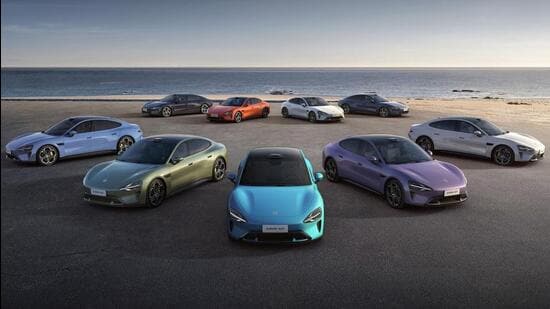
When Xiaomi first made its intentions clear with the Human x Car x Home philosophy in early 2024, skeptics would have likely brushed it aside as another instance of corporate-speak. It didn’t feel that way, as I got a first glimpse of the Xiaomi SU7 electric sedan at the Mobile World Congress (MWC) showcase in Barcelona. Or a few days earlier, when walking through history and the cutting-edge present at the Leica Gallery Wetzlar and the Ernst Leitz Museum. More than the words and the timing, it is the underlying form, the intent and the sentiment which often needs to be assessed to gauge the seriousness. I saw that then, and I see that now. There’s a reason why I jogged you through a bit of history.
A few days ago, Xiaomi in China stood at a new frontier. Network attached storage, or NAS. A space that’s so far been dominated by the likes of Synology, QNAP, WD and Seagate—Xiaomi said the first word about it earlier this month, and the Xiaomi Smart Storage device has reportedly clocked more than 30,000 orders in the first hour of crowdfunding. This now goes into mass production stage, in three storage configurations (4TB, 8TB and 16TB). It’ll do everything you expect a NAS to do, apart from offering lots of storage space. Multi-device backups, remote file access, 4K media streaming and AI photo organisation, all ticked off.
Also Read: Tech Tonic | We live in a disc-less world, intent on erasing history
This is where things get interesting. While this may vary depending on which part of the world you reside in, Xiaomi’s product portfolio often looks disparate. Often, not as much. In India, Xiaomi sells a number of popular smartphones, equally popular smart TVs across price points, tablets that have delivered consistent experiences, wearables including fitness focused smart watches, smart air purifiers, audio products including wireless earbuds and even a grooming kit if you’re lucky to find stock. Look closely, and you’ll see a hint of legacy. Accessories for robotic vacuum cleaner that’s no longer on sale. Or replacement head accessories of electric toothbrush, till a while ago.
The unrelated nature of Xiaomi’s global portfolio means everything is on the menu. A rugged portable bluetooth speaker, Mini LED TVs, side-by-side door smart refrigerators, front load washer and dryer, a gaming monitor, smart air conditioners, dehumidifier, an electric wine opener, a coffee machine, smart night light, a reading light bar to sit atop your computer screen (more relevant than you realise), electric scooters, smart audio glasses, a Wi-Fi 7 router (mind you, this beauty looks nothing like a router), a massage gun, portable photo printers, and a full range of electric cars. I’m out of breath, and this list has barely scratched the surface.
We used to talk about Apple’s “walled garden” as the ultimate ecosystem. Xiaomi’s garden? It cooks your dinner, makes you coffee, backs up your family photos, is the large screen on which you watch the football World Cup, lights up your living room, and then drives you to work. Think about the sheer audacity of Xiaomi’s product lineup.
In a scenario where you have access to everything, this is how your home and routine could look—you can wake up to a Xiaomi smart alarm, quickly check your Xiaomi smartphone or Android tablet for notifications, pull fresh clothes cleaned by a Xiaomi smart washing machine, and eat breakfast made in a Wi-Fi-connected Xiaomi air fryer and coffee maker. Your home network is managed by a Xiaomi router, your files sit on a Xiaomi NAS, and your floors are swept by their robot vacuum. The playbook has remains beautifully simple for years. It is meant to be functional and cost effective (at least when compared to other brands).
The strategy has by and large paid off. In Q1 2026, they reported a net income of 4.72 billion Yuan (that’s around $695 million) on total revenue of 99.1 billion Yuan. Big numbers, despite being somewhat tempered by rising chip costs that impact most of their ecosystem. In a blockbuster FY 2025, a record high adjusted net profit of 39.2 billion Yuan.
Xiaomi has delivered 600,000 electric vehicles to customers between last year and up to Q2 2026. This year so far has contributed 185,000 deliveries, with the tech giant aiming to clock 550,000 deliveries by the time 2026 draws to a close.
Two reasons why Xiaomi’s Human x Car x Home philosophy is working brilliantly. First, the software. Think of HyperOS as the singular nervous system connecting it all. Xiaomi developed this as a replacement to MIUI for a reason, and with an eye on the future. We are in that future now. The other thing, is sheer pragmatism. At no point is the brand trying to charge you for or lock the user into a pretentious luxury lifestyle. Instead, and look carefully, they are building an infrastructure for the every day. By building home appliances, network storage and routers, smart lighting, smartphones and tablets, TVs, and now smart electric vehicles.
Xiaomi is piecing together the sort of tech ecosystem that has never existed before. In terms of its sheer width, relevance and sync. At some point, a large part of this will have to emerge from China, and into more markets worldwide. That’s when the theoretical transforms into real-world experience. Empires are built on strategy, and an ounce of bravery. The efforts into making the puzzle as it stands, now needs a dollop of bravery.
Vishal Mathur is the Technology Editor at HT. Tech Tonic is a column that looks at the impact of personal technology on the way we live, and vice versa. The views expressed are personal.