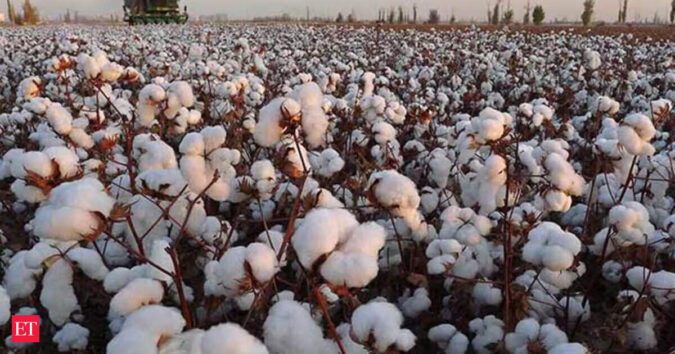
Cotton acreage stood at 63.18 lakh hectare as on July 5, against 82 lakh hectare planted at the same period last year, though the gap has narrowed as rains improve, Singh told PTI.
“The monsoon has improved. It is raining well in July and sowing has picked up,” he said.
Cotton is sown twice a year in India and the planting window varies by region, Singh said. Sowing typically begins in Punjab and Haryana before spreading to Tamil Nadu. The window usually closes by July 15 but has been extended to July 30 this season because of the delayed monsoon.
A trader in Ahmedabad said cotton acreage in Gujarat had risen sharply after lagging as recently as last week, with Gujarat, Maharashtra, Karnataka and Madhya Pradesh all receiving good rains.
Some farmers may be shifting from paddy to cotton, he said, since cotton and pulses offer better price prospects than paddy.
In Maharashtra, farmers who had sown soybean reported poor germination and are now turning to cotton as rains return, the trader added. India’s major cotton belts are Gujarat, Maharashtra and Madhya Pradesh in the central zone, followed by the northern states of Punjab, Haryana and Rajasthan, and Telangana, Andhra Pradesh, Karnataka and Tamil Nadu in the southern zone.
Cotton production for 2025-26 stood at 290.91 lakh bales of 170 kg each, down from 297.24 lakh bales in 2024-25, according to the agriculture ministry’s latest estimate.
OVERALL KHARIF SOWING
——————————
On the broader kharif sowing season, Singh said weekly planting typically rises to 200-250 lakh hectare in July from about 50 lakh hectare a week in June, as the bulk of the season’s acreage is covered this month.
Of the last year’s average total kharif area of 1,140 lakh hectare, about 250 lakh hectare was planted in June, rising to 750 lakh hectare in July, he said, adding that production and productivity estimates could only be made once sowing is complete.
Sowing had initially been delayed by deficient rainfall in some areas, but heavy rains have since caused waterlogging in others, Singh added. Farmers in those areas are expected to resume planting once the water recedes.
“Agriculture is location-specific,” he said, adding that foodgrain production and productivity had not declined in any year since the 2015 El Nino, and he expected that trend to hold this year.
On concerns over delays in official sowing data, Singh said the government verifies estimates at three levels- initial eye estimates, cross-checking initial figures with remote sensing, and block-level digital crop surveys.