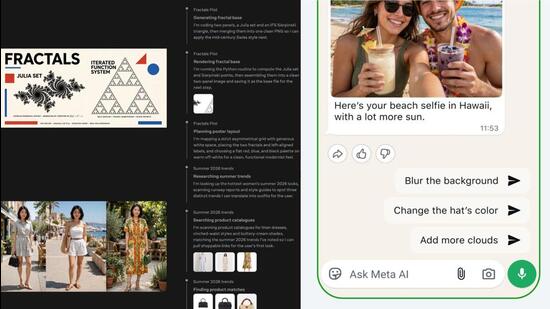
Meta’s heavy investments towards creating the Superintelligence Labs, has finally borne a public release fruit. The tech company has released its first media generation models, called Muse Image and Muse Video, which is in the preview stage. Meta’s Muse Image and Muse Video models compete directly with top commercial and open-source creative artificial intelligence (AI) suites, including those from OpenAI, Google, and Adobe. Meta is of course looking at deep integration across its social media apps.
This roll-out marks a pivotal moment for Mark Zuckerberg’s ambitious AI roadmap, underlined by billions of dollars in investments over the previous year, and in a way signals what is potentially a significant forward step for Meta’s AI models. Despite setting a groundwork with its open-source Llama models, Meta has consistently found itself trailing frontier capabilities of rivals including Google, OpenAI, and Anthropic.
The Muse model family, which also has the Muse Spark large language model that was released earlier this year, is expected to eventually replace the open-weight Llama models. This marks Meta’s pivot towards proprietary AI models.
Meta says the Muse Image model uses advanced reasoning to understand complex prompts, and can blend multiple photos into shareable generations. “We provide Muse Image with access to tools to enhance its agentic capabilities. During reinforcement learning, Muse Image learns to write and execute code that produces accurate plots and QR codes, and condition on rendered figures to improve the accuracy of generated images,” the company says.
Muse Image can search the web for grounding generated images with real-time information and visual references depending on the prompt, and has a self-refining behaviour which is expected to help improve work. Interestingly, Meta says, “we didn’t design this behaviour. Instead, it emerged during RL training simply because self-refinement produced better images and therefore higher reward.” RL training refers to reinforcement learning training, part of building an AI model.
Meta’s Muse Image can edit images such as restoring details, cleaning up effects such as fog in a photo, changing patterns in a specific element in a photo, edit images with text, and compose elements from more than one reference image.
Meta talks about the benchmark test results, which place this in the same ballpark (though scores lesser) with OpenAI’s GPT Image 2 model, but ahead of Google’s Nano Banana 2 and xAI’s Grok Imagine Quality.
The Muse Video model, which is being previewed with a release scheduled for a later moment, claims competitive performance in prompt adherence, visual fidelity, and temporal consistency. “We’re investing in areas with current performance gaps, such as audio-video synchronisation and physically accurate fast motion,” Meta says.
In the latest benchmark results that Meta has shared, Muse Video ranks higher in the text-to-video Arena benchmark than OpenAI’s Sora 2 Pro and Google’s Veo models. However, Google’s Gemini Omni Flash and Bytedance’s Seedance 2.0 score higher.
For Meta, plugging in the Muse Image and Muse Video models across its ecosystem is a given. The company confirms that Muse Image is now available in the Meta AI app and on the web, as part of Instagram Stories in the US, and also finds integration within WhatsApp in some countries. HT notes that the Meta AI suite within WhatsApp in India does not, at the time of writing, reflect any new media generation functionality which could indicate the availability of these models.
“You can use more than 30 new AI-powered effects for Instagram Stories and generate images in your direct chats with Meta AI on WhatsApp — starting in limited countries with more locations on the way,” they say, in a statement.
Meta says Muse Image and Muse Video models are coming soon to Facebook and messenger, while Muse Video specifically will be available to creators and as part of Meta AI in the coming weeks.