There is something reassuring about generational chip leaps. It is part hope and expectation that the future of computing is in good hands. Also part knowing, having spent almost two decades in this profession, that Intel is indeed in swashbuckling form. The Arc G3 Series processors that the chip maker detailed a few weeks ago, will be to gaming handhelds, what John Cooper’s mid-engined Copper T43 car of 1958 was to modern day single-seater racing. A spark, the beginning of something great. The first step in an unstoppable journey.
Intel is confident (and rightly so, as I’ll illustrate in this analysis) that the Arc G3 series chips represent a big step forward for PC gaming, particularly the portable handheld form factor. They’ve achieved a significant leap for laptops with the Panther Lake chips not too long ago. Not everyone can get their hands on an Xbox console these days (or even the Sony PlayStation 5 for that matter) owing to shortages and their price tags. The Claw 8 EX AI+ CG3EM is itself a rather refreshing alignment, which sees the MSI betting on Intel’s gaming chips, unlike rivals including Asus that work with AMD instead. The use of a highest-spec Arc G3 Extreme chip is another testament to a sureness of success.
The MSI Claw 8 EX AI+ gaming handheld hasn’t officially launched in India yet. For context, global pricing hovers around the $1,799 mark (roughly ₹1,70,000 upon conversion). This is serious territory for what is still a niche, with gaming laptops that cost significantly less, marking their own territory. As an aside observation, the gaming handheld territory could go either way—either this is early adopter premium, or this category of devices are unlikely to ever be truly affordable. Hopefully we’ll see the former play out.
In an illustration of true attention to detail, Intel provided an engineering sample of the MSI Claw 8 EX AI+ CG3EM with 32GB memory, 1TB storage and the Intel Arc B390 GPU with 12 graphics cores and benefitting from the LPDDR5x-8533 fast system memory. That isn’t all, Intel provided HT with a top tier OWC Thunderbolt Go Dock to simplify connecting this console to a large screen TV, and Samsung’s Galaxy Buds 4 for the Bluetooth Core 6.0 LE advancements.
The primary objective of this analysis is to illustrate Intel’s progression with the Arc G3 Series chips and what it means for the real-world gaming experience; I’ll get to the finer aesthetic and ergonomic points of the Claw 8 EX AI+ CG3EM later. Having come away largely unimpressed, all things considered with the Asus ROG Ally generations powered by AMD silicon (key stumbles were overall experience and inconsistent performance), there was some understandable trepidation whilst approaching this. That dissipated, soon enough.
There are some key things to remember, whilst setting up the MSI Claw 8 EX AI+ CG3EM (beyond the frustrating Windows 11 setup process). The preloaded MSI Centre M utility (there’s only one key software; HP must take note of this simplified approach) is your friend to get the tuning just right for games to be as they are intended to be played. You must notice and select a power preset—the default is AI Engine mode which runs games at 25-watts power and will dynamically adjust frame rate and overall performance without much intervention.
For some of us, that may not be enough. And it certainly may be the path of least resistance for some gamers, but tune a bit more and the real prowess of the Arc G3 Extreme and the Arc B390 graphics comes to the fore.
I’d like to draw your attention to the Manual option, which when selected, opens up two sliders labelled PL1 and PL2. Simply put, this dictates how modern CPUs dynamically adjust clock speeds and power consumption based on workload. Ideally, PL1 and PL2 must not be the same, else effectiveness is blunted—the former dictates sustained power use while the latter is the leeway you allow for short bursts of performance. Slide these to 35-watt and 45-watt if most of your gaming is likely to happen with the power adapter plugged in—you’ll find this option in the MSI Quick Settings overlay in the Xbox Game Bar, which can be invoked with the shortcut key on the left of the display.
The other setting you must check is in the Intel Graphics suite (do update to the latest drivers off MSI or Intel’s website) to enable XeSS 3 AI-based upscaling and frame generation. This will have a significant uptick on any game’s visual quality and smoothness. Any upscaling methodology has fine visual compromises if you look closely, and an occasional aberration can occur in this instance too. But this is the ideal way to achieve faster frames, and it will iron out as games optimise for this as well.
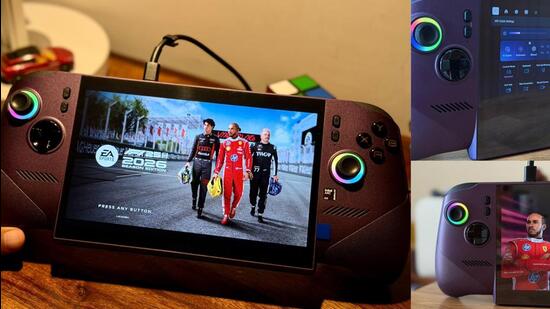
Two successful sides to the Arc G3 Extreme’s coin. I’ll particularly reference the F1 25: 2026 Season Pack title with AI Engine mode selected, visual settings at Very High, and the AI-based upscaling turned off, it peaked at close to 60fps and most race gameplay was around 40fps. No complaints, smooth enough gameplay and absolutely no dropped frames.
Great, if you wish to get in a couple of hours or so of gaming on a flight to somewhere. Staying on the point of battery stamina for a moment, Intel and MSI’s optimisations deliver the sort of battery life that AMD and Asus never could. 2.5 hours of F1, and 2 hours of Forza Horizon 6, before the 80Wh battery blinked—in AI Engine mode which uses Intel’s Dynamic Tuning Technology to lock frame rates between 30fps, 40fps and 60fps. Alongside, power consumption depending on gameplay and the specificity of the moment, can drop to as low as 4-watts (the range is as high as 25-watt). All in all, superb battery life for a powerful gaming rig.
At this point, one may not even realise how much headroom this Intel chip generation affords. And if you don’t experience that, no chance of appreciating the upgrade.
With Manual power settings locked in and XeSS 3 enabled with 4x multi-frame generation capping, the F1 25: 2026 Season Pack at Ultra visual settings peaked at 240fps and gameplay ranged between 90fps and 140fps depending on frame and state of the race. Much smoother, significantly more detailed visuals and overall, the Intel Arc G3 Extreme in the Claw 8 EX AI+ CG3EM holds performance better for longer than even the newest generation Acer Predator Helios Neo 16s AI gaming laptop with the Nvidia GeForce RTX5060 graphics. For this form factor, and the chip generational improvements, this is massively creditable.
All of this, without a noisy fan to keep the innards cool. Yes, the Claw 8 EX AI+ CG3EM has active cooling with dual fans blowing out warm air from the vents placed on the top spine (as you hold the gaming handheld), but neither does it ever get loud nor does the hot air become apparent in its vicinity. MSI were first to implement Intel’s codenamed Esther Island cooling technology in the first-generation MSI Claw—and this generation sees height of the fans increased by 0.5mm. That immediately means 9% more airflow and 5-watts of additional cooling capacity.
Important to note, the MSI Claw 8 EX AI+ CG3EM sets the default gaming resolution at 1920 x 1200 pixels.
There are certain design improvements that MSI has integrated in this generation of the gaming handheld, including the reassuring contours of a flared grip on either side. The Claw 8 EX AI+ CG3EM as a result sits better in the palm of either hand, and the chunkier design also makes it better to hold the rest of the time. I really like the laser etched dot texture on the Void Purple colour way. It definitely gets attention. Generationally, the A/B/X/Y buttons have seen subtle redesign and haptics now require less power.
The 8-inch display is gorgeous, vivid and very responsive. Yet, at this price, one could perhaps expect an OLED display, though that would have complicated the frugality proposition in the long term. Speaking of finer details, MSI says the SSD module on the Claw 8 EX AI+ CG3EM is user replaceable, which is great for upgradeability at some point down the line.
MSI has given the Claw 8 EX AI+ CG3EM uncompromising specs beyond the chip and graphics combination. This can connect with Wi-Fi 7 as well (the 160MHz for 6GHz channels on routers that support it) as well as a newer Bluetooth standard. There are two Thunderbolt 4 ports (both can do power delivery and display) on the handheld gaming device, and one is easily very usable if the Intel provided OWC Thunderbolt Go Dock is to be deployed to connect this to a 2026 edition 75-inch Xiaomi Mini LED TV S to transform an otherwise personal gaming experience into a console-esque affair in the living room.
Two key observations here. Gaming on the TV or a large display doesn’t really work smoothly if you’re using the more frugal AI Engine power settings. The Manual tuning which I’d described earlier, is the way to go for best performance. Secondly, you’ll need a good USB-C to USB-C Thunderbolt cable (ideally one rated at 240-watts power), to eliminate potential of lag.
Typical Windows 11 foibles (I was trying to remain positive, but well, Windows) show up. Setting Windows to open Xbox Mode by default renders the handheld’s controller non-functional within that interface at every startup. Secondly, Windows absolutely refuses to remember if I set it to use both the handheld’s screen and the TV in tandem. It’s unbelievable how bad Windows as an OS is, even for the basics.
That’s before I bore you with a minor observation that some games suddenly begin to open in windowed mode, rather than full screen. Inexplicable Windows 11 behaviour, that’s no longer surprising.
There is absolutely no argument about this, that the Intel Arc G3 Extreme is miles ahead of AMD Z2 Extreme that powers an MSI Claw 8 EX AI+ CG3EM’s rival made by Asus. The bigger difference is at lower power consumption settings, with Intel now delivering much higher sustained performance and longer battery stamina—not an easy balance to achieve. A generation ago, one couldn’t have imagined that the handheld form factor would give PC gaming the boost that gaming laptops seem averse to deliver for some reason. And that’s exactly what has happened. Especially with XeSS, which gives the handheld a big performance leap.
MSI is demanding top money (at least in global markets) for the Claw 8 EX AI+ CG3EM and that price may make this a smidgen too expensive for many gaming enthusiasts. But for those who have pockets deep enough for this, the combination of specs and performance is more than impressive.
In MSI’s defence, being the torchbearer to the latest and greatest Intel silicon, isn’t easy to price in this economy and supply chain scenarios. To that point, Intel doesn’t dictate final pricing of gaming devices either, and one would assume the Arc G3 Extreme will make its way into more such consoles and the Arc B390 graphics in more laptops, sooner rather than later. That widens availability of performance.
The Intel Arc G3 Extreme is truly something special. The MSI Claw 8 EX AI+ CG3EM is truly something special too. At some point, economics of scale will make its mark. It simply has to.