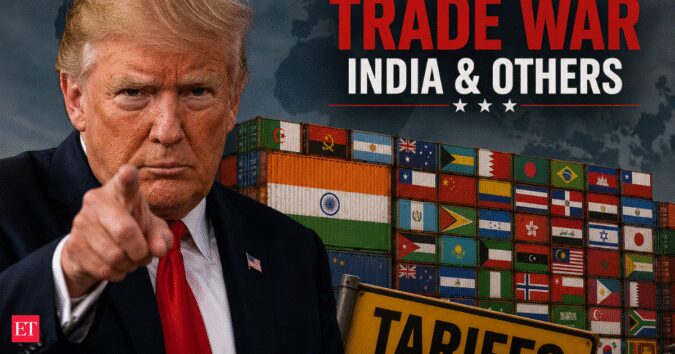
The Office of the United States Trade Representative (USTR) has proposed an additional 10- 12.5% duty on imports from India and other economies that, according to its findings, have failed to impose and effectively enforce prohibitions on imports made with forced labour. The proposal comes at a sensitive moment, with a US trade delegation currently in New Delhi negotiating an interim trade agreement and a broader Bilateral Trade Agreement (BTA) with Indian officials.
The move has raised an important question: how is Washington pursuing new country-specific tariffs after courts curtailed a key pillar of Trump’s tariff strategy?
The court didn’t kill tariffs. It killed one way of using them
The answer lies in the legal authority being used.
Earlier this year, the US Supreme Court held that the International Emergency Economic Powers Act (IEEPA) does not authorise the president to impose tariffs. The ruling weakened one of the administration’s preferred routes for unilateral tariff action.
However, the judgment did not eliminate presidential tariff powers altogether. Instead, it limited the use of emergency economic powers as a basis for imposing tariffs.
That distinction is central to understanding the latest USTR action.Rather than relying on emergency powers, the administration is now turning to Section 301 of the US Trade Act of 1974 — a law specifically designed to investigate foreign trade practices and impose trade remedies.
Same destination, different road
The renewed focus on Section 301 follows the legal setback on IEEPA.
Washington responded to the court ruling by imposing a temporary uniform 10% tariff under Section 122 of the Trade Act of 1974. While that provided a short-term solution, it removed the country-specific leverage that had become a key feature of the administration’s trade strategy.
Section 301 offers a different path.
The law authorises the USTR to investigate whether the acts, policies or practices of foreign governments are unreasonable, discriminatory or burden US commerce. If the investigation supports such findings, the United States can respond through tariffs or other trade measures.
Unlike IEEPA, Section 301 was created specifically as a trade enforcement mechanism, giving the administration a stronger statutory foundation for imposing country-specific duties.
A trade delegation arrives. A tariff warning follows
The timing of the USTR proposal has drawn attention.
A US delegation led by chief negotiator Brendan Lynch is in New Delhi for a four-day round of negotiations with Indian officials led by Darpan Jain, Additional Secretary in the Department of Commerce.
The talks are focused on finalising the details of an interim trade agreement whose framework was agreed in February, while also advancing discussions on the broader BTA covering market access, customs procedures, non-tariff barriers, investment promotion and economic security cooperation.
The USTR’s forced labour findings add a new layer to those discussions.
“India remains engaged with US on Section 301 proceedings on forced labour issues,” the Commerce Ministry said in a statement in response to the new proposed tariffs.
Under the proposed tariff framework, economies that impose a forced labour import prohibition, commit to doing so through an Agreement on Reciprocal Trade, or operate a partial regime that blocks certain forced labour goods would face a 10% additional duty.
Other economies, including India, would face a proposed 12.5% duty.
That structure potentially gives countries an incentive to conclude trade arrangements before the current tariff framework expires on July 24.
Enter Section 301, Washington’s trade enforcement weapon
Section 301 has long been one of the most powerful tools in the US trade policy arsenal.
It gained prominence during the US-China trade war beginning in 2018, when Washington imposed tariffs on hundreds of billions of dollars worth of Chinese goods following investigations into intellectual property practices and technology transfer policies.
In the current case, the USTR has concluded that India and several other economies have failed to impose and effectively enforce prohibitions on imports made with forced labour.
 ET Online
“The failure of our most important trading partners to address the importation of goods made with forced labor is unacceptable. This creates a dynamic where American workers are forced to compete globally on an unlevel playing field,” US Trade Representative Jamieson Greer said in a statement.
“We will no longer tolerate this disparity,” he added.
The proposal also includes a textile mechanism that could allow certain apparel and textile imports to enter the United States at a lower Section 301 tariff rate.
More than one investigation
The forced labour probe is not the only Section 301 investigation involving India.
In March, Greer announced investigations into the acts, policies and practices of multiple economies relating to structural excess capacity and production in manufacturing sectors.
India was named alongside China, the European Union, Japan, South Korea and Vietnam.
According to the USTR notice, Washington has concerns about sectors where it believes excess industrial capacity exists. The agency cited India’s solar manufacturing sector, petrochemicals and steel production among the areas under scrutiny.
The forced labour investigation is running separately.
Unlike traditional labour-rights allegations, the probe is not based on claims that Indian exports are produced using forced labour. Instead, it focuses on whether India has laws prohibiting imports linked to forced labour in third countries and whether those restrictions are effectively enforced.
Does Trump have a stronger legal footing this time?
The administration’s latest approach rests on a law that expressly deals with trade disputes and retaliatory measures.
Section 301 has been used by multiple administrations over several decades and includes a formal process involving investigations, public consultations and hearings before tariffs are imposed.
That gives Washington a more established legal basis than the emergency powers approach that faced challenges in court.
Any future lawsuits are therefore likely to focus on whether the USTR’s interpretation of Section 301 is valid and whether the agency has followed proper procedures, rather than on the broader question of presidential tariff authority.
India’s objection: Take it to the negotiating table
India has rejected the allegations made under the forced labour investigation.
According to Bloomberg, New Delhi has asked Washington to terminate the investigations and argued that such issues should be addressed through ongoing trade negotiations rather than unilateral trade measures.
Reuters reported that Indian officials are expected to discuss the Section 301 investigation and its potential tariff implications during the current round of negotiations.
An Indian government source told Reuters that New Delhi intends to discuss tariff rates, the impact of the Section 301 probe and the need to secure tariff treatment that remains competitive against rival manufacturing economies.
“India has to discuss tariff rate, 301 probe impact, and aim for competitive tariff rate versus direct competition,” the source told Reuters.
The source added that a deal could be reached if India receives terms that are “fair, equitable, and balanced.”
India is also seeking tariff treatment that would provide an advantage over competing manufacturing destinations in South and Southeast Asia, including Bangladesh, Pakistan and Sri Lanka, according to Reuters.
US Ambassador Sergio Gor has expressed confidence that an agreement can be signed within weeks.
Not everyone agrees Section 301 fits the case
The administration’s legal strategy may be stronger than its earlier reliance on emergency powers, but it is unlikely to go unchallenged.
The Global Trade Research Initiative (GTRI) argued on Wednesday that the proposed tariffs go beyond the intended scope of Section 301 because the investigation is not focused on market-access barriers faced by US companies in India.
“The current investigation exceeds the scope of Section 301, which deals with market-access barriers faced by the US firms in the country being investigated and not what it imports and from where,” GTRI said.
According to the think tank, the investigation is not based on allegations that Indian exports are produced using forced labour. Instead, it focuses on whether India prohibits imports that may have been produced with forced labour in third countries.
GTRI founder Ajay Srivastava said India should challenge the legal basis of the investigation and argue that the United States is attempting to impose its preferred import-control framework on other countries through unilateral trade measures.
“India may also argue that concerns regarding forced labour, particularly in countries such as China, are often product-specific and that the US itself remains a major importer of many of the products at issue. Hence, broad country-wide tariff actions are an inappropriate response when the problem could be limited to a few products,” Srivastava said.
The think tank also argued that the proposed 12.5% tariff exceeds US commitments at the World Trade Organization and warned that India could face additional Section 301 actions linked to excess-capacity investigations currently underway.
Tariffs aren’t here yet. The process is
The proposed duties have not yet been finalised.
The USTR has opened a consultation process under which interested parties can submit comments and participate in hearings before a final decision is taken.
Written comments are due by July 6, while public hearings are expected to begin on July 7.
The final decision could come before July 24, when the temporary Section 122 tariff framework is expected to expire. If the duties are approved, they could take effect shortly thereafter.
The bigger picture: A tariff tool — and a negotiating lever
The latest USTR proposal shows how the administration is adapting its trade strategy after the Supreme Court’s ruling on emergency tariffs.
Instead of relying on IEEPA, Washington is turning to Section 301, a law specifically designed to investigate and respond to foreign practices that it believes disadvantage American businesses and workers.
At the same time, the proposal has become intertwined with ongoing India-US trade negotiations.
Commerce Minister Piyush Goyal said this week that 99% of discussions between the two countries have already been completed. The American delegation remains in New Delhi until June 4, with both sides attempting to finalise an interim arrangement while advancing negotiations on the broader BTA.
According to Reuters, US Trade Representative Jamieson Greer could visit India once the broad contours of an agreement are finalised.
For now, Section 301 has become more than a trade enforcement mechanism. It is also emerging as one of the key pressure points in the final stages of India-US trade negotiations — and the White House’s clearest path yet to revive country-specific tariffs after its court setbacks.