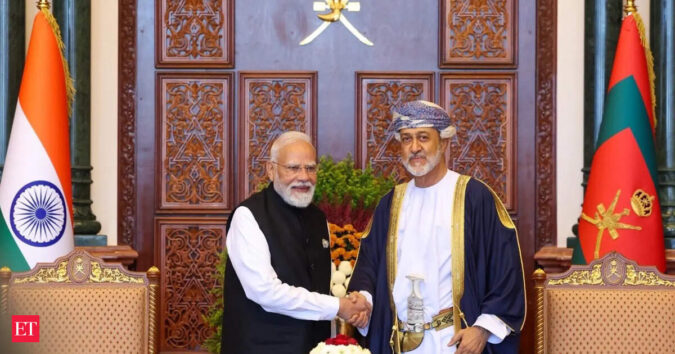
This marks the fifth free trade agreement (FTA) implemented under the Modi government since 2014. It follows trade pacts rolled out with Mauritius (April 2021), the UAE (May 2022), Australia (December 2022), and the European Free Trade Association (EFTA—comprising Switzerland, Iceland, Liechtenstein, and Norway in October 2025). India has also signed deals with the UK (July 2025) and New Zealand (April 2026), alongside concluding trade talks with the 27-nation European Union (EU) on January 27 this year.
CEPA vs FTA
Modern trade pacts typically span around 20 chapters. These encompass comprehensive regulations across trade in goods, trade in services, investment, intellectual property rights, customs procedures, and dispute settlement mechanisms.
Similar bilateral frameworks are also designated as Comprehensive Economic Cooperation Agreements (CECA), Comprehensive Economic Trade Agreements (CETA), or Economic Cooperation and Trade Agreements (ECTA).
India-Oman trade
Bilateral trade between the two nations reached USD 11.18 billion during 2025-26, up from USD 10.61 billion in 2024-25. India’s exports stood at USD 4.02 billion, while imports from Oman were valued at USD 7.16 billion.
In the services domain, India’s exports to Oman expanded from USD 397 million in 2020 to USD 665 million in 2024, driven primarily by telecommunications, computer and information, transport, and travel sectors. Conversely, services imports from Oman grew from USD 101 million to USD 197.7 million over the same period, led by transport, travel, telecom, and other business services.
What does India gain?
The deal unlocks 100% duty-free market access for Indian exports to Oman, covering 98.08% of Oman’s tariff lines, which represents 99.38% of the trade value (based on the 2022-23 average).
- Immediate Concessions: All zero-duty access comes into effect from “Day One” of the agreement. Currently, only 15.33% of India’s export value (11.34% of tariff lines) enters Oman duty-free under the Most Favoured Nation (MFN) regime.
- Price Competitiveness: The pact eliminates the current 5% import duty on Indian goods worth USD 3.64 billion.
- Growth Drivers: Key sectors poised for immediate advantages include textiles, agricultural products, transport equipment, precision instruments, processed food, and gems & jewellery.
- New Horizons: The agreement unlocks fresh export windows for Indian minerals, chemicals, base metals, machinery, plastic, rubber, automobiles, clocks, instruments, glass, ceramics, marble, and paper.
India-Oman CEPA: Key sectoral gains
Oman will grant immediate zero-duty access to crucial Indian industrial segments, including:
- Iron and steel
- Electrical and industrial machinery
- Marine products and copper goods
Furthermore, the removal of the 5% tariff is set to directly bolster the competitiveness of Indian vehicles in the Omani market, while securing binding zero-duty access for key finished medicines and vaccines.
India protects sensitive sectors
To insulate local industries and farming communities, India has placed 2,789 tariff lines on its exclusion list.
- Excluded Categories: Key domestic sectors shielded from tariff concessions include transport equipment, major chemicals, cereals, fruits, vegetables, spices, coffee, tea, and products of animal origin.
- Manufacturing Safeguards: High-value manufacturing chains including rubber, leather, textiles, footwear, petroleum oils, and mineral-based products remain protected.
- Agricultural Shielding: Strategic segments such as dairy products, meat, oilseeds, vegetable oils, sugar, and food-processing residues are entirely kept out of the liberalisation purview.
Service sector stands to gain
With Oman’s total global services imports standing at USD 12.52 billion in 2024, India’s current share of 5.31% presents significant room for expansion.
Oman has made robust commitments regarding the temporary entry and stay of Indian service professionals. Notably, the Intra-Corporate Transferees (ICT) ceiling has been raised from 20% to 50%, allowing Indian firms to deploy a higher volume of managerial and specialist personnel.
Additionally, for the first time in any FTA, Oman has locked in specific commitments for professional service providers, benefitting Indian talent in IT, accounting, engineering, medical, education, construction, and consulting fields.
Gains for India’s agri sector
Indian agricultural exports such as natural honey, potatoes, cashews, boneless meat, and bakery items will secure immediate duty-free entry into Oman.
Oman has agreed to dismantle tariffs—which currently range from 5% to 100%—on an array of items. These include cheese, curd, milk, cream, frozen fish, butter, meat, yoghurt, pastries, cakes, chocolate, sugar confectionery, mineral water, alongside animal and vegetable fats and oils.
In return, Indian consumers will benefit from cheaper imports of Omani dates, with India granting zero-duty access for up to 2,000 tonnes of the commodity annually. New Delhi is also extending tariff concessions to Oman’s traditional products: Gum Arabica (utilised in food, pharmaceuticals, and cosmetics) and Frankincense (utilised in the incense and perfume sectors).
Oman to benefit from tariff concessions
India is extending tariff concessions across 77.79% of its total tariff lines (equivalent to 12,556 lines), which encapsulates 94.81% of India’s total imports from Oman by value.
For items that hold significant export value for Oman but remain sensitive for domestic industries in India—such as dates, marbles, and specific petrochemical products—liberalisation will be managed via a controlled Tariff-Rate Quota (TRQ) mechanism.
India strengthening presence in Middle East
The Oman CEPA serves as another pillar in India’s deepening trade ties with the Gulf Cooperation Council (GCC), following its May 2022 pact with the UAE. New Delhi is set to commence trade talks with Qatar soon, and has already inked terms of reference (TOR) to initiate broader trade pact negotiations with the entire GCC bloc (comprising Saudi Arabia, UAE, Qatar, Kuwait, Oman, and Bahrain).
Despite its size, Oman commands vast geopolitical importance as it borders the Strait of Hormuz, a critical maritime chokepoint heavily relied upon by Asian enterprises for oil trade. The nation serves as a strategic gateway for Indian goods and services into the broader Middle Eastern and African markets.
Currently, nearly 7 lakh Indian nationals reside in Oman, sending home approximately USD 2 billion in annual remittances. Over 6,000 Indian establishments operate within Oman, and India has clocked USD 615.54 million in foreign direct investment (FDI) from Oman between April 2000 and September 2025. Notably, this CEPA is the first bilateral trade pact Oman has signed with any nation since its agreement with the United States in 2006, cementing its position as India’s third-largest export market within the GCC.