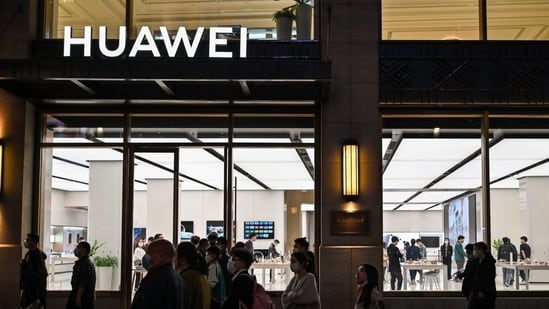
SHANGHAI—Huawei Technologies said it has developed a workaround that will allow it to make chips on par with leading products manufactured by Intel and other top global companies by 2031, the latest effort by the Chinese company to overcome U.S. semiconductor technology barriers.
The details
Huawei said its approach would allow it to make more-advanced chips without the one-of-a-kind machines its rivals use—equipment the U.S. has blocked it from accessing.
The Shenzhen, China-based company expects to design high-end chips by 2031 that match the transistor density of those manufactured with a 1.4-nanometer process. The 1.4-nanometer level is considered the next frontier for cutting-edge chips, which Intel, Taiwan Semiconductor Manufacturing and Samsung Electronics are aiming to mass produce within the next few years using specialized machines manufactured by ASML of the Netherlands.
If Huawei is able to produce these high-end chips at scale, it would overturn a prevailing belief in the industry that advanced manufacturing technologies and machinery are necessary to make top-of-the-line chips—removing an obstacle for China in its tech rivalry with the U.S. It could also make Huawei’s chips cheaper to produce than rivals’.
“Our solution is feasible and affordable,” He Tingbo, president of Huawei’s chip arm, said Monday at an event in Shanghai.
Huawei said its approach focuses on improving computing efficiency, such as by stacking multiple layers of circuits within a single chip and reducing the time it takes to move data among them.
“Whether Huawei will gain a distinct advantage here remains to be seen, but it’s at least an alternative path forward, a breakthrough Huawei managed to find while facing supply chain challenges,” said Lian Jye Su, a Singapore-based analyst at research firm Omdia.
The context
The U.S. has blacklisted Huawei since 2019 and has restricted China’s access to advanced semiconductor technologies since 2022. That has forced Huawei to develop its own alternatives. Huawei has since become a central player in Beijing’s national push for technological self-sufficiency, helping build China’s domestic semiconductor supply chain.
Huawei and Nvidia are often pitted against each other as proxies in the escalating rivalry between Beijing and Washington. The Chinese company has increasingly leaned on alternative designs, advanced packaging techniques and its networking technology to boost the computing performance of its hardware to catch up with its American counterparts.
Huawei said it has honed its semiconductor technology over the past six years, mass producing 381 chip models with its approach. The latest iteration of its Kirin smartphone chips, set to launch this fall, will be Huawei’s first to be made with what it calls “LogicFolding” architecture, designed to enhance chip performance, according to the company. Huawei said it is also using this workaround to develop chips for artificial intelligence. It didn’t provide an independent evaluation of its chip performance.
The challenges
While conventional chip manufacturing relies on squeezing more circuits onto a single silicon wafer to enable faster computing, some analysts say the traditional fabrication technique is hitting a physical ceiling in which the components soon won’t be able to get any smaller.
In response, researchers are stacking circuits, but this nascent approach faces major hurdles such as overheating and requires engineers to write more sophisticated code to coordinate the different layers of circuits.
Only in the past year has Huawei achieved more stable results with the new technology, people familiar with the progress said. The company still needs to work with data centers and equipment vendors to prove its viability in larger-scale applications, which could take time, they said.
Write to Hannah Miao at hannah.miao@wsj.com and Raffaele Huang at raffaele.huang@wsj.com