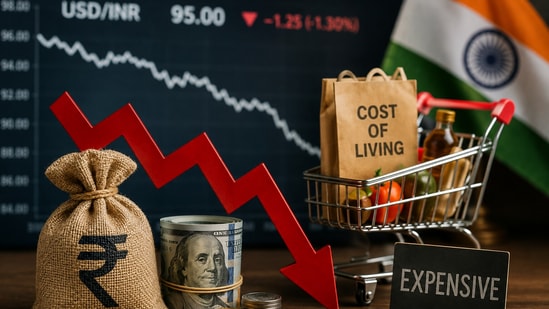
On 5th May 2026, the Indian Rupee (INR) breached the 95 mark against the US Dollar (USD), hitting a new all-time low. Over the last few months, the INR has been steadily hitting new lows against the USD. Since the start of the US–Iran War, the situation has only aggravated, with the INR hitting new lows more frequently. A depreciating Rupee hits the overall economy, companies, and even individuals. In this article, we will understand how the depreciating Rupee affects your personal finances.
How has the INR performed
In most years, the INR has depreciated by an average of 3-5% per year. However, in the last one year, the INR has depreciated by 10%, far more than the usual average.

Source: https://tradingeconomics.com/india/currency
The above chart shows how the INR has depreciated from around Rs. 85 (May 2025) to around Rs. 95 (May 2026) against the USD in the last 1 year.
Some of the reasons why the Rupee has depreciated against the US Dollar include:
- Higher crude oil prices, putting pressure on the balance of payments, US Dollar outflows, and fiscal deficit
- Continuous selling of Indian equities and debt by FPIs and taking US Dollars out of the country
- A rise in the US Dollar Index, putting pressure on the Indian Rupee and other currencies
- Costlier imports of gold, silver, fertilizers, metals, etc., due to an increase in prices due to disruption in supply chains, demand-supply mismatch, and other reasons
As mentioned earlier, a depreciating Rupee impacts everyone: the finances of the Government, companies, and even individuals. Let us discuss some ways in which a depreciating Rupee affects the personal finances of individuals.
- Higher cost of living
Since the start of the US–Iran War, crude oil prices have jumped from levels of below $80/barrel to more than $100/barrel. Rising prices of crude oil and other imports have led to a sharp depreciation of the Indian Rupee. India imports more than 80% of its crude oil requirements. Crude oil products include fuels such as petrol, diesel, ATF, etc., which move people and goods.
Higher crude oil prices and a depreciating Rupee make the freight and logistics cost of transporting goods costlier. As a result, the prices of most goods have moved up, increasing the overall cost of living. Due to higher fuel prices, travel by flights and other modes of transport has become expensive. So, if you are planning a summer vacation, be ready to pay more for travel tickets and other items.
India imports a major portion of its LPG requirements through the Middle East. Since the start of the US–Iran War, the supply of LPG through the Strait of Hormuz has become constrained, sending LPG prices soaring. As a result, eating out at restaurants or ordering food delivery has become expensive.
So, costlier imports and a depreciating Rupee have made travel, food, and other goods more expensive, leading to an overall increase in the cost of living.
2. Expensive jewellery purchases
In the last couple of years, gold and silver prices have risen sharply in the international market. However, a depreciating Rupee makes gold and silver jewellery even more expensive for Indian customers.
In the earlier section, we saw that the Indian Rupee has depreciated by around 10% in the last one year. It makes gold and silver jewellery that much more expensive for Indian customers.
However, if you have already invested in gold ETFs, your investments have gained from the depreciating Rupee. The gains from a depreciating Rupee will get added to your overall returns. For example, after your investment, let us assume gold prices have increased by 5% in the international market, and the Rupee has depreciated by 3%. In such a scenario, your overall investment gains will be 8%.
So, with a depreciating Rupee, while gold jewellery purchases for consumption will become expensive, gold already bought for investment will gain.
3. Foreign trips pinch the pocket more than before
With a 10% depreciation of the Indian Rupee, a foreign trip booked today will be 10% more expensive than it was a year back, even if the prices haven’t changed in US Dollar terms. So, just because of the Rupee depreciation, everything that you pay for in US Dollars on your foreign trip (flights, hotels, food, local travel within the foreign country) will pinch your pocket more than before.
4. Expensive electronics
Over the last few years, due to the Government’s PLI schemes, Make in India schemes and other initiatives, manufacturing within India has picked up. However, we still continue to import a lot of goods, for which we have to pay in US Dollars.
For example, many electronic goods, such as mobiles, laptops, and other gadgets, or their parts are still imported. A stronger US Dollar makes these imports expensive as they are priced in US Dollars. So, if you are planning to buy an Apple iMac imported from the US, be ready to shell out more than before.
5. Shell out more for your child’s education abroad
You plan to send your child to the US for higher education. You are building a higher education fund factoring in an average 5% annual depreciation in the INR against the USD. However, with the INR depreciating at a higher rate in the recent past, you may fall short of the estimated corpus required to fund your child’s education abroad. A higher-than-anticipated depreciation of the Rupee will make course fees, accommodation, and the cost of living more expensive than what was initially budgeted.
6. Returns from G-secs MFs are falling
A depreciating Rupee eats into the returns that FPIs earn on G-sec investments. As a result, FPIs have been selling G-secs in large quantities and taking their Dollars back to the US. The higher selling of G-secs by FPIs is resulting in G-sec bond prices falling and yields rising. The fall in G-sec prices is resulting in the NAVs of Gilt funds falling. If you have invested in Gilt funds, you must have noticed that returns have been subdued in the last one year or so.
How can you protect yourself against the INR depreciation?
We have discussed the various ways in which a falling Rupee can affect your personal finances. You can protect yourself against INR depreciation by investing in US-Dollar-denominated assets. For example, many Indian mutual fund houses offer international fund of funds (FoFs), which give exposure to companies listed on the US and other global stock markets.
You can consult your financial advisor on which international FoFs you can invest in based on your risk profile and other factors. When you invest in these funds, you benefit from the growth of the underlying companies and the depreciation in the INR.