Opening thoughts. Microsoft Xbox CEO Asha Sharma is overhauling the company’s gaming unit. She needs to wield the wrecking ball too, because Microsoft had let things drift for far too long. Four out of the six previous quarters have seen gaming revenue decline. There has been regular talk, including from Satya Nadella about trying to win back Xbox fans and gamers, but precious little except for an overwhelming obsession with AI. Sharma has put an end to the Copilot journey on Xbox, and a serious price restructuring for the Xbox Game Pass subscriptions.
EDITOR’S CORNER
ANDROID’S NEW DIRECTION
The way millions of Android phones work will undergo a significant overhaul in the coming months, starting with flagship phones. Ahead of their annual I/O developer conference, Google has detailed a vision for Gemini’s deeper integration into Android. Core to this is a new Gemini Intelligence layer, which will add context and personalisation with an intent to automate tasks where possible—a significant change in how you use your Android phone, is incoming. Gemini Intelligence brings context to auto-fill when filling forms across websites and apps, a Rambler feature to the keyboard app which can now convert typically spoken sentences will fillers into cogent messages or lists, and automating certain tasks such as booking tickets for an event you’ve discovered.
Three things, I’d like to note:
- Google has essentially put together a foundation for millions of Android phones to become “AI devices”, even as whispers of that becoming a device category in the coming months, were doing rounds. Now you really wouldn’t need a separate AI device.
- With Gemini at the fingertips of millions of Android phone users, across all the apps they use on their phones (with context), is there really a need left for a separate AI subscription? Where does that leave the likes of OpenAI? Perhaps the space to compete now will be with enterprise AI functionality, but Anthropic sets the benchmark there.
- By announcing Gemini Intelligence before anything Apple announces around its AI pursuits next month, Google will forever hold a first mover advantage. Mind you, Apple and Google do have a deal in place for using Gemini models in the next Apple Intelligence redo, including for the smarter Siri expected sometime this year. Perhaps with iOS 27?
To HT’s question about a possible subscription layer defining usage and utility of Gemini Intelligence as core to the Android experience on phones, Ben Greenwood, who is Director, and Product Manager for Android Core Experiences confirms that base features will remain broadly available to all devices, but with a caveat. “There are some usage limits for higher usage, and in those cases, you can upgrade to an AI subscription plan,” he says. It remains to be seen the limits on the free tier and how those stack up when these features are accessible at the OS level rather than a separate Gemini app or specific instances where Gemini is invoked in other apps. In India, Google has three paid AI plans—AI Plus that costs ₹399 per month, AI Pro for ₹1,950 per month and AI Ultra priced at ₹24,500 per month.
Gemini Intelligence brings context to auto-fill when filling forms across websites and apps, a Rambler feature to the keyboard app which can now convert typically spoken sentences will fillers into cogent messages or lists, and automating certain tasks such as booking tickets for an event you’ve discovered. Starting in late June with Chrome Auto browse, Gemini inside Chrome will be able to help you with everything from appointment, party planning, or searching for an out of stock item, from your Android phone. These new features will roll out in waves through the next few months, starting with flagship Android devices.
And it isn’t just the Android overhaul on phones. Google is also making a renewed computing device bet with a more premium Googlebook laptops range, and the Gemini Intelligence layer will also extend to Android Auto in your car, via your smartphone. This is, putting it mildly, Google at its most aggressive, unwilling to waste momentum. And that’s really prime Google we don’t want to lose.
TECH SPOTLIGHT
DESKTOP CHARGING STATIONS
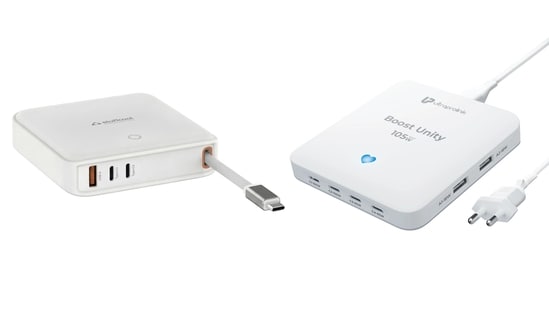
There is an undeniable utility of desktop charging stations, which those of us who may have a laptop and more than one other device to fast charge at the same time, would realise. Many of you may remember I have regularly talked about some of the better options you can buy over time, and I distinctly remember my analysis of the UltraProlink’s Boost Unity 100 and Acefast’s Z4 PD218W. That era is now moving forward, with Indian tech companies UltraProlink’s Boost Unity 105 and Stuffcool’s Zeno 100 charging stations. Similar form factors, very differing approaches to utility, yet undeniable success.
The UltraProlink Boost Unity 105, as the name suggests, is a 105-watt charging station which essentially has 6 USB ports—two USB-A ports each capped at 18-watt charging speeds, and four USB-C ports. Among these four USB-C ports, the ports marked C1 and C2 will top out at 100-watt speeds when used individually, while the C3 and C4 ports have a 65-watt each ceiling. While this is a theoretical six device charging hub, much like any other device of its kind, the charging speeds will distribute in a specific ratio (C1 gets a higher share if C3 is also being used, for instance). This is more than enough bandwidth for most laptops plus fast charging phones or tablets being charged as well at the same time.
It is impressive how cool this charging station remains, even when a full 100-watt is being drawn to power a 15-inch MacBook Pro via C1, or if two fast charging phones are plugged into C3 and C4. The Boost Unity 105 will also charge a smartwatch or true wireless earbuds with the USB-SA ports in the midst of fast charging activity elsewhere, without any fuss. You do pay a fair premium at ₹6,999 but this is primed to last long. And be very relevant.
Stuffcool has a rather interesting take on desktop charging stations too. The Zeno 100 has four simultaneous avenues for charging devices. Tops out at 100-watts combined, and it’s a simple enough proposition nevertheless. Both Type-C ports can do a maximum of 100-watt charge speeds, while the USB-A port is rated at a maximum of 18-watt. The uniqueness in Stuffcool’s approach comes from the retractable USB-C cable, which at 65-watts, is ideal for quickly plugging in a phone to charge at your desk, without having to go searching for a cable or plugging one in. This flat design cable has a 1.5 meter length, which means the edges of your work desk aren’t entirely out of reach.
The retractable cable idea was first seen in the Stuffcool Zeno 65W and as I had noted then, key is to be gentle with this extension and retraction. Nevertheless, it is good to not have to carry around a separate charging cable, when one’s built into the charger. The Zeno 100 is priced at ₹3,999 and would certainly be among my shortlisted recommendations for a desktop charging hub. And it’ll work great during travel too.
SECOND THOUGHTS
IQ AND SNOOPING
There’s a new fraud targeting Android phone users, something researchers at security firm ESET have discovered. It is called CallPhantom, and these are basically a set of malicious apps that claim to provide access to call logs, messages and WhatsApp call history of any number in exchange for a payment made with real money. ESET says they’ve uncovered 28 separate CallPhantom apps on Google Play, which have been collectively downloaded as many as 7.3 million times. Quite how they passed Play filters, remains a concern. That said, ESET reported these apps to Google, and they’ve since been taken down.
“In November 2025, we came across a Reddit post discussing an app named Call History of Any Number, found on Google Play. Unsurprisingly, our analysis showed that the ‘call history’ data provided by this app is entirely fabricated — the app generates random phone numbers and matches them with fixed names, call times, and call durations, which were embedded directly in the code,” says ESET researcher Lukáš Štefanko.
While the demand for real money for fake data varied across apps, researchers note realistic looking subscription options offered weekly, monthly and annual payment options, which prices as high as $80. Many of the apps came with India’s +91 country code preselected, and did support UPI payments in this region. ESET says 53.7% of all CallPhantom detections worldwide were found in India—there is just something to be said about the mixture of an urge to snoop and low intelligence levels.
A question remains is, how many apps (and users) chose the Google Play billing option, as against a direct or third-party payment gateway. In case of the former, Google would’ve automatically cancelled recurring subscriptions for these apps once they were unlisted from the Play Store. For the latter, any recourse (or refunds) if any, is purely a matter of luck.
Wired Wisdom peels away the glitz for a closer look at Technology & AI, with the hope to critically analyse how it impacts you, the human. Want this newsletter delivered to your inbox. Subscribe here.