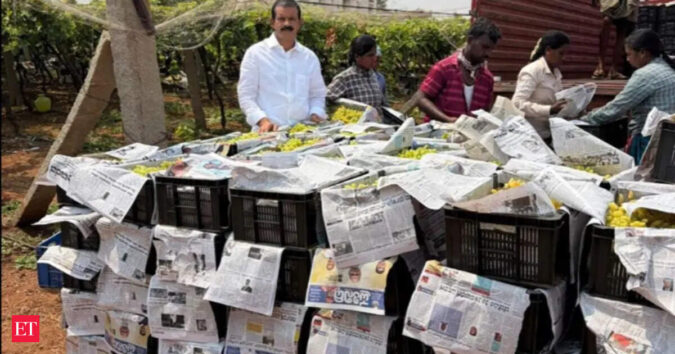
A journey shaped by scarcity
Reddy’s story begins in Prasannayapalli village in Anantapur district, Andhra Pradesh, an area known for erratic rainfall and water stress. With limited formal education, he entered farming early and learned through practice rather than textbooks.
Instead of following traditional methods, he focused on solving the region’s biggest constraint, water.
Early bet on technology pays off
At a time when most farmers relied on conventional irrigation, Reddy installed drip systems in 1990s. This move changed the trajectory of his farm. By supplying water directly to plant roots, he reduced wastage and improved productivity.
Over time, he added fertigation and refined irrigation schedules. The result: more than 50% water savings compared to older practices, along with better crop health.
Moving beyond traditional crops
Reddy did not stop at water management. He also rethought what to grow. Starting with groundnut, he gradually shifted towards horticulture, bringing in crops like grapes and sweet orange.
Back in 2007, he created a remarkable milestone in commercial farming by earning nearly ₹1.4 crore within just 75 days through muskmelon cultivation. Farming across 20 acres, he produced close to 400 tonnes of muskmelon, making it one of the most talked-about agricultural success stories of that period.
Over the years, he further expanded his agricultural ventures into pomegranate, banana, papaya, grapes, coconut, and other high-value horticultural crops. In another major achievement, he reportedly earned more than ₹1 crore from just 5 acres of grape cultivation, further establishing his reputation for high-value, market-driven farming.
His journey reflects a long-standing history of innovation, large-scale cultivation, and progressive agricultural practices, making him widely recognized for transforming horticulture into a highly profitable enterprise.
Experimenting with new possibilities
Reddy’s farm today looks less like a traditional field and more like a testing ground. He has introduced 30 to 40 varieties of exotic fruits, including persimmon, lychee and macadamia.
This approach is not just about profit. It allows farmers visiting his fields to see what works in real conditions and encourages them to diversify beyond low-return crops.
Early adopter of quinoa
In 2012, Reddy explored another unconventional idea, quinoa. At a time when the crop was still new to India, he successfully cultivated it in Anantapur’s tough climate. His success showed that even drought-prone regions could support high-value crops with the right approach.
Reddy’s influence goes beyond his own land. Many workers who worked with him or learned from his methods have started their own farms. Some have even become employers, creating jobs in rural areas.
His model focuses on reducing input costs, improving soil health and using resources wisely. Farmers who adopted his practices reportedly cut input costs by up to 40% and reduced water use by over 30%, while still increasing output.
Recognition and a larger message
His work has earned him several honours, including the Innovative Farmer Award from the Government of India and recognition from the International Commission on Irrigation and Drainage.
At a time when climate uncertainty is reshaping agriculture, Reddy’s journey offers a practical blueprint. It shows that farming in dry regions does not have to mean low income or high risk. With the right mix of technology, crop choices and experimentation, even difficult landscapes can become productive.
Today, Reddy stands as an example of how innovation at the grassroots level can change not just one farm, but an entire farming mindset.