After acquiring point-of-sales (PoS) payment solutions provider Ezetap in 2022, Razorpay had planned aggressive expansion of its terminal presence across the offline merchant ecosystem. That strategy has been stalled.
“Razorpay is very strong in the online small business ecosystem. For the retail play, they are only focusing on those players who need both offline and online payments,” one of the executives said. “The company has not gone aggressive on building large field teams to acquire merchants and service them.”
 ETtech
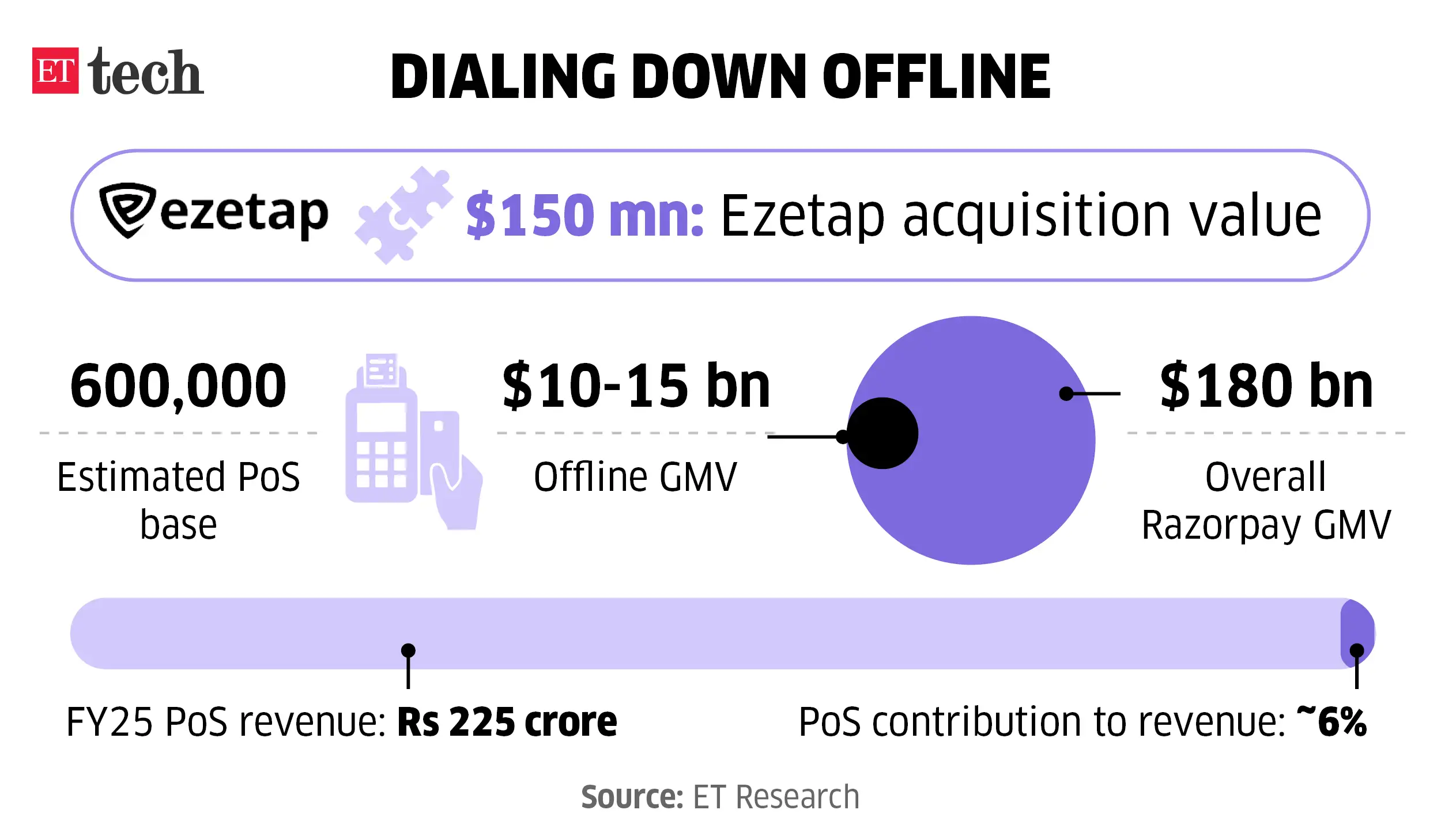
Razorpay, valued at $7.5 billion, has not been able to grow its offline payments GMV (gross merchandise value) significantly, executives said. Its PoS terminal base is currently estimated at around 600,000 units, processing between $10 billion and $15 billion in annual GMV.
When it acquired Ezetap, the latter was already processing around $10 billion in GMV with around 500,000 terminals deployed.
Rival Pine Labs, which primarily focuses on the PoS business, has a base of 1.9 million, while also registering strong growth in its online vertical.
“The base has grown for Razorpay, but compared to their online business, the offline segment continues to be very small,” a second executive said.
Its revenue from the PoS business in FY25 at around Rs 225 crore was only about 6% of its overall revenue, according to people in the know.
Razorpay did not respond to detailed queries sent by ET.
The company currently processes more than $180 billion, or about Rs 16.93 lakh crore, in annual GMV across its overall business.
 ETtech
Eye on IPO
The shift comes as Razorpay prepares for its planned initial public offering (IPO) and is trying to build a more profitable and sustainable business model around its core small and medium enterprise-focused online payments business.
Amid heightened market volatility, IPO-bound startups are focusing on better cost control and more predictable revenue channels.
Last month, ET reported that Razorpay is planning to file for an IPO confidentially and is targeting a valuation of around $5 billion, a drop from its last $7.5 billion tag. Razorpay is looking to raise around $600-700 million through the IPO.
The fintech’s IPO plans come at a time when Walmart-backed PhonePe, India’s biggest fintech startup in terms of valuation, delayed its IPO, citing choppy markets.
Offline Challenge
For online payment companies, entering the offline PoS ecosystem has proven tough, as it is usually a more execution-heavy business. It typically requires on-ground merchant acquisition, device deployment, servicing infrastructure, and continuous field support. This makes the model more cost-intensive than online payments, where distribution and servicing can be more scalable.
A founder of a rival payment firm told ET that building a network of payment devices is an investment made for the next five to six years, which is typically the life cycle of a hardware device.
“Given so much focus around tap and pay and QR code payments, how much sense does it make for companies to create large PoS networks is being questioned in the industry,” the founder added.
Diversification Push
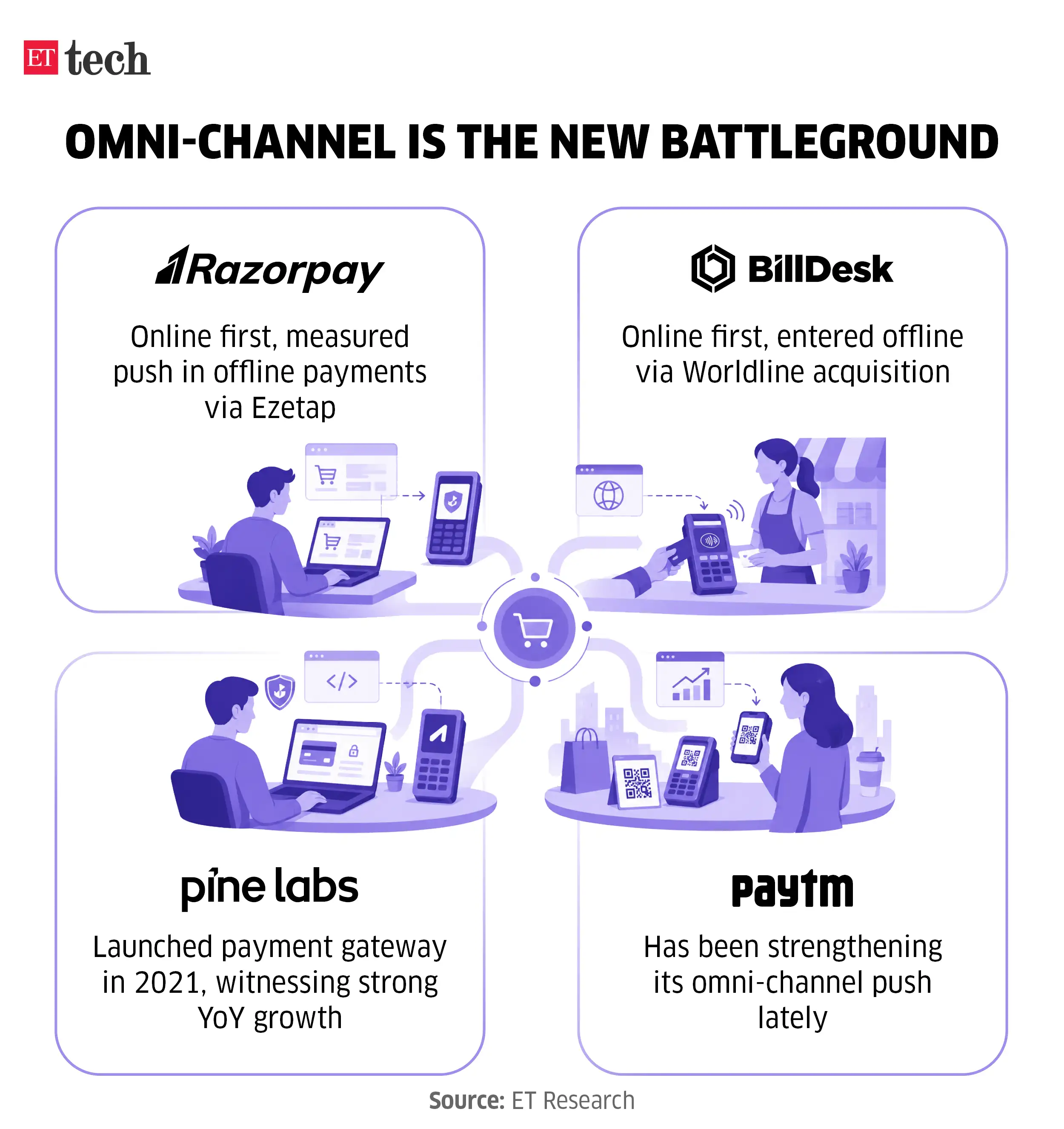
To be sure, Razorpay is not the only company trying to build a pure-play omnichannel strategy for merchants.
Last week, Billdesk, another major online payment company, acquired Worldline’s India operations for about $70 million to enter the offline payments ecosystem, thus positioning itself as an omnichannel platform for payments.
On the other hand, Pine Labs and Paytm have both built online businesses to compete with payment aggregators.
Vijay Shekhar Sharma, Paytm’s founder and CEO, has stressed the importance of having an omnichannel strategy for payments companies in recent earnings calls and result presentations.
Pine Labs’ online payments business grew 50% year-on-year in the third quarter of FY26 and its CEO Amrish Rau said, “We have already highlighted the fact that today, Flipkart, Myntra…Zepto, Big Basket all of these guys use our services on the online payments platform today.”