A report by the Global Trade Research Initiative (GTRI) warns that Quality Control Orders (QCOs) on fasteners are raising costs, choking supplies, and disrupting production without delivering clear gains in quality — raising fresh concerns for the “Make in India” programme. Industry bodies cited in the report say the policy is already cutting MSME output and risks triggering supply bottlenecks in sectors such as automobiles and infrastructure.
Also Read: New quality control orders for steel parts may lead to factory shutdowns, job losses: GTRI
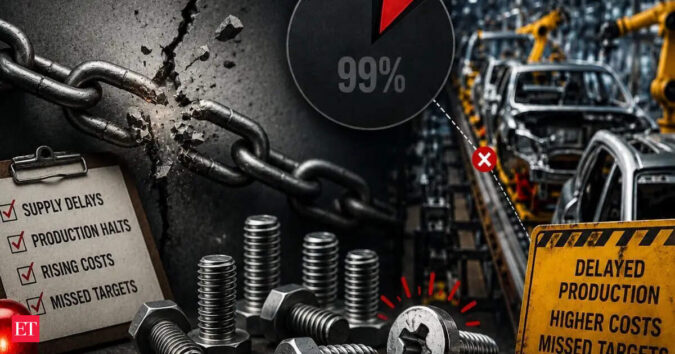
“Fasteners form under 1% of costs — but their absence can halt entire production lines,” the report notes, underlining how even small regulatory frictions in this segment can cascade into large-scale industrial disruptions.
A policy that doesn’t fit the product
Fasteners — bolts, nuts, screws, washers, rivets, and studs — are produced in thousands of variants, often in small batches on the same machine. A single production line may switch between multiple sizes, grades, and coatings depending on demand.
But the current QCO framework imposes a rigid “one-product-one-licence” system, requiring separate approvals for each variant. The report flags this as fundamentally misaligned with industry realities, noting that one machine can produce dozens of variants, while a single product may require multiple licences under different standards.
This creates duplication, delays, and uncertainty, making the idea of “one standard, one licence” impractical in a high-variation industry.
Costs up, supply down
Mandatory certification from the Bureau of Indian Standards (BIS) is adding to the strain. The report details the scale of the burden: ₹80,000 to ₹1 lakh per licence, ₹22,000 to ₹25,000 per variant test, and ₹30 lakh to ₹40 lakh to set up in-house lab facilities.
Also Read: Govt bans screw imports priced less than Rs 129 per kg
For MSMEs, which dominate the sector, these costs can exceed profit levels, effectively forcing firms to scale back operations or exit certain product lines. At the same time, many foreign suppliers have withdrawn from the Indian market due to certification hurdles, shrinking the supplier base.
“Costly BIS certification is driving out suppliers and pushing up prices for critical inputs,” the report says. With fewer certified players, prices have risen while availability — particularly for specialised or low-volume fasteners — has tightened.
Early signs of disruption
Shortages are already emerging in niche segments, especially for specialised fasteners that are not produced at scale domestically. The report highlights that certain categories, such as quality cross recessed screws used in drywall and chipboard applications, are currently not available in India, leaving firms without viable sourcing options.
The impact is disproportionately large. Fasteners are used across nearly every sector — automobiles, construction, machinery, electronics, railways, aerospace, and infrastructure — meaning even a small disruption can ripple across supply chains. A missing fastener can stall an assembly line, delay a project, or halt production altogether.
Compounding the problem are port-level delays linked to HS code confusion, which are adding to transaction costs and uncertainty for importers.
Not import dependence, but capability gaps
The report also pushes back against the idea that imports signal dependence. India exports $882.3 million worth of fasteners to major markets including the U.S. (29.8%), Netherlands (9.4%), UAE (9.3%), and Germany (8.5), supplying standard and mid-grade products at scale.
At the same time, it imports $1.13 billion worth of fasteners — largely high-precision, specialised, or technology-intensive components — from China (24.6%), Japan (13.3%), South Korea (9.9%), and Germany (9.8). These are typically used in advanced manufacturing segments such as electronics and high-end machinery.
This pattern, the report argues, reflects capability-based specialisation: India exports what it produces efficiently and imports what it does not yet produce competitively.
The bigger risk to manufacturing
The GTRI report argues that QCOs are unnecessary for many applications, noting that sectors such as railways, defence, and power already follow strict quality checks, while existing duties and standards address substandard imports.
Instead, the current framework risks reintroducing licence-style controls in a sector that depends on flexibility and speed. Delays from certification bottlenecks, reduced supplier diversity, and trade friction could ripple across manufacturing supply chains, raising overall costs and weakening competitiveness.
“Free and frictionless fastener trade is critical to keep manufacturing supply chains running,” it states.
The recommendation is clear: withdraw the current QCOs and replace them with a simple, risk-based system focused on critical safety items, while allowing easier compliance for standard products.
At stake, the report suggests, is not just one industry, but the efficiency of India’s broader manufacturing ecosystem — where a “1% input” has the potential to derail the other 99%.