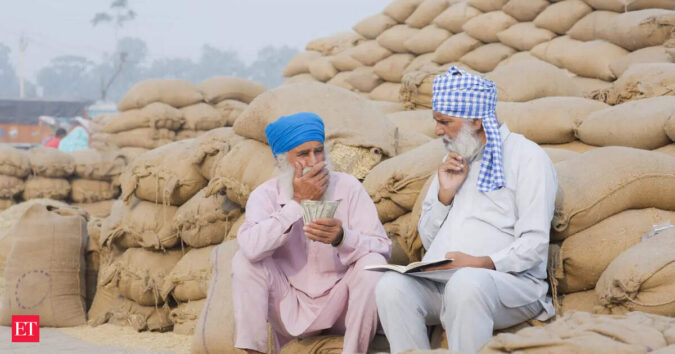
India, the second-largest producer of wheat, has witnessed bumper harvests for the past few years. In 2025-26, the government expects wheat output of 110-120 million tonnes even after unseasonal rains and hailstorms hit key states. Earlier, the agriculture ministry had pegged production at 120.21 million tonnes, up from 117.94 million tonnes last year.
With opening stocks estimated at 22 MT for 2026-27 and a higher procurement target, total availability could reach just over 56 MT, traders said. This far exceeds the annual PDS requirement of 18-20 MT. As a result, closing stocks by the end of the next season could swell to 30-35 MT, well above the buffer norm of about 7.5 MT.
These are all India estimates. The data for the year 2025-26 is of 2nd Advance Estimates.
Wheat procurement in India runs from April to March, with most purchases typically happening in the initial months. The Food Corporation of India (FCI), along with state agencies, dominates procurement in the country, lifting around 30% of total wheat production.
As per government data, FCI holds a storage capacity of 48.69 MT and state agencies have 46.53 MT, totalling 95.22 MT as of April 1, 2026. Currently, the central pool has a stock of 60.40 MT (both rice and wheat), while 49.99 MT of unmilled paddy with states is being converted into rice for central storage.

“This leaves just 34.82 MT of space for new wheat procurement (target 34.53 MT) and incoming milled rice (33.50 MT). With limited storage headroom, wheat prices are unlikely to rise significantly after procurement ends,” explains Navneet Chitlangia, President of the Roller Flour Millers’ Federation of India (RFMFI).
With exports remaining largely uncompetitive globally, industry players say procurement could be constrained by limited storage capacity and the absence of a clear disposal plan. They believe that this could create a potential pressure point. Surplus stocks will need to be offloaded soon, likely via the open market sale scheme (OMSS), with sales expected to begin around July, earlier than the usual Diwali timeline, they note.“The core constraint is storage. With already high stocks, agencies like FCI have limited space, restricting further lifting despite availability. A large portion of existing stocks already exceeds the immediate requirements for the Public Distribution System (PDS), leaving a surplus without a clear outlet,” says Rahul Chauhan, Director of iGrain India, an agri-commodity research firm.
Due to unseasonal rains, wheat arrivals at mandis were delayed this season, slowing procurement. In the first half of April, FCI and state agencies procured 1.53 MT, which was sharply lower than the 5 MT recorded a year ago, as per data. Else, the situation could have been worse.
Vikas Singhal, Owner of Shree Ganesh Roller Flour Mills, Lucknow, says that after meeting PDS requirements, buffer norms, and allocations, including about 19 MT for welfare schemes, the government could be left with a surplus of nearly 30 MT. With limited storage, this creates a clear pressure point, likely forcing excess stock into the market via the OMSS.
“Given the scale of surplus, the government may have little choice but to release wheat at competitive, possibly discounted, prices to clear stocks. Even if procurement falls short of target, surplus levels will remain substantial, forcing market intervention. In effect, stock liquidation through OMSS is not optional but inevitable,” adds Singhal.
Like Chitlangia, Singhal expects only a modest uptick in wheat prices. “A sharp rise is unlikely,” Singhal says.
Trade sentiment remains cautious
Stakeholders say the overall trade sentiment remains cautious, as last year’s heavy losses have made processors, stockists, and traders reluctant to build inventories at current higher prices.
Wheat is harvested in a short two-month window, mainly in April, while consumption spans the year, creating carrying costs, such as interest and storage. Without visibility on recovering these costs, processors, traders, and stockists are reluctant to hold inventory at higher prices, keeping trade sentiment cautious, says Chitlangia.
“There is widespread uncertainty, especially given the large government stockpile. A significant portion of this stock is of lower quality, procured under relaxed norms due to unseasonal rains, leading to discolouration and higher moisture content. Reduced shelf life makes long-term storage riskier, discouraging private participation and keeping buyers cautious. At similar prices, buyers will always prefer better quality or lower-risk options, reinforcing the market’s cautious stance,” explains Chitlangia.
 iStock
Wheat is harvested in a short two-month window, mainly in April, while consumption spans the year, creating carrying costs, such as interest and storage.
Notably, following the procurement hike, state-wise wheat buying is now projected at 10 MT for Madhya Pradesh (compared to 7.8 MT last year), 2.5 MT for Uttar Pradesh (compared to 1 MT last year), 2.35 MT for Rajasthan (compared to 2 MT last year), and 5,000 tonnes for Uttarakhand (compared to 1,000 tonnes last year), with Delhi also contributing after a three-year gap. This lifts total procurement to 34.5 MT from 30 MT. Quality norms have been relaxed across key states—Punjab, Haryana, MP, and Rajasthan—to facilitate higher purchases from farmers.
The government has set the minimum support price (MSP) for wheat at Rs 2,585 per quintal for the 2026-27 Rabi marketing season, up Rs 160 from Rs 2,425 last year. The wheat price at mandi is hovering around Rs 2,300-2,400 per quintal.
Chitlangia informs that the wheat procurement is nearing the government’s target, with some states stepping up volumes. In Madhya Pradesh, early storage and packaging delays have eased, accelerating buying with priority to small and marginal farmers. He expects strong procurement by end-June, adding that storage bottlenecks lie largely with the government, not private trade.
A commodity analyst, requesting anonymity, says the industry is fragmented, with multiple federations and state bodies shaping outcomes. Surplus producers like UP, Punjab, Haryana, and Madhya Pradesh favour exports to support prices, while consumption-driven states, such as Karnataka, Maharashtra, and Tamil Nadu, prefer lower prices. High import duties (around 40%) further restrict inflows, adding to the competing domestic pressures that influence policy. For instance, recent OMSS allocations saw demand largely concentrated in Punjab, with limited participation elsewhere.
Procurement also varies by region, he adds, as in Punjab and Haryana, FCI purchases are routed through agencies that handle farmer payments. However, he notes that gunny bag shortages and logistical delays cause physical lifting to lag behind paperwork, resulting in a gap between recorded procurement and actual stock movement.
Structural bottlenecks remain
Singhal echoes that structural bottlenecks remain, including gunny bag shortages, limited storage capacity, and already elevated government stocks. “Weak past offtake under the OMSS, due to government prices being above market levels, led to stock build-up, while tight storage capacity and near-full godowns are now keeping prices firm to shift supply to private trade and ease the government’s procurement burden,” says Singhal.
“Earlier market prices of Rs 2,250-2,300 were seen as too low, prompting stockists and millers to expect a rebound. Slow procurement in early April led traders to gradually lift prices, turning sentiment bullish and drawing farmers into the market. The recent Rs 200 per quintal rise is a correction to fair levels, with a possible Rs 50-60 pullback but limited further upside. Farmers have benefited from the swift price gains and often prefer open-market sales due to fewer procedural hurdles,” adds Singhal.
Chauhan says wheat availability is ample in Punjab and Haryana, and procurement targets are likely to be met. However, unseasonal rain delayed stockists and millers by nearly two weeks, briefly tightening supplies and triggering a sharp Rs 100-130 per quintal spike, further supported by relaxed procurement norms.
“In Uttar Pradesh, old stocks have largely cleared, though quality is mixed, with some damage in the west (5-10%) and stable crops in the east. Madhya Pradesh wheat is of better quality, but procurement remains slow despite MSP incentives due to gunny bag shortages and limited government lifting, a situation also seen in Rajasthan,” adds Chauhan.
iStockOn April 1, 2026, the government carried 21.8 MT of wheat while the buffer norm is only 7.46 MT .
Mudit Goyal, MD of Megastar Foods, says the moves aim to support prices and ensure MSP parity, with a focus on domestic stability, not a broader policy shift, as prices in key states fell to nearly Rs 2,200 per quintal, below MSP even after bonuses in Rajasthan and Madhya Pradesh.
“Over the longer term, prices will hinge on supply and demand, currently distorted; policy may sway sentiment, but global factors won’t shift easily. Procurement is on track in Punjab and Haryana, while Rajasthan lags due to logistics and market factors, about 40% from gunny bag shortages and 60% from aggressive private buying at better prices. Punjab faces minor bag issues, but strong infrastructure should keep procurement firm,” adds Goyal.
“In the north (Punjab, Madhya Pradesh, and Haryana), there’s a push for firmer prices and sentiment; historically, wheat prices have been driven more by sentiment than stocks. The apparent north–south divide isn’t real: southern buyers stocked up in January-March and are now drawing down inventories after a price cooling. As they re-enter, demand should lift prices in MP and Rajasthan. In bonus states, procurement is lower as private buyers are offering competitive rates and diverting supply from government channels,” says Goyal.
Overall, procurement is seen at nearly 25-26 MT with about 21 MT in stocks, indicating comfortable supply and a broadly positive wheat outlook, says Goyal.
An email sent to the office of Food Supplies Secretary Sanjeev Chopra remained unanswered at the time of publication.
Export quota hike: Won’t help much
The government earlier cleared an additional 2.5 MT of wheat for exports, taking the season’s quota to 5 MT, plus 1 MT of wheat products in phases to support prices and offload surplus stocks. However, stakeholders see this largely as a sentiment boost, with Indian wheat still costing $20-40 per tonne more than key global origins. Shipments remain slow due to weak price parity, they add.
Former Union Agriculture Secretary Siraj Hussain calls it a good decision. “The Government would like this to enable it to avoid excessive procurement at MSP. But the global prices are depressed, and Indian exporters may not find it easy to export. Russian and Argentine wheat is available at $210-230 per tonne. But Indian wheat purchased at MSP cannot be exported at less than $310 per tonne.”
On April 1, 2026, the government carried 21.8 MT of wheat while the buffer norm is only 7.46 MT and the government wouldn’t like to procure much more than its estimate of 30 MT, he adds.
“With strong production and ample availability, the government’s approach is to open a limited export window and let the market test viability. If exports are feasible at current prices, the trade will move; if not, it will naturally fade, revealing that Indian wheat is not globally competitive. This is essentially a calibrated move: permission has been granted, but execution depends on industry response, pricing, and quality,” says Chauhan.
Black Sea wheat is at $230-235 FOB and Australian at $250-255, while Indian wheat has climbed to nearly $290 FOB after a Rs 150 per quintal rise, and adding $30-50 freight widens the gap further, say stakeholders.
“For key buyers like Bangladesh, the landed cost from other origins is roughly $275, whereas Indian wheat becomes significantly costlier, putting exports out of parity. The core reason is MSP, while it ensures better returns for farmers, it keeps domestic prices elevated compared to global markets where prices are purely demand-supply driven,” notes Chitlangia.
“As a result, large-scale exports are not viable, and even government-to-government deals are constrained. The current export decision is therefore largely sentiment-driven, aimed at improving farmer price realisation rather than actual export volumes. This year, even if Indian wheat aligns with global prices, it still loses out on quality. That means exports would require further price discounts to stay competitive. Otherwise, demand will only emerge in case of a global shortage, something not evident right now. At current price levels, meaningful exports are unlikely despite the government’s intent,” explains Chitlangia.
Exports will be viable only when domestic and global prices converge, experts say. Until then, trends will be driven by global factors, such as El Niño, and domestic price movements. They say India may struggle to secure new buyers due to uncompetitive wheat quality. Export moves are largely a “market test,” signalling surplus while tracking El Niño risks.