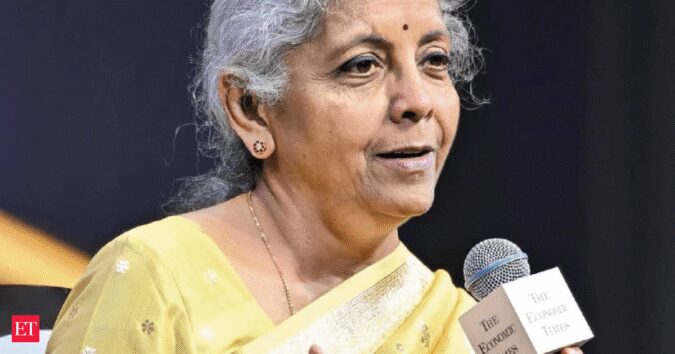
Addressing industry leaders at the ET Awards, the FM promised corrective steps for any hindrances faced by businesses in capacity addition while highlighting that the country’s large import reliance offers scope for companies to boost manufacturing and reduce imports. She also said that the government is in touch with the Trump administration and US AI company Anthropic on risks associated with the latter’s Claude Mythos, an advanced AI model which has raised cybersecurity threats, in a bid to resolve the issue. Edited excerpts:
You are now India’s longest continuously serving finance minister. Could you look back at this time and give us a sense of what this journey has been like?
I’m not sure if I’ll be able to summarise the journey. I don’t look at it like that. I’m all right carrying on with my assignment. But the last few years have been very challenging, not just for the finance ministry but in general, and I’m sure industry leaders will also have this feeling that never before has there been a stretch of, let’s say, six-seven years where each year poses a different challenge. That’s been my experience as well.
During your tenure, you’ve handled many crises. Would you look at the West Asia crisis and say this is a little different? And what is the source of resilience that India has to navigate this?
I don’t see it as something which is very different. Uncertainty marked the Covid outbreak, the Russia-Ukraine war, the Israel-Iran conflict, and now the Strait of Hormuz issue. There has been uncertainty, unpredictability, and challenge for critical inputs, including fertiliser and fuel, that India and its economy need. So, it just seemed to be an unending, relentless challenge for these particular commodities, which are so critical for any country, particularly for India, because we import most of our requirements of crude oil and related products. But the blessing that we have is that we have the refining capacity, and what little we get, we use for our country and are also able to export.
As for the second part of your question, I think our domestic consumption is what is giving us that shock-absorbing capacity. So as long as we are not going to fail in keeping our consumption boosted and wellsupported, we can be sure to weather the storm. So, I think that is the biggest support that we have for our economy.
Crude oil has been testing the $100 per barrel mark. How do you assess the trade-offs in terms of protecting growth, managing inflation, and maintaining external stability?
There are no trade-offs. You’ll have to just work on all three simultaneously. An eternal vigil, keeping ourselves alert to the changes (is the way forward), like the latest cyber challenge that we have because of Mythos. We have spent some time in the ministry, with the banks, with government cyber agencies. Suddenly, (Anthropic’s) Claude Mythos AI model seems to have taken such a dimension that no one is aware of what exactly this animal is, and how exactly it is going to play out. Now, would you have imagined a few days or weeks ago that there is this new threat which is as big as the war threat, and which is going to hit our entire digital network? That has brought about a great change for India, and it’s a fantastic force multiplier. But now, this (new AI model) isn’t like any other cyber threat, but a totally different thing which we are yet to grapple with. So, I think it is just a world where things are changing rapidly. We just have to remain eternally vigilant.
ET has reported Nasscom has written to Anthropic, saying Indian companies should get access. Anthropic has given access to only 40 firms globally. Now, on a key matter like this, which really could undermine cybersecurity, we are somehow at the mercy of a private entity in another country. How do we tackle this?
First, I want to give you a reassuring word on that. The Ministry of Electronics and Information Technology (MeiTY) is fully seized of the challenge. And they are engaging with the US administration and with Anthropic. The ministry is also in touch with those few agencies or vendors that have been given the chance to test what this whole thing is all about.In fact, electronics and IT minister Ashwini Vaishnaw was sitting with me when I interacted with banks to alert them and get them together to see if we already have ways in which, using AI, we are able to respond to the challenge coming through Mythos.
India has historically been very good at fast-tracking reforms in the face of external shocks. Right now, there is an external shock. Do you see this as a good opportunity to push through enough structural reforms that are on your radar?
Every challenge is an opportunity. There’s no doubt. We will carry on with reforms. Not just the finance ministry but every ministry is working on how best to ease the compliance burden, the regulatory stiffness. So, work is happening on that, and you’ll gradually see a lot more things happening.
Any tactical measures or relaxations for industry that you’re planning in the wake of the disruptions caused by the West Asia war?
I don’t know what tactical means here, but just when we had the additional US tariff, we came up with a package to help those who were exposed to the US market. Similarly, in December last year, we came up with a package again for people who are affected. I think it was discussed or even announced that we would give support similar to what was given during the pandemic, such as the emergency liquidity credit guarantee scheme, or something of that order, for most of the units that have been affected because of supply disruptions, price rise, or insurance risk. So, all this is being kept in mind, and things are being worked out.
The recent weeks and months have really reinforced the view that energy is not just about prices but also about access. What should India do to ensure its energy security?
India has been very clear that its priorityis its citizens. The government kept strategic reserves full and ready when global oil prices had crashed. And when prices went up, it extended support to oil marketing companies in bringing crude into the country and then refining and redistributing it. So, we have been very clear that what suits Indian interest will be the top of our priority—source oil from wherever it is cheap and whoever can supply the required volumes on time. So, irrespective of what anyone would say, I think the government has kept the country’s interest on top.
Should I then read that as a guidance about what could happen with regard to, say, fertiliser subsidies? Are we saying that we will prioritise fertiliser supply and fulfil all subsidy obligations, even if it is at the cost of the fiscal glide path to which you have so assiduously stuck to?
I’ll answer that by saying, didn’t we do that during Covid, when fertiliser prices abroad hit through the roof? We still bought them at that price and made sure that supply disruptions didn’t happen. And above all, the additional fertiliser costs don’t get transmitted to the farmers. The farmers kept paying the same price. We never pushed forward with putting that burden on the farmers. Farmers paid the same price as before.
We’ve been seeing sustained foreign portfolio investment (FPI) outflows for the past several years now. More recently, we are also seeing some weakness in foreign direct investment (FDI) numbers. Now, is this part of a cyclical global trend, or are there domestic factors we need to address to improve the situation?
Every factor—profit booking by investors, global uncertainty, the rupee-dollar exchange rate—will hold good when somebody wants to go out. Despite the fact that your macroeconomic fundamentals remain absolutely sound, the funds are going out, the investment monies are going out. There are more than just the commercial or money market principles which govern capital flows. You tend to think that if your macroeconomic fundamentals are fine, money will flow. No, it doesn’t. There are other considerations as well. And we can always flag ourselves or flog ourselves and say, more reforms are required.
We are ready. The Prime Minister is always keen to say, ‘Go ahead with reforms, we need to make it easier for people to come and invest and operate and manufacturers; MSMEs should be able to function more easily’. We are not against reforms. But is it just that, or are there strategic considerations for big private equity operators or big fund managers to consider India? This country needs an open conversation on this. It can’t always be “you have to do this; you have to do that”. Yes, we are ready to do all that. And under this prime minister, there is never a shut door when it comes to reforms. But please, look at what is happening. Tell us, is it our fundamentals which are worrying? Is it our inflation which has been kept completely under control for the last one-and-a-half years? Yes, the exchange rate could be a consideration.
Another consideration that market participants often point out is the dual incidence of having capital gains tax as well as securities transaction tax (STT). At this stage, is this something the finance ministry is reviewing or is there a case to review it?
Again, this is a question which has been asked since the time I’ve come into this ministry. Again, I’m looking at ways in which I can answer without irritating anybody who thinks I’m not catering to their requirements. I’m still saying in 2023-24, India saw the highest investments into the country. Even then, we had the tax on capital gains and the STT.
Yes, there was a time when everybody said, ‘It was a promise given some time ago that the STT, the tax, would be removed. I understand the logic. But that’s a question which was being asked even in 2023-24 when you had investments coming into this country. So, I’m neither saying yes nor am I saying no.
Two data points that are held in criticism of the Indian private sector. One, our expenses on R&D are low compared with many other countries. Second, private investment has not quite picked up. With so many captains of industry here, anything you would like to say in this regard?
First, if there is something which is worrying the industry, we’d love to hear it, because in response to what we had heard in 2019, we cut the corporate tax rates. Anything that has to be done for the ease of doing business, we are certainly willing to hear. Any other difficulty that stops the Indian industry from expansion or capacity building or investing in newer technologies, AI, we are willing to hear that. Your production formula itself is going through a change. So, we’ll be open to hearing anything of this sort and responding.
Second, the domestic market still needs a lot of things for itself to be manufactured here in India. Everything that is imported also gives an opportunity to businesses to manufacture it within the country, whether these are finished or intermediate goods.
If PM Modi is talking about Atmanirbhar Bharat, it is with the hope that Indian industry would start manufacturing those goods that we no longer need to import.
So, please be in conversation with the government and tell us what you need; tell us what you want us to do so that you feel incentivised to further invest and grow.
Equally, wouldn’t you want to look at the opportunities that exist within India and manufacture products instead of importing them? So, some more agility is my expectation from Indian industry.
About the stake sale in IDBI Bank, is there a recalibration of the process? Is there an overall rethink in terms of our disinvestment strategy?
IDBI will go through the formal process. I think the explanation was given on why it couldn’t go through the last time—the valuation issue. So, no, there is no halting the IDBI Bank strategic sale. It’ll happen.
What do you make of the high voter turnout in the West Bengal and Tamil Nadu assembly polls?
You know, the normal psephological analysis would say when there is a strong anti-incumbency, that’s when there is a voter turnout of this kind. I guess, therefore, there will be a change in West Bengal and Tamil Nadu, going by this.
And what is it about your party that so many opposition leaders seem to want to leave their parties for and join yours? What is the formula?
The formula is you run a responsive government, be a party which touches all sections of the country and be absolutely fair in dealing with every section of society. Therefore, people get attracted. And we have Prime Minister Modi’s leadership, which has made him stay in public office for more than 25 years, either as chief minister or as prime minister. He is one leader who has continuously held that kind of position without question on his integrity. His governance capability appeals to people, so they come.