
Companies use the confidential filing route to submit their IPO documents to the Securities and Exchange Board of India (Sebi) without immediately disclosing financials and other business information to the public. New-age startups such as Swiggy, Groww, Meesho and Zepto, among others, have used this method in the recent past.
The move comes at a time when PhonePe, the Walmart-backed payments company, paused its IPO plans last month, citing geopolitical tensions stemming from the West Asia conflict. ET reported the company’s decision was also because the $7 billion valuation offered by public market investors was more than 50% below its on-paper valuation.
 ETtech
Concerns over growth sustainability and the road to profitability could weigh on the IPO’s pricing for Razorpay, said people aware of the matter. Public market investors in India have grown increasingly selective, favouring companies with clear profitability timelines or clocking big growth numbers.
“With a number of new-age companies now listed, investors in the public markets are pricing startups more conservatively as the performance of a bunch of them hasn’t been great,” said a person in the know. “But if you show exceptional growth while being loss-making, there is appetite for those assets at a particular price.”
Razorpay did not respond to ET’s queries.
The company’s IPO preparations have been underway for some time. Razorpay completed its reverse flip to India in May 2025, shifting its domicile from the US, a move that cost it about $150 million in taxes. It also received board approval to convert itself into a public limited company, a key regulatory precondition for listing.
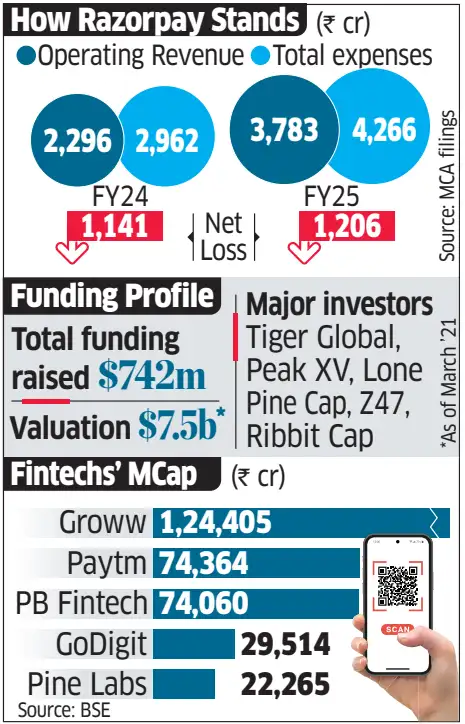
On the financial front, Razorpay reported a 65% year-on-year jump in consolidated operating revenue to Rs 3,783 crore in FY25 from Rs 2,296 crore in the year prior. The Bengaluru- headquartered fintech, founded by Harshil Mathur and Shashank Kumar in 2014, posted a net loss of Rs 1,209 crore during the year, weighed down by Esop expenses and costs related to its domicile transition.
The payments firm competes with the likes of listed entities like PayU, Paytm and Cashfree.
Payment slowdown
Razorpay is authorised as a payment aggregator by the Reserve Bank of India and offers online, offline, and cross-border payments. The company, which primarily works with small and mid-size merchants, also entered the consumer payments space by acquiring a majority stake in Pop last year.
However, the overall slowdown in the direct-to-consumer segment has impacted companies like Razorpay, which is one of the preferred payment service providers for new-age ecommerce companies. Razorpay is currently processing around $180 billion in total payments value, as per the company’s disclosures. In 2023, the company had reported processing $150 billion in total payment value and a year earlier the amount was $100 billion.
“Growth across the digital payments industry has slowed down, which has impacted Razorpay as well,” said an investment banker. “There will be a higher degree of scrutiny on the company’s valuation ask and future profitability projections.”
Top line growth was driven by its payment gateway, point-of-sale (POS) offerings, loyalty programmes, business banking platform RazorpayX and international operations, the company said in a recent statement.