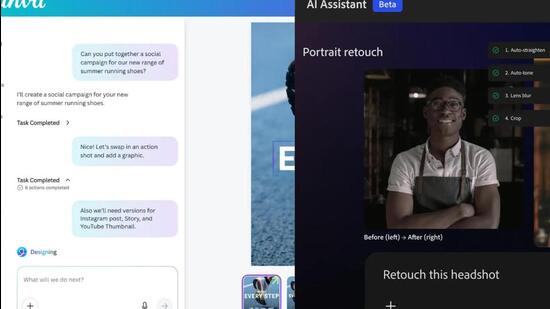
An orchestra, where everything works seamlessly. Melanie Perkins, co-founder and CEO of Canva credits one of the company’s engineers for curating this analogy to describe a new direction the 13-year old platform is taking. Focus is now on artificial intelligence (AI) agents, which will take guidance from humans, to execute complex tasks. Adobe too, earlier today, announced a new creative agent across their platforms.
Agentic AI is on the agenda for tech companies, though each is approaching the conversation differently. Creative platforms are visualising AI as a collaborative element in designing, a subtle change from a theme repeatedly set by AI companies including OpenAI, Nvidia and Anthropic, which centers around replacing humans in creative workflows.
Perkins is confident the combination of Agentic Orchestration, Conversational Design and Object-based Intelligence in Canva AI 2.0 announced today at the Canva Create keynote, will become a “true creative partner” and “with tools to turn ideas into complete outcomes”. A conversational prompt can generate not just multiple elements or types of content, but also help with edits.
The foundations for this agentic AI integration began in a phased manner last year, with the release of Canva Code, followed by a Creative OS that refined AI across Docs, Photo Editor, and Video editing. Canva hopes new agentic tools will give them a better foothold with business and team workflows.
It is not only competing with Adobe’s Creative suite, but a much wider canvas including Apple’s Creator Studio bundle as well as work platforms. Acquisitions of Australian AI companies Simtheory and Ortto this month, add substance to a sharpened agentic workspace focus. The keynote comes on the back of strong momentum, with 265 million monthly active users of which 31 million are paid subscribers, and $4 billion in annualised revenue.
Adobe’s new Firefly AI Assistant can orchestrate and execute complex, multi-step workflows across Firefly, Photoshop, Premiere, Lightroom, Express, and Illustrator. David Wadhwani, President, Creativity & Productivity Business at Adobe, says this is a “new era of agentic creativity, where you direct how your work takes shape and your perspective, voice and taste become the most powerful creative instruments of all”.
The company says the Firefly AI Assistant will be available in public beta in the coming weeks.
American venture capital firm Andreessen Horowitz (a16z) notes that Canva sits behind only OpenAI’s ChatGPT and Google’s Gemini in global AI usage hierarchy, and ahead of Deepseek, Grok and Claude. Also, a16z and market researchers YipitData note that Canva registered a 101% uptick annually in customer spends, ahead of Replit (78%), Vercel (72%), Hubspot (63%), Box (60%) and Figma (47%).
Adobe is leveraging a Foundry architecture, giving companies freedom to train Adobe’s Firefly models with their guidelines and data, in a commercially safe structure. Nvidia’s Agent Toolkit tests complex workflow loops, including if an AI agent can iterate on a design to match defined aesthetic guidelines.
“These aren’t the chatbots of the past offering generic suggestions. Our AI assistants carry context across tasks, understand your creative intent, anticipate your needs, and learn from what you choose to share, adapting to your style and getting better over time,” explains Ely Greenfield, Chief Technology Officer and SVP of Adobe’s Creative Products.
Collaborative design tool Figma has introduced an Anima agent, often called “God Mode”, which can automate UI designs, and also convert ready designs into production-ready code.
Frugal models, and right connectors
“We have a saying now that Canva is more AI, less UI,” notes Cliff Obrecht, co-founder and Chief Operations Officer at Canva. This summarises a more profound and visible industrywide shift to agentic AI.
Connectors with popular apps, are proving key. Canva, for instance, can link with Google Workspace apps as well as Slack, ChatGPT, Claude, and Notion. Adobe too has connectors, including with ChatGPT, Dropbox and Slack, to name a few. Adobe’s Greenfield notes AI agents “act like capable teammates”.
Versatile “small” models, also less costly to use compared to frontier models, make it viable for enterprises to run agents on longer or continuous tasks. They can be trained for specific tasks. Obrecht explains their models run between five to thirty times cheaper than competition frontier models. “That allow us to power a lot of our workplace for free users too,” he says.
Investments in an AI frontier lab, resulted in frugal Canva Proteus, Canva Lucid Origin, and Canva I2V models. Overall frugality means agents run locally on tablets or laptops, ticking off offline usage and privacy aspects.
Anthropic’s Claude Managed Agents, released this month, allows platforms to build autonomous agents that can “operate autonomously for hours, with progress and outputs that persist even through disconnections.” This could make agents relevant for complex workflows, which take time, precision, and often require redos.
Google is investing in a foundational infrastructure, called Agent2Agent (A2A) Protocol. A2A allows Google’s Gemini agents to “talk” to agents from other platforms. In a creative context, a team’s Adobe Firefly agent could theoretically send an asset built to specific guidelines to a Gemini agent, for inclusion in a corporate presentation.