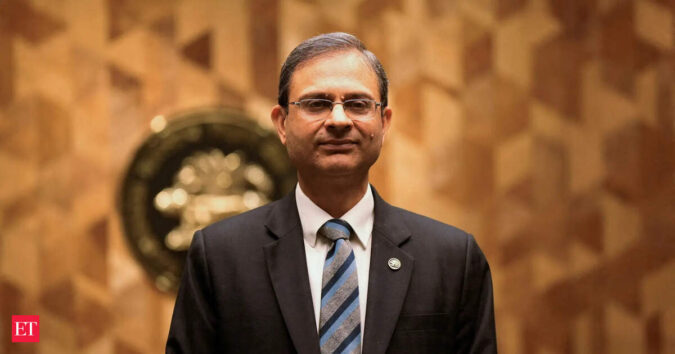
Governor Sanjay Malhotra said the conflict could have an impact on the domestic economy due to higher oil prices, rising agriculture inflation due to higher input costs, weakening remittance inflows and effect on consumption, investment and economic activity due to global liquidity seeking safe havens across the world.
“Overall, the initial supply shock can potentially transform into a demand shock over the medium term if the restoration of supply chains is delayed,” Malhotra said in his statement.
The monetary policy committee (MPC) voted unanimously to keep the policy repo rate unchanged at 5.25% and continue with the neutral stance. “The outbreak of the conflict in West Asia has led to severe disruption of global supply chains. This poses an unprecedented challenge for the global economy – higher prices and lower global growth. In this environment, monetary policy faces a difficult trade-off – anchoring inflation expectations through policy tightening while minimising its impact on the growth forgone,” the monetary policy committee said in its statement.
The MPC said that the upside risks to the inflation outlook have increased because of energy price pressures and probable weather disturbances affecting food prices. Supply chain dislocations and the risk of second round effects render the future inflation trajectory uncertain.
“Growth impulses continue to be supported by robust private consumption and investment demand. However, the West Asia conflict will adversely impact growth. Higher input costs associated with increase in energy prices and international freight and insurance costs along with supply-chain disruptions could constrain availability of key inputs for downstream sectors, thus impairing growth,” the MPC said.
Malhotra said that the recent spikes in energy prices due to the West Asia conflict have emerged as a risk. Though food price outlook remains comfortable in the near term with robust rabi production, adequate reservoir levels and comfortable buffer stocks of food grains the likely emergence of El Niño conditions could pose a risk.The central bank has projected full year inflation for fiscal 2027 to be at 4.6% and now expects consumer inflation to increase to 4.4% in the second quarter of this fiscal from 4.2% earlier. The first quarter inflation has been kept unchanged at 4%. “Excluding precious metals, core inflation is even lower indicating that underlying inflation pressures are expected to remain contained. The risks are on the upside,” Malhotra said.
Malhotra said domestic growth is well anchored with underlying strong momentum in economic activity, supported by robust consumption and investment, amidst supportive policy measures, ongoing structural reforms, and favourable financial conditions while acknowledging that the shocks to availability of commodity inputs due to disruptions in the Strait of Hormuz are likely to impact growth in 2026-27.
The RBI has projected the growth for the current fiscal year to be at 6.9% and reduced the first quarter estimate to 6.8% from 6.9% earlier and second quarter estimate to 6.7% from 7% earlier.
“GDP growth is projected at 6.9% and inflation at 4.6%. This virtually indicates few chances of any further rate cuts as RBI has flagged El Nino as a risk to inflation too. The view on economic prospects is balanced and indicates resilience to a large extent,” said Madan Sabnavis, chief economist at Bank of Baroda.
The 10 year yield was trading at 6.92% and was range bound after opening at 6.94%, the yield however was softer from its previous close of 7.04%. The Indian rupee strengthened 0.53% to 92.51/$ versus its previous close of 92.98/$.
The benchmark BSE Sensex was trading at 77,409.28, up 3.74%, while the broader NSE Nifty 50 index advanced 3.65% to 23,968.55.
As part of the market measures Malhotra said the central bank will permit certain additional categories of non-bank entities to borrow in the call market. RBI will also enhance the borrowing limit of primary dealers in the term money market.
RBI will also remove the condition regarding NPA provisioning for inclusion of quarterly profits in capital adequacy computation. MSMEs will also not be required to do due diligence before joining any TREDS platform.