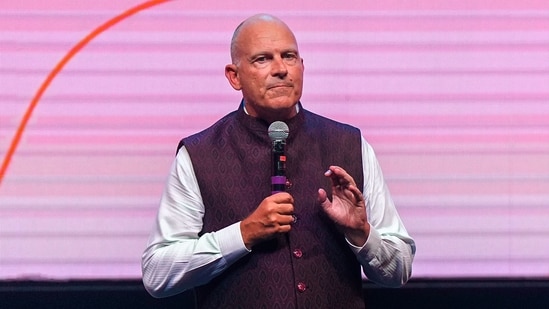
Air India Ltd. has confirmed the resignation of CEO Campbell Wilson, as reported by Hindustan Times earlier today, underscoring the top-level churn among some of India’s biggest airlines.
Wilson, who took the helm following the airline’s privatisation, had signalled his intent to exit as early as 2024, Air India said in a statement on Tuesday. He will remain in his current role until a successor is appointed by a newly constituted board committee.
His contract was originally slated to run through July 2027.
“The time is right for me to hand over the reins for the next phase of Air India’s rise,” Wilson said in the statement on Tuesday. According to him, the storied airline “has reached a point of stability”, with foundational blocks now in place ahead of a massive influx of new hardware.
Air India Chairman Natarajan Chandrasekaran credited Wilson with navigating significant external pressures, ranging from geopolitical tensions to the lingering supply chain disruptions that followed the pandemic.
Leadership Churn
The resignation marks a leadership vacuum for the storied airline, which was acquired by Tata Sons Pvt. Ltd. from the government for ₹18,000 crore in early 2022. Wilson, a veteran of the Singapore Airlines Ltd. ecosystem, was hired from low-cost unit Scoot in May 2022 with a mandate to modernise a fleet and culture long hampered by state control.
During Wilson’s tenure, Air India underwent consolidation, successfully merging four separate airlines—including the integration of Air Asia India into Air India Express and Vistara into the flagship full-service carrier.
Under his leadership, Air India expanded its fleet by 100 aircraft and placed a historic order for nearly 600 more. He modernised the airline’s legacy systems and overhauled the company culture to align with private-sector standards.
But then came one of the deadliest aviation disasters in India’s aviation history.
Air India Plane Crash
The 12 June 2025 crash of an Air India flight from Ahmedabad to London shortly after takeoff triggered a wave of regulatory scrutiny and forced the temporary grounding of several aircraft.
The airline’s international operations have also been squeezed by regional instability. The closure of Pakistani airspace due to cross-border tensions and the ongoing conflict in West Asia have driven up fuel costs and forced longer, less efficient flight paths.
Air India financials
Despite the turmoil, Wilson managed to narrow the carrier’s financial bleeding. Air India reported a 13% rise in standalone revenue to ₹61,080 crore in FY25, narrowing its loss to ₹3,976 crore. However, the airline remains the largest loss-making entity within Tata Group.
Success has been even more elusive at its low-cost subsidiary, Air India Express, where losses more than quadrupled to ₹5,822 crore in the same period.
Global Ambitions
The Tata Group is betting heavily on Air India’s ability to reclaim its status as a world-class global carrier. The group currently employs more than 30,000 people and operates a fleet of over 300 aircraft. Its network now spans 60 domestic and 51 international destinations across five continents.
The departure of Wilson leaves the board with the task of finding a leader capable of managing the massive operational scaling required when the bulk of its 600-strong aircraft orderbook begins arriving next year.
“Campbell and his team have demonstrated tenacity and resolve,” Chairman Chandrasekaran said. “The new Air India is now emerging.”