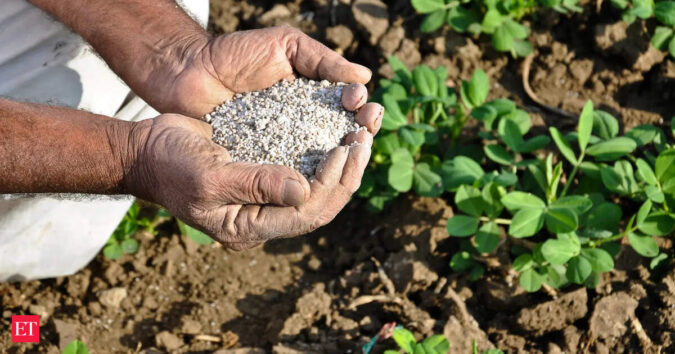
He expressed concern that rising input costs are increasingly undermining farm viability. Urea, officially priced at around Rs 280 per bag, is being sold in the black market at Rs 1,100-1,200 per kg. “I have harvested wheat but could procure only a limited number of [fertiliser and pesticide] bags,” he says.
The price surge extends beyond urea. Since the beginning of the war, diammonium phosphate (DAP) rates have risen sharply from about Rs 1,300 to Rs 2,100-2,200 per bag. Pesticide prices have also increased by up to 25%, pushing per-acre input costs from roughly Rs 3,500 to Rs 5,000-6,000 per kg.
Experts and analysts say rising crude oil prices have further escalated overall costs. They add that if the conflict subsides, demand could pick up from affected and participating countries, particularly those impacted by disruptions in the Strait of Hormuz, potentially supporting trade flows.
India, the world’s second-largest fertiliser consumer after China, relies heavily on imports routed through the Strait of Hormuz, which is currently facing disruptions. Fertiliser industry executives caution that prolonged supply constraints could lead to shortages later in the season, depending on how long the disruptions persist. They also warn that domestic production may be affected and stressed the need for preparedness to manage potential urea shortages ahead of the monsoon.
Taking stock
The Ministry of Agriculture and Farmers Welfare on April 1 said it is closely monitoring the impact of developments in West Asia and has initiated measures to ensure uninterrupted availability of key farm inputs.
Kharif demand is estimated at 390.54 lakh metric tonnes (LMT), with opening stocks of around 180 LMT, about 46% of requirement, significantly higher than the usual 33%. The Centre and states are coordinating to ensure timely distribution, curb hoarding, and prevent diversion, supported by local monitoring committees and state-level best practices.
Pesticide availability remains adequate, with production at 2.61 lakh metric tonnes against an estimated demand of 74,266 metric tonnes, including about 42,000 metric tonnes for the Kharif season.
Packaging costs rise
Rahul Mirchandani, President, Indian Micro-Fertilizers Manufacturers Association (IMMA) and Chairman & MD, Aries Agro, says the fertiliser supply situation is highly strained, with both costs and availability under pressure. The specialty plant nutrition segment relies on imports, such as boron and biostimulants from the US and Turkey, and NPKs and additives from China. He adds that elevated oil and gas prices are impacting both bulk fertiliser production and energy costs of specialty nutrients.
“China has also banned exports to all countries for fertilisers and biostimulants to ensure their domestic demand is met. This means the alternative sources that avoid the Strait of Hormuz are also blocked. Packaging material costs have also risen almost 70% to 80% for plastics and 15% to 20% for paper-based packaging materials,” adds Mirchandani. Petrochemical-linked inputs such as HDPE and PET have seen 30-40% cost increases, driven by crude oil price volatility, say stakeholders.
Considering all of these, the cost escalations are massive, and it is doubtful farmers will be able to afford the entire price increase, say stakeholders. “Companies may, hence, need to cushion part of the inflationary pressure due to these disruptions at the cost of their own bottom lines. Existing stock in transit is also getting affected by war insurance premiums being added to the contracted prices,” says Mirchandani.
‘Outcome hinges on government response’
Ankur Aggarwal, Chairman, CropLife India, and Executive Chairman & Managing Director, Crystal Crop Protection, says the pressure on fertilisers and rice exports is already evident. He adds that the crop protection industry is witnessing a 20-25% rise in input costs due to shipping and supply chain disruptions, which could translate into higher prices for farmers.
“We anticipate that it may lead to a shortage of certain products, impacting yield and quality of produce. The Government of India has been taking proactive steps and has been gathering inputs from all relevant stakeholders, including the crop protection industry. Policymakers are calibrating accordingly to minimise the anticipated impact,” says Aggarwal.
“The rise in input costs for farmers globally is already a concern; it will inevitably feed into food prices, but whether it translates into broader shock is yet to be seen. Much will depend on how governments respond, how farmers adjust sowing decisions, input usage, and crop choices,” adds Aggarwal.
Regarding the adequacy of buffer stocks, Aggarwal says current inventory levels are sufficient to meet near-term demand but could come under pressure in the coming months.
He notes that, as per standard industry practice, manufacturers and importers typically maintain 30-45 days of finished goods inventory and around 30 days of raw material stocks. However, several critical raw materials stored in pressurised tankers or cylinders have a storage capacity of just one to two weeks due to licensing and safety constraints.
Based on current stock positions and distribution across the country, Aggarwal says the demand for the ongoing Zaid season is expected to be largely met. However, the upcoming Kharif season could face challenges depending on specific product categories, with existing inventories likely to support only the initial phase of the cropping cycle.
Rajesh Aggarwal, Managing Director, Insecticides (India) Limited and Vice-Chairman, Crop Care Federation of India, says, “The Israel–Iran conflict has sparked legitimate concerns for India’s agriculture and agrochemical sector, as the Gulf remains pivotal for energy and crude linked raw materials. Even routine disruptions in this corridor could squeeze global availability, spike prices, and strain farm inputs at a critical planting season. Yet, short-term risks appear contained. India holds crude oil and fuel reserves, bolstered by ample refined petroleum stocks, offering a buffer against immediate shocks. If tensions stay limited, trade routes may reroute swiftly be minimising lasting damage. Prolonged escalation for a longer duration, however, could usher in more structural challenges for the sector, with higher freight rates, elevated prices, working capital strains for agri-input firms, and ripple effects on crop economics.”
Abhishek Wadekar, Founder Chairman of Tradelink International, says the short-term impact has been cushioned by adequate buffer stocks and proactive procurement. However, he cautions that the bigger concern is not availability, but volatility in global prices.
The immediate pressure has been managed due to sufficient inventories, but the real threat lies in price fluctuations, notes Wadekar. This could translate into a higher cost of cultivation for Kharif crops, impacting farmer margins and eventually feeding into food inflation.
Against this backdrop, Wadekar emphasises the need to recalibrate India’s fertiliser subsidy framework. “There is a strong rationale for re-aligning the fertiliser subsidy policy, and it must be done in a strategic manner rather than an expansionary one,” he says.
Wadekar outlines three key reforms. He calls for a shift to a price-linked subsidy mechanism aligned with global input costs to protect farmers without significantly increasing the fiscal burden. He also emphasises promoting balanced fertilisation, including NPK and bio-fertilisers, to reduce dependence on imported urea and ammonia. Additionally, he stresses the need to expand domestic production capacity and diversify import sources to mitigate risks arising from geopolitical chokepoints such as the Strait of Hormuz.