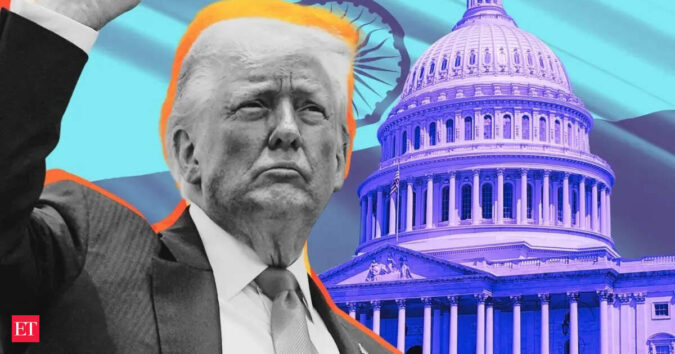
By the time India and the United States announced an interim trade deal on February 2, 2026, it was clear this had not been a straight path.
Also Read: India, US review next steps in trade pact talks
The whole year played out in phases, with legal issues, political decisions, and economic pressure all happening at the same time, often making things more complicated rather than easier.
The opening salvo
The first shock came on April 2, 2025, when Trump imposed a 26% additional tariff on Indian goods, combining a 10% baseline duty with a 16% reciprocal levy. The move was part of a broader attempt to reset global trade relationships in favour of the United States.
For India, the pressure showed up almost immediately. Exports to its biggest market suddenly became less competitive, and industries like textiles, engineering goods, and chemicals had to quickly prepare for the hit.
Even then, New Delhi didn’t rush its response. Instead of giving in quickly, Indian negotiators made it clear from the start that any deal would keep long-term national interests first. Key sectors — agriculture, dairy, and IT services — were placed firmly off the table for hasty compromise.A temporary breather came on April 9, when Donald Trump suspended the additional 16% tariffs for 90 days, bringing India’s effective tariff burden down to 10%. But this was less of a real concession and more of a tactical pause, a window to negotiate, not a final resolution.
Negotiations take shape
By mid-April, diplomacy moved into high gear. US Vice President JD Vance’s visit to New Delhi on April 16 helped formalise the structure of talks. Within days, chief negotiators began engaging across 19 chapters, from tariffs to non-tariff barriers and customs facilitation.
Also Read: US tariffs drag India apparel export growth to modest 1.5%: ICRA
Through May and June, Commerce Minister Piyush Goyal and Commerce Secretary and chief negotiator Rajesh Agrawal led multiple rounds in Washington. Discussions centred on tariff reductions and market access, but differences persisted, especially on agriculture and regulatory barriers.
Even as Trump claimed on June 27 that a “very big” deal was imminent, the July 9 deadline for the tariff pause came and went without agreement.
Then, on July 31, the US once again imposed an overall 25% tariff on Indian goods, effective August 7. This followed the suspension of the earlier 16% reciprocal tariffs in April, and sharply increased the pressure on Indian exporters.
India chose not to rush, and that decision proved consequential.
The low point
August marked the most strained phase. Planned talks were abruptly cancelled, and tariffs on Indian goods surged, in some cases reaching as high as 50%, with that figure including a 25% penalty linked to New Delhi’s “continued purchase of Russian oil.”
India briefly found itself among the most heavily taxed exporters to the US.
The fallout was uneven but visible. According to ICRA data, India’s apparel exports to the US fell by about 6% in dollar terms between April and December 2025, even as overall export growth remained subdued at 1.5%.
Globally, US import volumes contracted by 3–4%, reflecting the broader dampening effect of tariffs.
For Indian exporters, particularly MSMEs, the impact went beyond demand. Margins were squeezed, working capital cycles stretched, and uncertainty became the domoninant business condition.
Yet, India resisted reactive policymaking. Instead, it doubled down on diversification.
Hedging bets
Even as US talks faltered, India accelerated parallel trade strategies.
In July 2025, it signed a free trade agreement, the Comprehensive Economic and Trade Agreement (CETA), with the UK, ensuring near-zero duty access for 99% of Indian exports.
Additionally, negotiations with the European Union under the India–European Union Free Trade Agreement advanced and were concluded on January 27, 2026, with a deal covering 99% of trade nearing completion. Engagements with Gulf nations and Israel slowed due to geopolitical tensions, but the broader message was clear: India would not remain dependent on a single market.
Also Read: India grants temporary customs duty relief for SEZ goods sold domestically
At home, the government and the Reserve Bank of India pushed structural reforms to cushion the external shock.
The RBI also stepped in with targeted liquidity support. It extended export credit timelines to 450 days, giving firms some breathing room as tariffs and supply disruptions delayed payments.
The rollout of “GST 2.0” — simplifying tax slabs into a two-tier structure — aimed to strengthen domestic consumption. According to Finance Minister Nirmala Sitharaman, these reforms were not a reaction to US tariffs, but its timing helped offset weakening export momentum by boosting internal demand.
Just as tariff pressures began to stabilise, a new disruption emerged. Conflict in West Asia, involving the US, Israel and Iran, began to choke key shipping routes.
Freight costs surged, transit times lengthened, and exporters faced delayed consignments. The nature of the shock shifted: from pricing pressure due to tariffs to physical disruption of trade flows.
Recognising this, India introduced additional flexibility. Special Economic Zone (SEZ) units were allowed to sell part of their output domestically at reduced duties, helping firms utilise excess capacity and offset export losses.
Rajiv Chugh, a partner at EY India, speaking to Reuters, noted that the policy aimed to “make surplus capacity utilisation more cost-effective” while reducing dependence on increasingly expensive imports.
Diplomacy resets and the breakthrough
The tone had already begun to shift by September. A direct call from Trump to Prime Minister Narendra Modi signalled renewed political intent to close the deal.
Subsequent visits by US trade officials in September and December helped rebuild momentum. By mid-December, Indian officials indicated that a framework agreement was “very close”.
On February 2, 2026, a breakthrough finally came.
The US agreed to reduce tariffs on Indian goods to 18% from 25%, while scrapping an additional 25% penalty linked to India’s purchases of Russian oil.
In return, India committed to lowering tariffs on a wide range of US goods, and to significantly increase purchases of American energy, technology and other commodities, potentially exceeding $500 billion.
The deal also addressed non-tariff barriers, digital trade rules, and supply chain cooperation, signalling a broader strategic alignment beyond tariffs alone.
Even then, things didn’t fully settle. In February 2026, the Supreme Court of the United States struck down several of Donald Trump’s tariffs, forcing Washington to rethink its approach. New duties — first set at 10% and later raised to 15% — came in their place, adding another layer of complexity to the final negotiations.
“The ‘Liberation Day’ tariffs violated World Trade Organization rules, yet no country opposed them—showing that global trade rules are no longer effective in checking even the most blatant violations. The world should thank the US Supreme Court for stepping in and striking them down,” think tank GTRI founder Ajay Srivastava told ET online.
“The Trump administration used its “Liberation Day” tariffs to extract major concessions from partners such as the European Union, Japan, South Korea and others. But the February 20 ruling by the Supreme Court of the United States striking down reciprocal tariffs has removed the core leverage behind these agreements, removing any incentive for honoring trade deals on earlier terms.”
He added that Malaysia has already stepped back for this reason, and India should take another look at its own position. The US–India joint statement issued on February 6 clearly says that if one side changes tariffs, the other can also revisit its commitments, leaving room for a reset if needed.
India responded by postponing a planned US visit, choosing to reassess the evolving legal landscape before committing to final terms.
What the year revealed
India’s experience through the “year of Trump tariffs” underscores a deeper shift in global trade dynamics.
First, trade conflicts are no longer confined to tariffs. They now intersect with legal rulings, geopolitical crises and supply-chain vulnerabilities, often amplifying each other.
Second, resilience is increasingly built at home. India’s ability to absorb shocks, through GST reforms, central bank support and domestic demand, proved as critical as its negotiating strategy.
Finally, diversification is no longer optional. By advancing deals with the UK and EU while negotiating with the US, India reduced its exposure to unilateral shocks.
The road ahead
Even after the February deal, the story is far from over.
The agreement remains an interim framework, contingent on evolving US tariff structures and ongoing negotiations over a broader bilateral trade agreement. Meanwhile, global uncertainties, from West Asian conflicts to shifting US trade policy, continue to cast a shadow.