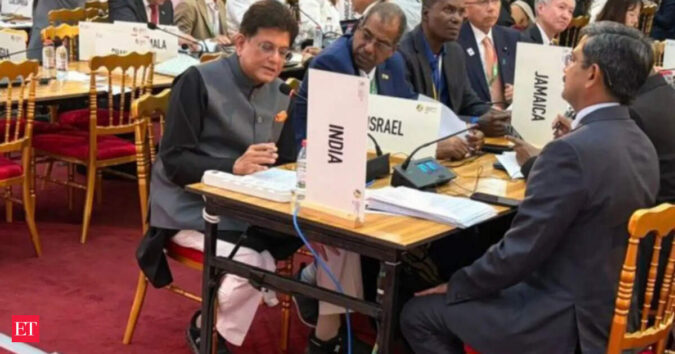
The deadlock in talks, marked by sharp disagreements between major powers and emerging economies, shows that the struggle over rules, markets and sovereignty is now as intense at the negotiating table as it is on any battlefield.
A ministerial that ended in deadlock
The 14th ministerial conference of the World Trade Organization ended without agreement on even its most routine outcomes. The most striking failure was the inability to extend the long-standing moratorium on customs duties on e-commerce, a rule in place since 1998 that had prevented countries from taxing digital transmissions.
Also Read: WTO talks run overtime as Brazil, US clash on ecomm moratorium
For the first time in over two decades, that moratorium has now lapsed, opening the door for tariffs on digital goods such as software downloads and streaming services. This was not merely a technical breakdown but a reflection of deeper disagreements over the future of global trade itself.
Negotiations also failed to produce consensus on WTO reform, intellectual property issues and broader rule-making, underlining how difficult it has become to secure agreement among 160-plus members operating under a consensus-driven system.
The Brazil-US fault line
One of the most visible clashes in Cameroon was between Brazil and the United States. The US pushed for a long or even permanent extension of the e-commerce moratorium, arguing that free digital flows are essential for modern trade. Brazil, backed by several developing countries, resisted, favouring shorter extensions and review mechanisms. At stake is revenue and policy space. Developing economies argue that continuing the moratorium deprives them of the ability to tax a rapidly growing digital economy. For them, this is not just about trade liberalisation but about fiscal sovereignty in a digital age.Also Read: Piyush Goyal defends low fisheries subsidies, seeks fair rules at WTO
The failure to reconcile these positions ultimately derailed the talks. The breakdown reflects another crack in the foundations of the WTO system, for long under pressure.
India’s resistance
If Brazil’s clash with the US defined one axis of the conflict, India’s stance formed another critical front. India resisted pressure, particularly from the US, to agree to a longer extension of the e-commerce moratorium. India’s position is rooted in a broader concern. The digital economy is dominated by a handful of global technology firms, most of them based in developed countries. Agreeing to a permanent or long-term moratorium would effectively lock in a system where developing nations cannot tax digital imports, even as their domestic markets are increasingly penetrated by foreign platforms.
For India, this is also about strategic autonomy. Policymakers fear that premature commitments in digital trade could constrain future regulatory frameworks, including data governance, taxation and industrial policy. In that sense, India’s resistance is less obstructionist than defensive, aimed at preserving room to manoeuvre in an evolving economic landscape.
India versus China-backed investment rules
Another significant flashpoint saw India standing almost alone against a China-backed Investment Facilitation for Development agreement. With over 130 countries supporting the pact, India’s opposition stood out sharply.
India’s concern is procedural as much as substantive. It argues that such plurilateral agreements risk bypassing the WTO’s consensus-based structure and could set precedents for introducing rules without universal approval. This would, in India’s view, weaken the multilateral character of the institution.
The episode also highlights a subtle divergence between India and China. While both often align as developing economies, China has increasingly supported new rule-making initiatives within the WTO framework, whereas India remains wary of commitments that could constrain policy flexibility.
A system under strain
Even as India and China diverged on some issues, the broader US-China rivalry continued to shape the atmosphere of the talks. American and European officials have long argued that existing WTO rules inadequately address Chinese state subsidies and industrial policies. Yet in Cameroon, there were also signs of cautious engagement. Chinese officials showed willingness to strengthen trade cooperation with the US, even as they criticised American trade investigations. This duality, competition mixed with selective cooperation, reflects the current state of global trade politics. The WTO has become a field where strategic rivalry is managed but rarely resolved.
The Cameroon deadlock is not an isolated incident but part of a broader pattern. The WTO has struggled for years with stalled negotiations, disputes over its dispute settlement system and growing unilateralism among major economies.
The failure to extend even a routine moratorium underscores how consensus has become harder to achieve. Economic nationalism, differing development priorities and technological shifts have all combined to strain the system. There is also a structural issue. The WTO’s consensus model, once its strength, now allows a few countries to block outcomes, making progress slow and often elusive.
Why India matters in this moment
India’s role in these negotiations is increasingly central. As one of the largest developing economies, it speaks for a constituency that is sceptical of rapid liberalisation without safeguards. Its positions on digital trade, agriculture and institutional reform reflect a broader push to rebalance the global trading system. At the same time, India’s assertiveness also raises questions about the future of consensus-building. When major players dig in, the system risks paralysis.
Yet from India’s perspective, the stakes justify the stance. In a world where trade rules increasingly intersect with technology, data and development, conceding too early could lock in disadvantages for decades.
The Cameroon talks have shown that the battles are not only fought with weapons but with words, clauses and red lines too. The failure to reach agreement is itself a message that the global trade order is fraught with serious faultlines. As discussions move back to Geneva, the question is whether the WTO can adapt to a world where power is increasingly more dispersed.