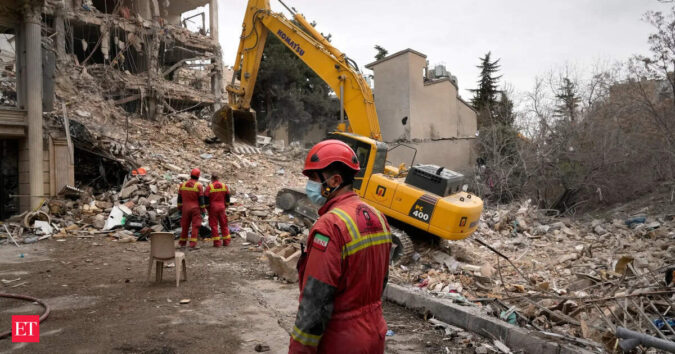
While President Donald Trump’s chaotic tariff campaign took months to filter through supply chains, the spiking prices for oil, gas, aluminum, fertilizers and chemicals since the bombing of Tehran began on Feb. 28 have rapidly been felt by factory managers, farmers and freight carriers.
Now the effects are reaching industries that might’ve seemed insulated from the fallout, or too far away to feel it. And that’s unlikely to be reversed soon even as Trump signaled Monday that a potential cease fire was possible.
ALSO READ: Iran denies talks with US after Trump postpones strikes on power grid
In Bengaluru, producers of the 6 billion rupee ($65 million) “Toxic: A Fairy Tale for Grown-ups” have delayed release from March to June for fear of missing out on cinema goers across the Gulf region — a huge market for Indian films due to its vast South Asian diaspora. The delay meant the March 19-22 Eid holiday passed without a major Indian film release for the first time since 2020.
In Calabria, the toe end of Italy’s boot, farmers worry about squeezed profits as higher diesel, fertilizer and pesticide costs intersect with Trump’s tariffs to both drive up costs and dampen demand. To conserve fuel in Pakistan, fans of its top cricket tournament were instructed to stay home and watch matches on television.
ALSO READ: Pentagon officials weigh deployment of airborne troops for Iran warIn the US, the boost from elevated tax refunds to Americans is being eroded as consumers pay steeper prices at the pump. Britain’s hospitality industry, pummeled by soaring power rates after Russia invaded Ukraine four years ago, is having flashbacks.
“2022’s energy crisis tells us that consumer confidence can freefall quickly and be slow to recover,” Saxon Moseley, head of leisure and hospitality at the consultancy RSM UK, said in a statement on March 18. “If the situation continues, we could see input costs increase across food, logistics and utilities, presenting potential headwinds of higher costs and a further slowdown in demand later this year.”
For cash-strapped governments, there’s little scope for stimulus to cushion the blow. Fuel subsidies in economies such as Indonesia risk undermining fiscal balances, with emerging economies facing the biggest economic blow. While the blunt instrument of tighter monetary policy can seek to limit pressures that lead to inflation, interest rates hikes on top of surging energy bills would deliver a double hit to households.
‘Ready to Act’
Australia’s heavily indebted households will pay about A$100 ($71) a month more on their mortgages after the war in Iran turned a potential rate increase into a slam dunk on March 17.
Two days later, the Bank of England said it “stands ready to act” against a surge in inflation, prompting traders to ramp up bets on a rate hike as soon as next month. Traders are pricing in almost three quarter-point rate increases this year by the European Central Bank. Bets the US Federal Reserve will cut borrowing costs this year — something Trump has berated the central bank to do — have dried up, though most Fed policymakers continue to expect one cut this year.
As the economic strains widen and financial markets slump, Trump appears to be looking for an offramp. On Monday he postponed for five days a deadline for Iran to reopen the Strait of Hormuz, citing ongoing talks to de-escalate hostilities. His move spurred a sharp fall in Brent crude and a rebound in US equities and Treasuries.
It’s not just energy and goods that stand to get costlier in a protracted conflict. The World Trade Organization last week warned its forecast for a 1.9% increase in the volume of global goods trade this year would be at risk if the Middle East war keeps energy prices elevated for a sustained period. International services would be hurt, too, given the expected increase in airfares and cargo rates.
“The Middle East is a transportation hub and a tourism hub, and those services are very important to the global economy,” WTO Chief Economist Robert Staiger told Bloomberg Television on Friday.
If the high-intensity war continues and Hormuz remains blocked for the next few weeks, a Bloomberg Economics model puts oil at close to $110 a barrel, with damage spreading across the global economy. Such an outcome would cut UK and euro-area GDP by about 0.5 percentage point and lift inflation by 1 percentage point, BE finds. In the US, the impact concentrates on prices with inflation around 0.7 percentage point above the pre-war path.
“If the war stretches on for three months — less likely, in our view — oil could approach $170 a barrel,” according to the BE analysts. “At that level, the shock intensifies and the economic damage to growth and inflation is nearly doubled.”
Triggered by the series of hawkish central banker comments over the past week, traders have driven up bond yields, with Treasuries flirting with a loss for the year. Yields on short-term government debt also jumped from Canada and Brazil to the UK and South Korea.
“The market is looking for an offramp, the market is looking for a ceasefire,” Bank of America strategist Michael Hartnett said in an interview on Bloomberg Television. Financial conditions have been tightening, but the Fed will find it tough to address the squeeze if oil prices are high, he added.
In India, the spillovers are already spreading beyond the front lines of the energy problems. “Toxic” — the film set in the coastal paradise of Goa where a powerful drug cartel pulls the strings behind a facade of sun-soaked beaches — is just one of several Indian movies to delay their release.
“The current uncertainty, especially in the Middle East, has created a situation that impacts our goal to reach and connect with the widest possible audience,” lead actor and co-producer Yash, who goes by his first name, wrote on X. “Therefore, in the interest of our partners and our audience we have made the difficult but carefully considered decision to reschedule our release.”
Movie business analysts have warned that box office collections in the Gulf region could decline by 20% to 25% as a result of the war. Others peg the combined losses in the UAE-GCC market at close to $15 million.
India is among the economies most exposed to the war’s fallout as it imports about 90% of its crude oil and nearly half of its liquefied petroleum gas. About half of its crude and over three-fourths of LPG imports pass through the Hormuz strait. From factories to restaurants and delivery drivers, the gas shortages are being felt, with the southern city of Pune even halting the use of LPG for cremations.
The impact on prices and growth isn’t linear, said Madhavi Arora, economist at Emkay Global Financial Services.
“Oil and gas supply constraints are now impacting demand and operational capacities across industries,” she said. “Growth could face headwinds through several transmission channels: softer consumption as household purchasing power erodes; constrained government spending as possibly higher oil subsidies complicate fiscal deficit management; and weaker investment as elevated input costs compress corporate margins and profitability.”
Some chief executives have warned of supply strains widening with time unless the bottlenecks are cleared.
“Anybody that manufactures anything has to pay attention to this and any consumer in our economy has to pay attention to it,” John Pfeifer, president and CEO of Wisconsin-based defense contractor Oshkosh Corp., said at an investor conference on March 18. He noted that 25% of the world’s aluminum transits Hormuz. “That will be very disruptive to economies, ours and others, if it doesn’t get resolved in a relatively expeditious way.”
For Francesco Scala, a third-generation winemaker in Calabria, a 60% jump in the price of diesel couldn’t come at a worse time. He’s sending out tractors to prepare the soil for the growing season, with intense farming taking place from April through mid-July, when the heat kills off mildew and other pests and his Gaglioppo and Greco Bianco grapes can mostly take care of themselves. “Everything will be more expensive,” Scala said.
Even with diesel available to farmers tax-free from the government, he worries about the affordability of producing everything from wine to pasta. The fuel price pressures are hitting growers and winemakers at the same time as Trump’s tariffs. And because wine sales have been slowing not just in the US but around the world, Scala said he’s probably going to have to swallow the higher costs himself.
“If we put one euro more on the price of the bottle, I’m sure that we will sell less wine,” he said.
To underpin consumer spending in the US, the Trump administration has partly counted on enlarged tax refunds to bolster economic growth in 2026. But if the war pushes oil to settle at $83 per barrel or above for much of the year, that would cancel out the average household’s gains from the refunds, according to Anna Wong, chief US economist at Bloomberg Economics.
Higher gasoline prices are already cutting into the financial boost households typically get from tax refunds, according to Citigroup Inc. economist Gisela Young. She estimates that a 20% increase in fuel prices would force Americans to spend about $6 billion more on gas in a single month, based on typical spending levels.
So far, total tax refunds are only running about $20 billion higher than last year, according to data from the Internal Revenue Service. If gas prices stay elevated for three to four months, it could quickly eat through that cushion and “basically it offsets a pretty good chunk of the higher tax refunds, if not all,” Young said.
Joe Lavorgna, chief economist at SMBC Nikko Securities America and a former US Treasury official, said increases in gas prices are effectively a tax hike because consumers have to pay that cost.
“Another few weeks, we’re okay. We go a few months from now, we’re going to have some issues,” Lavorgna said on Bloomberg Television on March 18. “We have to watch the confidence in the consumer spending numbers and see if the economy’s holding up.”
Already stressing are US farmers, even though they received $12 billion in government aid during the first year of Trump’s second term. They’re gearing up for planting season and getting sticker shock from their projected fertilizer and fuel bills. Those financial strains portend crop shortages that could spread the pain to grocery checkout lines far from rural America.
“Not only is this a threat to our food security — and by extension our national security – such a production shock could contribute to inflationary pressures across the US economy,” wrote Zippy Duvall, president of the American Farm Bureau Federation, in a letter to Trump this month.
In Australia, RBA Governor Michele Bullock summed up the dilemma confronting monetary policy makers in her press conference on March 17 after raising interest rates for a second straight meeting.
“If we don’t raise interest rates and we’re going to see second-round effects coming from petrol prices and fuel prices, they’ll get into supply chains,” Bullock told reporters. “If inflation gets built into the fibres and then we will see the costs of everything going up and that will be a much worse outcome.”