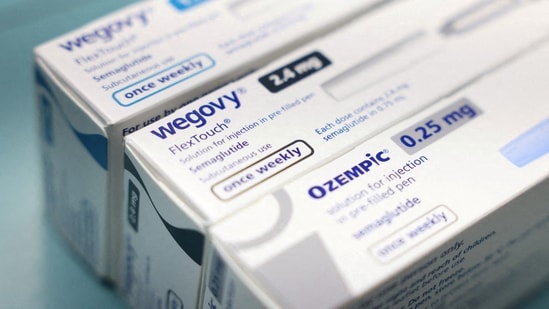
India’s pharma industry is ready to flex its generics muscle as the patent for a key ingredient of blockbuster weight-loss drugs expires today.
More than 40 Indian drugmakers are gearing up to launch over 50 brands that’ll compete with Ozempic and Wegovy at half the price. The impending supply glut is expected to democratise access in a notoriously price-sensitive market, while raising concerns over regulatory oversight and the potential for widespread drug misuse.
The stakes are immense. India, the world’s most populous nation, carries the second-highest diabetic burden globally after China—450 million of us may be obese or overweight by 2050, according to The Lancet. Pharmarack estimates India’s obesity drug market will surge from roughly ₹1,500 crore today to ₹8,000 crore by 2030.
Half-Price Ozempic, Wegovy, Mounjaro
India’s generic drugmakers—globally renowned for their ability to manufacture low-cost medicines at scale—are preparing to aggressively undercut the market. Analysts project these generics will debut at steep discounts of at least 50% to 60% compared to branded counterparts like Novo Nordisk’s Wegovy and Ozempic, or Eli Lilly & Co.’s Mounjaro.
Monthly costs for the lowest dose of semaglutide—the key active pharmaceutical ingredient (API) whose patent is expiring today—are expected to plummet from ~ ₹11,000 to a range of ₹3,000 to ₹5,000 almost immediately. As production scales, prices could eventually bottom out between ₹1,500 and ₹2,500.
This sharp deflation is poised to radically expand the consumer base. “Onboarding of patients from lower economic strata may happen on branded generics,” noted Sheetal Sapale, commercial vice president at Pharmarack, told Reuters, though she cautioned that corporate profitability will hinge heavily on maintaining pricing discipline amid the glut.
Too Many Options
Industry heavyweights including Sun Pharmaceutical Industries Ltd., Dr. Reddy’s Laboratories Ltd., Lupin Ltd., Mankind Pharma, and Alkem Laboratories Ltd. are all jockeying for market share.
Rather than engaging in solo price wars, some top-tier firms are leveraging strategic co-marketing pacts to consolidate distribution. In a major pre-emptive move earlier this week, Zydus Lifesciences Ltd. and Torrent Pharmaceuticals Ltd. struck a licensing agreement to co-market a semaglutide injection.
Under the terms of the deal, Zydus Lifesciences will manufacture an innovative formulation—a 15 mg/3 ml pre-filled cartridge utilised with a reusable pen—while Torrent Pharma secures semi-exclusive rights to market the drug under the brand name Sembolic. The upfront licensing fee structure allows Zydus to monetise its manufacturing prowess while Torrent Pharma leverages its massive domestic field force in chronic therapies.
While the influx of generics is a boon for affordability, healthcare analysts are sounding the alarm over the potential for a regulatory “Wild West”. Semaglutide remains a prescription-only medication, but pharmaceutical enforcement in India has historically been porous.
“With high demand, falling prices and multiple brands, you may see direct pharmacy purchases, distributor-level leakages, or cosmetic or lifestyle use, especially in urban markets,” warned Salil Kallianpur, an independent pharma analyst, told Reuters.
Such unstructured access, Kallianpur argues, could lead to poor dosage titration, unmanaged side effects, and eventually, forced regulatory tightening by the state.
Survival of the Fittest
The immediate aftermath of the patent cliff will be chaotic. The market will be saturated with “sema”-branded derivatives, overwhelming prescribers with aggressive marketing campaigns and varying device quality.
However, in India’s physician-driven pharmaceutical ecosystem, long-term success will rely on clinical trust rather than just rock-bottom pricing.
Doctors acting as gatekeepers are expected to eventually consolidate their prescriptions around a handful of reliable players who can guarantee supply chain integrity and consistent patient outcomes.
For the dozens of companies entering the fray today, the clock is already ticking. “Weaker players with poor quality and no differentiation will likely exit within two to three years,” Kallianpur said.