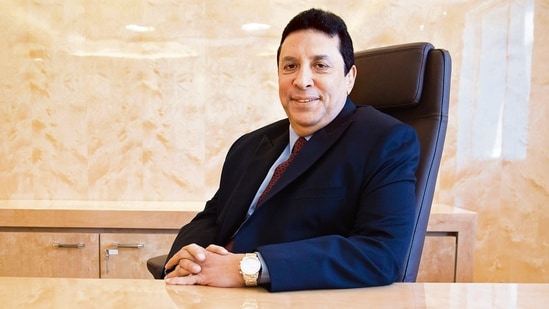
For Keki Mistry, it’s a return to the helm born out of sudden necessity. Doesn’t matter if it’s only for three months. The man who built India’s largest mortgage financier over four decades is now interim chairman of a combined HDFC Bank Ltd.
Following the shock resignation of part-time chairman Atanu Chakraborty over what he said were “ethical concerns”, the Reserve Bank of India swiftly approved Mistry as the interim chairman of the “systemically important bank”. He got to work immediately. Less than 12 hours after the former bureaucrat’s exit was made public, he was speaking to the media to calm the nerves of investors and customers alike, even as the stock of India’s largest private bank tumbled.
“There could have been a relationship issue between [Atanu] Chakraborty and (the bank’s) management. That may have manifested over a period of time,” he told the media and analysts over a call earlier today.
“None of us are aware of the issues raised by Chakraborty in the [resignation] letter… Differences on minor issues do come up from time to time…(but) no material issues raised,” he said. “There’s no power struggle within the bank.”
With that out of the way, Mistry immediate job would be to steady the ship that’s treaded choppy waters since the mega HDFC Bank merger came to a fruition in 2023, as “benefits of the merger are yet to fructify”, according to Chakraborty.
Keki Mistry before HDFC Bank merger
Mistry, in a way, has been in the HDFC ecosystem since before the bank we know of today existed. Joining Housing Development Finance Corp. Ltd. in 1981 and ascending to the role of CEO in 2010, the Mumbai-born bred and educated Parsi was instrumental in transforming HDFC Ltd. into a profitable mortgage machine—albeit with slim margins.
By the time of the mega HDFC Bank merger in 2023, HDFC had total assets of ~ ₹10.9 lakh crore and assets under management worth ₹7.2 lakh crore. The lean cost-to-income ratio generate a net profit of ₹26,160 crore in FY23.
Mistry’s HDFC Ltd. relied heavily of wholesale borrowings rather than low-cost CASA deposits. That meant thinner net interest margins (2% to 2.5%) but large scale and low operational costs, which drove high return-on-equity.
At the time of the HDFC merger, Mistry stepped away from daily ops, advising the board and CEO Sashidhar Jagdishan in a non-executive capacity. Now, he is back in the spotlight to oversee an institution that’s grappling with merger pangs.
The HDFC Bank merger
While the strategic rationale for the merger was sound on paper—HDFC Bank’s CASA heft meets HDFC’s mortgage strength—the execution has lacked.
- The margin squeeze: HDFC Bank consistently delivered net interest margins of around 4% fuelled by its massive depositor base, but the merger fundamentally altered this math. Absorbing HDFC’s high-cost wholesale borrowings—which increased HDFC Bank’s liabilities to 21% from 8% pre-merger—compressed NIMs to 3.4%-3.5%.
- The loan-to-deposit ratio (LDR): The most glaring post-merger financial metric was the surge in credit-to-deposit ratio, which spiked to 110% in FY24. To avoid regulatory scrutiny, HDFC Bank increased its deposits to ₹27.14 lakh crore in FY25 to lower the LDR to under 100%, but that came at the cost of ceding its mortgage market share to rivals ICICI Bank Ltd. and State Bank of India.
- The Dubai debacle: In late 2025, the Dubai Financial Services Authority put severe regulatory restrictions on HDFC Bank’s Dubai branch, barring it from onboarding new clients or promoting its financial services. The ban stems from an investigation into alleged mis-selling of high-risk Credit Suisse Additional Tier-1 bonds.
Mistry at work, again
Keki Mistry steps into the interim chairmanship facing a dual mandate: project absolute stability and oversee a seamless transition after a shock exit.
The financials back him—in FY25, HDFC Bank clocked a consolidated net profit of ₹70,790 crore, on net interest income of 1,21,700 crore and net interest margin of 3.4-3.5%—but Chakraborty’s resignation exposes an unknown underbelly.
“While governance standards have historically been strong for the bank, the current episode raises concerns about aspects that we may have limited insights, but could be material from a stock multiple perspective,” Kotak Institutional Equities wrote in a note.
JPMorgan, which has a “neutral” rating on HDFC Bank, said that Chakraborty’s exit adds to the macro headwinds, along with a hit to sentiment. “We believe that the stock is likely to trade weak following the resignation announcement, with impact amplified by a softer macro backdrop amid geopolitical uncertainties.”
Macquarie has removed HDFC Bank from its marquee buy list following the exit.
Institutional Investor Advisory Services, a proxy advisory firm that counts HDFC Bank among its shareholders, said RBI should be on top of the issue as HDFC Bank is a systematically important bank. “But since the RBI has appointed a group insider Keki Mistry in his place it could mean less alarm for shareholders,” IiAS CEO Amit Tandon said.
Clearly, Mistry has a task at hand—that of assuring institutional investors that the “practices and happenings” referenced in Chakraborty’s resignation letter are isolated and not systemic cracks. At the very least, he has RBI on his side.