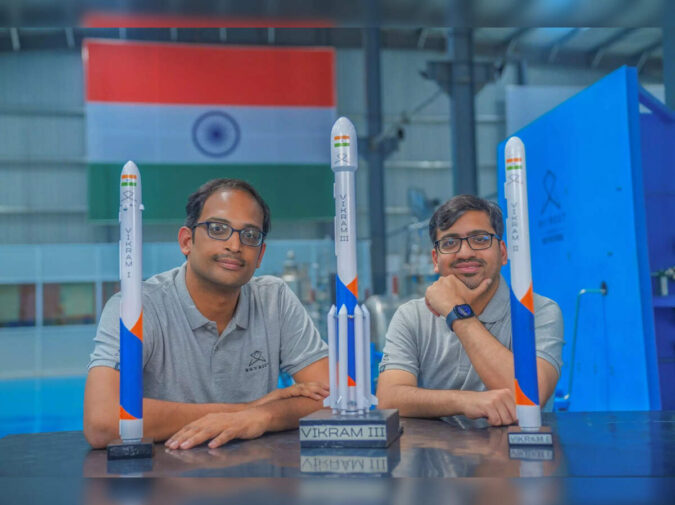

“We don’t want to directly compete with what SpaceX does or with larger rockets operated by governments,” Chandana told ET. He added that the dedicated launch segment remains under-served globally, where US-based Rocket Lab — which completed 21 successful launches in 2025 — is currently the most established player.
“There are limited options for global satellite companies, and that is the market we want to address. We believe Vikram-1 will be very cost competitive in this space,” said Chandana, who runs Skyroot along with cofounder Naga Bharath Daka, both former ISRO scientists.
Earlier, ET had reported that Skyroot is looking to raise $150-200 million (Rs 1,800 crore) to fund its next phase of expansion. This could value Skyroot at close to $1 billion, making it the first unicorn in spacetech. As per Tracxn, the startup has raised $99.8 million till date.
The Hyderabad-based startup is preparing to launch India’s first private orbital launch vehicle in the coming months. Chandana said the launch window from ISRO and IN-SPACe will be finalised by the end of March. Around 80% of the rocket has already reached the launch site, while a few remaining components are undergoing testing.
“The main part we are testing now is essentially the brain of the rocket. We need to simulate all possible scenarios and ensure it works multiple times. That’s where things can go wrong during the first flight, so we have to be extremely careful,” Chandana said.
The payloads for the first launch are largely finalised and are currently undergoing regulatory authorisation. The mission will carry a mix of CubeSat-sized (small) satellites and equipment for in-space experiments for telecommunication, insurance, and other domains. “It’s a mix of Indian and global customers. Most are private companies,” he said.
However, payload capacity will intentionally be limited during the first mission as the focus is on collecting flight data. Skyroot aims to produce one rocket per month as it builds reliability and manufacturing capacity.
“The plan is to build the capacity and rockets to eventually reach a cadence of one launch a month. Exactly when that will happen is difficult to predict, but we are aiming for next year,” Chandana said.
Skyroot’s four-stage Vikram-1 rocket is about 75 feet tall, and designed to carry satellites weighing up to 300 kg into the low earth orbit (LEO).
In a report titled India’s Space Odyssey 2026, VC firm Arkam Ventures said that India’s space economy, currently estimated at about $13 billion, is projected to grow to $40 billion by 2030. The report also says that about $3.5 billion of private capital could flow into the sector over the next five years.