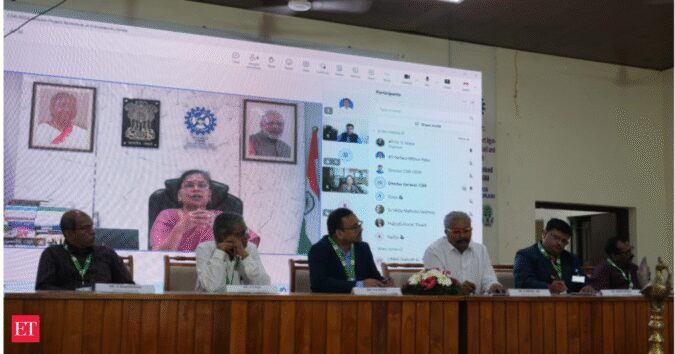
Welcoming the participants, G. K. Patra, Director of CSIR-Fourth Paradigm Institute (CSIR-4PI) and Mission Director of RSSA, presented an overview of the mission and its objectives. He highlighted that the mission integrates advanced technologies such as Artificial Intelligence (AI), Internet of Things (IoT), remote sensing, and precision engineering to enable data-driven decision-making for farmers, with significant potential for improving productivity while achieving substantial economic savings.
The workshop was inaugurated by N. Kalaiselvi, Director General of CSIR and Secretary, Department of Scientific and Industrial Research (DSIR), who delivered the presidential ad ess. She highlighted the importance of CSIR’s mission-mode programmes in supporting small and marginal farmers through innovative technologies and scientific interventions that promote sustainable agriculture.
B. Ashok, Vice Chancellor of Kerala Agricultural University, attended the event as the Guest of Honour. In his adress, he emphasised the significance of collaborative efforts between national research institutions, agricultural universities, and government agencies to empower the farming community through technology- driven solutions.
Directors from various CSIR laboratories, P. C. Panchariya, Arup Ghosh, and Theme Director Prabodh Kumar Trivedi, who are associated with the RSSA mission, also addressed the gathering and shared their perspectives on the technological innovations developed under the programme. Vibha Malhotra Sawhney, Head of the Technology
Management Division (TMD), CSIR, highlighted the importance of the mission in advancing precision agriculture in India. K. Rajendran, Director of the International Centre for Climate Studies (ICCS), spoke on the importance of climate-smart agriculture within the framework of the RSSA mission.
The Nodal Principal Investigator of the mission, V. Rakesh, presented an overview of the workshop and elaborated on the conception, progress, and outcomes of the RSSA mission. The Associate Director of RARS briefed the participants on how the workshop benefits farmers and students by providing exposure to cutting-edge agricultural
technologies.The workshop brought together leading scientists from several national institutions including the Indian Council of Agricultural Research (ICAR), Kerala Agricultural University, Tamil Nadu Agricultural University, University of Agricultural Sciences Bengaluru, and Amrita School of Agricultural Sciences. Farmers from Kerala, Tamil Nadu, and Karnataka also actively participated in the event.
The primary objective of the workshop was to showcase technologies developed by CSIR laboratories under the RSSA mission to farmers, students, and experts from agricultural universities and research institutions. Scientists demonstrated how integrated smart agrotechnologies powered by AI and machine learning can help farmers improve crop productivity, reduce input costs, and manage climate-related risks more effectively.
A key highlight of the workshop was the interactive sessions between farmers and experts from different agricultural domains. Farmers shared real field challenges, and experts provided practical solutions during live discussions. The second day of the workshop featured a special student–scientist interaction session, where students had the opportunity to engage with experts and learn about emerging technologies in agriculture.
The workshop also featured live field demonstrations of several innovative technologies, including:
• Variable Rate Fertiliser Applicator (Ground and UAV-based): Enables precise fertiliser application according to the nutrient requirement of individual crop zones using tractors or drones, with a spatial resolution of 3.5 square metres. This technology significantly reduces fertiliser usage compared to conventional uniform application methods.
• AI-based Mobile Application and Cloud Solution: A mobile application capable of identifying paddy crop diseases from images captured in the field. The cloud-based system also generates crop stress maps to enable targeted pesticide application.
• IoT-based Microclimate Observation Network: Established for the first time in India in farmer paddy fields across Kerala, Karnataka, and Tamil Nadu. The network ecords microclimatic parameters in real time and enables remote data access for modelling weather-induced crop diseases.
• Low-cost Optical Soil Nutrient Probes: An indigenous “Made-in-India” technology with a lifespan of over 10 years and no refill requirements, capable of measuring multiple soil nutrients—from nitrogen to zinc—in real time.