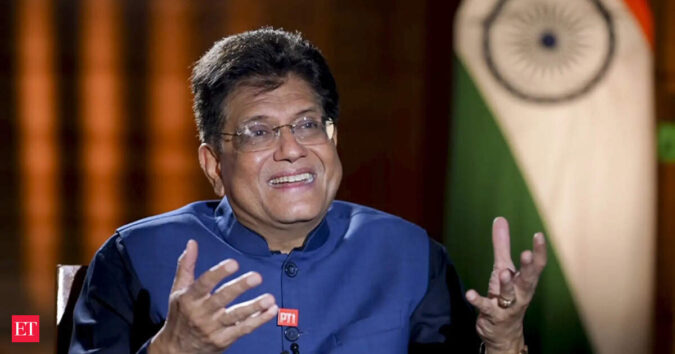
Referring to the shifting trade environment, Goyal said, “It’s an evolving situation. Trump administration has made some comments, they have other tools that they can use, next week they can increase it to 15%. Various dialogues are going on. I had said that if the circumstances change, the deal will be rebalanced.”
Goyal made the remarks at the News18 Rising Bharat Summit 2026.
Citing the joint understanding between the two sides, he said, “India-U.S. joint statement says that should circumstances change, deal will be rebalanced.”
Also read: India, US to resume trade talks once there is clarity on tariffs, says Piyush Goyal
‘Wait and watch’ on US tariffs
The minister said India remains engaged with the United States as discussions continue.
“In dialogue with U.S. on trade, is an evolving situation,” he said.
On tariff actions by Washington, Goyal added, “On U.S. tariffs: will wait and watch and ensure India’s best interests are protected.”
He also noted that the US administration has multiple policy tools available. “There are many tools that Trump administration can use in this evolving situation; one of them the 10% tariff move,” he said.
India’s exports poised to increase
Despite recent global trade headwinds, the minister expressed confidence in India’s export trajectory.
“Despite the headwinds India faced recently; exports this year poised to increase,” he said.
Highlighting the broader economic rationale behind trade negotiations, Goyal stated, “Assure that there are so many positives in the U.S. deal, lets see how the situation moves forward. International trade deal is about competitive advantage.”
Addressing concerns from the farm and dairy sectors, he reiterated that sensitive segments have been protected in the proposed arrangement.
“No GM foods will come into India,” he said.
He further clarified, “Dairy, maize, soybean, poultry is exempt from U.S. trade deal. We have preserved interests of farmers, dairy. No GM foods will come into India. The deal preserves our interests.”
Also read: US Supreme Court rules against Trump’s global tariffs imposed under emergency law
India-US trade talks deferred
India and the United States will resume negotiations on their proposed interim trade pact once there is greater clarity on tariff changes announced by Washington, Goyal had said earlier on Tuesday, days after the two sides deferred a scheduled meeting of trade negotiators.
The three-day meeting, which was to begin in Washington on Monday, was postponed after the US administration recalibrated its tariff regime. Officials said the talks would be rescheduled at a mutually convenient date after both countries assess the implications of the latest developments.
The Indian delegation was to be led by chief negotiator Darpan Jain. New Delhi is also expected to seek legal opinion on the impact of the US court judgment and subsequent tariff revisions before returning to the negotiating table.
Earlier this month, both sides had agreed on a framework for an interim trade deal. Under that understanding, the US indicated it would reduce the reciprocal tariff on India to 18% and remove the additional 25% punitive levy.
At present, Indian exports to the US are subject to a 25% reciprocal tariff, while the February 6 joint statement on the interim pact proposed lowering it to 18%.
India-US trade deal: Chief negotiators’ meet on interim pact rescheduled
US Supreme Court setback doesn’t deter Trump
The tariff reset follows a ruling by the Supreme Court of the United States that struck down the sweeping reciprocal duty structure introduced under President Donald Trump.
The tariff landscape has shifted sharply in recent months. On April 2, 2025, the US announced a 26% reciprocal tariff on Indian goods, later reduced to 25% in July. In August, Washington imposed an additional 25% levy as a penalty for India’s continued purchases of Russian oil, effectively taking the total tariff incidence to 50%.
However, under the interim framework agreed earlier this month, the US signalled a rollback — reducing the reciprocal tariff to 18% and scrapping the additional 25% levy.