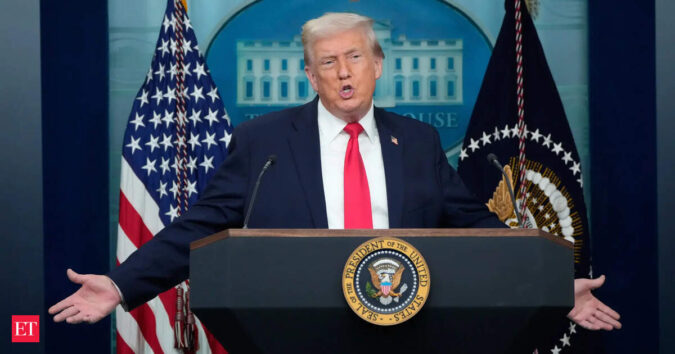
In a 6–3 ruling, the court held that the International Emergency Economic Powers Act (IEEPA) does not authorise the president to impose broad-based tariffs under emergency powers. The judgment invalidated country-specific duties imposed under that legal route.
Within hours of the verdict, Trump invoked Section 122 of the Trade Act of 1974 and signed an executive order imposing a uniform 10% global tariff, effective immediately. Sector-specific tariffs on steel, aluminium and automobiles remain in force.
For India, the decision marks another shift in a tariff cycle that began in early 2025 and saw US duties climb to as high as 50% before being partially reduced under an interim trade arrangement.
What did the US Supreme Court rule on Trump’s tariffs?
The Supreme Court ruled that IEEPA does not grant the president authority to impose sweeping global tariffs under emergency economic powers. As a result, tariffs imposed under that provision were invalidated.
However, the ruling did not affect duties imposed under other statutory provisions. The administration subsequently relied on Section 122 of the Trade Act of 1974 to maintain a 10% global tariff framework.
Timeline: How US tariffs on India moved from 26% to 50% and back to 10%
1. February 13, 2025: Trade expansion target setPrime Minister Narendra Modi and President Trump agreed to work towards more than doubling bilateral trade to $500 billion by 2030, even as trade tensions persisted.
2. March 4–6, 2025: Early negotiations
Commerce Minister Piyush Goyal travelled to Washington DC for discussions with US Trade Representative Jamieson Greer and other officials to address trade concerns.
3. April 2, 2025: 26% tariff imposed
The US imposed a 26% total tariff on Indian goods comprising a 10% baseline duty and an additional 16% reciprocal tariff — as part of a broader expansion of tariff measures affecting multiple countries.
4. April 9, 2025: Reciprocal tariff suspended
The 16% reciprocal component was suspended for 90 days, reducing India’s effective tariff burden to 10% while negotiations continued.
5. June 26, 2025: India steps up engagement
An Indian delegation returned to Washington ahead of a key deadline in an effort to prevent further escalation.
6. July 31, 2025: 25% tariff announced
The US announced a revised 25% tariff on Indian goods, effective August 7.
7. August 6, 2025: Tariffs raised to 50%
An additional 25% tariff linked to India’s Russian oil purchases was announced, taking the total tariff burden on Indian exports to 50%, effective August 27, 2025, the highest level during the dispute.
8. October 15–17, 2025: Negotiations intensify
Further rounds of talks were held in Washington, with six formal negotiation rounds completed by this stage.
9. January 31, 2026: Deal signals
Commerce Minister Piyush Goyal said India was working to finalise an agreement, indicating potential tariff relief.
10. February 2, 2026: Tariffs reduced to 18%
India and the US agreed on an interim trade deal under which US tariffs on Indian goods were reduced to 18% from 25%. India reduced tariffs on select US goods to zero under the arrangement.
11. February 20, 2026: 10% global tariff reset
Following the Supreme Court ruling, Trump imposed a fresh 10% global tariff applicable to all countries.
White House officials said the 10% rate would apply “until another authority is invoked.” Trump stated that the India–US trade deal remains intact. The final tariff structure applicable to Indian exports will depend on the formal implementation of the bilateral agreement.
From ‘Liberation Day’ to legal reset
The broader US tariff expansion began in February 2025, when duties of up to 25% were imposed on major trading partners including Canada, Mexico and China.
On April 2, 2025, the administration introduced a universal 10% baseline tariff along with higher reciprocal tariffs targeting multiple countries. Legal challenges followed over the use of emergency powers under IEEPA.
The Supreme Court’s February 2026 ruling invalidated tariffs imposed under emergency authority but did not affect sector-specific tariffs or duties authorised under other laws. The administration’s shift to Section 122 of the Trade Act of 1974 allowed it to maintain a 10% global tariff structure.
Over the past year, US tariffs on Indian goods have moved from 26% to 50%, then down to 18%, and now to 10% under the revised legal framework, with the final structure contingent on the implementation of the interim trade agreement.
With inputs from TOI