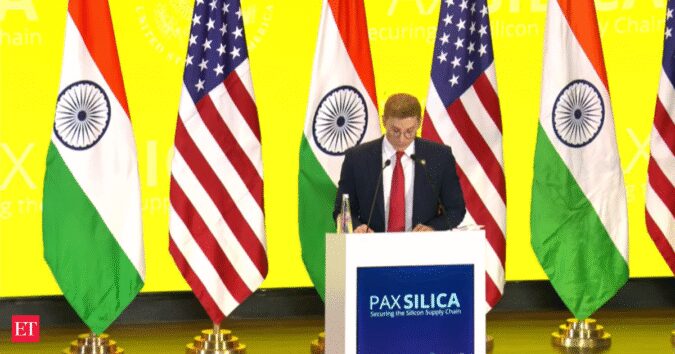
The announcement comes as US Under Secretary of State for Economic Affairs Jacob Helberg visits India from February 20–21 to join the American delegation at the summit and hold bilateral meetings aimed at strengthening economic ties in emerging technologies.
Also Read: India, US sign Pax Silica declaration to boost AI and semiconductor supply chains
It brings together trusted partner nations to coordinate across critical sectors ranging from minerals and energy to semiconductors, advanced manufacturing and AI infrastructure, reflecting a broader push to reinforce economic security partnerships and resilient supply chains.
The initiative is described by the United States as a positive-sum partnership focused on coordination among trusted partners, rather than isolating other countries.
United States Ambassador to India Sergio Gor on Friday highlighted India’s determination and the expanding scope of cooperation between the two countries. Welcoming India to the Pax Silica initiative he said by signing this partnership the two nations had chosen to win.
“We welcome India joining to co found the future tax silicon is about free society, whether free societies will control the commanding heights of the global economy. It’s about whether innovation happens in Bangalore and Silicon Valley or in surveillance states they use technology to monitor and control their people. We choose freedom, we choose partnership. We choose strength. And today, with India’s entry into Pak silicopa, we choose to win,” Gor said. Here’s all you need to know about the initiative and why it matters.
What is Pax Silica and why was it launched?
Pax Silica is a U.S.-led strategic initiative launched in December 2025 to secure global technology supply chains, specifically for semiconductors, AI, and critical minerals by reducing reliance on China. It fosters a “trusted” network of allies (Japan, Korea, UK, India, etc.) to counter China’s dominance and potential economic coercion in these sectors.
The US State Department describes it as an effort to reduce coercive dependencies, protect the materials and capabilities foundational to artificial intelligence, and ensure aligned nations can develop and deploy transformative technologies at scale.
The initiative reflects what US officials call a new economic security paradigm. Secure supply chains, trusted technology ecosystems and strategic infrastructure are now seen as indispensable to both national security and economic growth.
Pax Silica responds to growing demand among partners to deepen cooperation with the United States in emerging technologies, while addressing risks from excessive concentration, unfair practices and vulnerabilities in critical supply chains.
US officials have also described the current moment as transformational, with artificial intelligence reorganising the global economy and driving demand across the entire AI supply chain, from energy and minerals to semiconductors, infrastructure and advanced manufacturing.
The Pax Silica Declaration underlines the importance of a reliable supply chain that is indispensable to mutual economic security and recognises artificial intelligence as a transformative force for long-term prosperity.
The historical name itself combines “Pax,” meaning peace and long-term prosperity, with “Silica,” the compound refined into silicon, the foundational element of semiconductor chips that power AI systems and modern computing.
What does the initiative cover and who is involved?
Pax Silica covers strategic segments of the global AI and technology supply chain. These include critical minerals and refining, semiconductor design, fabrication and packaging, compute infrastructure, advanced manufacturing, transportation and logistics, energy grids and power generation, as well as connectivity and data infrastructure.
It also encompasses trusted Information and Communication Technology (ICT) systems, data centres, foundational AI models and software platforms.
Also Read: Why India should join Pax Silica high table
According to the State Department, signatories to the Pax Silica Declaration include Australia, Greece, Israel, Japan, Qatar, South Korea, Singapore, the United Arab Emirates and the United Kingdom. Non-signatory participants include Canada, the Netherlands, the European Union, the Organisation for Economic Co-operation and Development (OECD) and Taiwan.
The inaugural Pax Silica Summit was convened on December 12 by US Under Secretary of State for Economic Affairs Jacob Helberg. At the summit, countries explored joint flagship projects across connectivity, compute, semiconductors, advanced manufacturing, logistics, mineral processing and energy.
The summit aimed to strengthen trusted technology ecosystems, support long-term offtake arrangements, expand productive capacity across partner economies and coordinate responses to overcapacity and dumping so that supply chains remain secure, resilient and innovative over time.
Participants discussed pursuing multilayered partnerships to address coercive dependencies and single points of failure, reflecting what US officials described as a growing geopolitical consensus that economic security is national security.
They affirmed commitments to pursue joint ventures and strategic co-investments, protect sensitive technologies and critical infrastructure from undue access or control, and coordinate responses to overcapacity and dumping to keep supply chains secure and innovative.
The State Department has also announced that Helberg is visiting India from February 20–21 to join the US delegation to the India AI Impact Summit, led by White House Office of Science and Technology Policy Director Michael Kratsios.
During the visit, he is expected to hold bilateral meetings and deliver remarks aimed at advancing US–India economic ties in emerging technologies and helping launch the next phase of the American AI Exports Program under the AI Action Plan.
Why is India joining Pax Silica initiative?
India’s participation in Pax Silica comes shortly after it attended the Critical Minerals Ministerial convened by US Secretary of State Marco Rubio earlier in February, where External Affairs Minister S Jaishankar represented New Delhi.
On the sidelines of the ministerial meeting, Jaishankar expressed India’s support for the Forum on Resource, Geostrategic Engagement (FORGE), a newly launched initiative that succeeds the US-led Mineral Security Partnership.
The development also comes as New Delhi and Washington work to finalise a proposed trade deal and advance other economic initiatives aimed at solidifying ties between two of the world’s largest economies.
The renewed cooperation follows a period of tariff-related tensions, and signals a broader effort to stabilise and deepen bilateral economic engagement, particularly in critical minerals, semiconductors and the rapidly evolving artificial intelligence sector.
At the ministerial in Washington DC, Jaishankar called for structured international cooperation to “de-risk” critical mineral supply chains, noting that “excessive concentration” poses a major global risk.In a post on X, he said India underlined the challenges of excessive concentration and highlighted efforts to build resilience through initiatives such as the National Critical Minerals Mission, Rare Earth Corridors and responsible commerce, while conveying support for the FORGE initiative.
With India joining Pax Silica, the initiative expands its footprint into one of the world’s fastest-growing digital economies, reinforcing cooperation on AI infrastructure, critical minerals and resilient technology supply chains as artificial intelligence reshapes global economic and strategic dynamics.