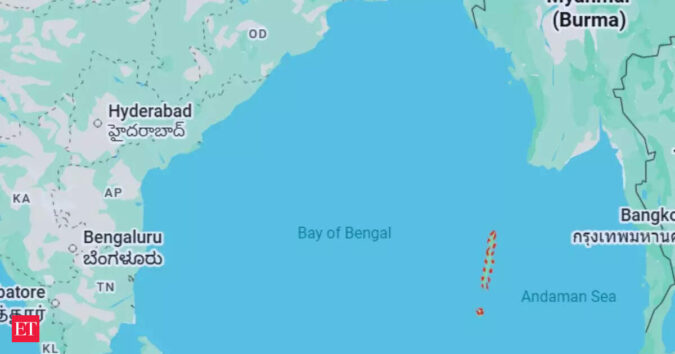
At the heart of this vision lies the International Container Transshipment Port (ICTP) at Galathea Bay, an ambitious effort to recast India’s role in global shipping, reduce its dependence on foreign ports, and anchor its strategic presence near one of the world’s busiest sea lanes.
Also Read:NGT clears Great Nicobar infrastructure project, says adequate safeguards provided
Scale, structure and strategic intent
The Great Nicobar infrastructure project, spread across 166 sq km near Galathea Bay, integrates three core components: a container transshipment port, a dual-use civil-military airport, and an integrated township. This multi-layered design underscores that the initiative is not merely commercial but strategic in conception and execution.
The ICTP alone is estimated to cost Rs 40,040 crore, with the first phase, targeted for commissioning by 2028, requiring Rs 18,000 crore and designed to handle over 4 million TEUs annually. At full capacity, the port is expected to process 16 million TEUs a year. A TEU (twenty-foot equivalent unit) is the global standard for measuring container capacity.
The government has decided that foreign port and terminal operators will not be allowed to participate in operating the ICTP, ET had reported recently based on information from sources. Instead, a joint venture company, majority-owned (over 51%) by an Indian private entity, will construct and run the facility. State-owned major ports, including Kamarajar Port Ltd., will hold minority stakes. The concession period has been fixed at 50 years, supported by viability gap funding from the Centre.This ownership structure reflects the port’s dual character of an economic engine and a strategic asset.
Location matters
Great Nicobar Island lies south of the Andaman Islands and is the southernmost and largest of the Nicobar group, roughly 520 km from Port Blair. Its location is its greatest strength.
The port at Galathea Bay will sit approximately 40 nautical miles from the Malacca Strait, the narrow maritime corridor linking the Indian Ocean to the Pacific Ocean. A substantial share of global trade, and a significant proportion of China’s energy imports, passes through this chokepoint.
The island’s position on the main east-west international shipping route, roughly equidistant from Colombo, Port Klang of Malaysia, and Singapore, gives India a rare opportunity. For decades, Indian transshipment cargo has been routed through foreign ports, these three. More than 75% of India’s transshipped cargo is currently handled outside the country, with over half routed via Colombo.
By situating a deepwater transshipment port close to this artery, India aims to reverse that flow.
Maritime independence and economic logic
India’s container traffic stood at about 17 million TEUs in 2020, compared to China’s 245 million TEUs. That disparity highlights the structural gap in maritime infrastructure between the two Asian giants. Even as India aspires to become a manufacturing and export powerhouse, its logistics backbone has lagged.
The Reserve Bank of India observed in a 2022 report that poor shipping connectivity has hindered India’s deeper integration into global value chains. Transshipment dependency is a key part of that problem. When Indian containers are routed via foreign ports, port charges and value-added services accrue to those economies.
The ICTP’s economic proposition is straightforward. If large container vessels dock directly at Great Nicobar instead of Colombo or Singapore, feeder vessels can distribute cargo to Indian ports in shorter timeframes. This could halve sailing distances and times for certain routes, reducing costs and keeping port revenues within India.
The port’s natural advantages strengthen its case. Galathea Bay offers natural water depths exceeding 20 metres, making it suitable for ultra-large container vessels without extensive dredging. The facility is designed to aggregate transshipment cargo from ports across the region, including Indian ports that lack the depth to handle large mother vessels.
A strategic counterweight in the Bay of Bengal
The project’s March 2021 pre-feasibility report explicitly cited national security and consolidation of India’s position in the Indian Ocean region as key drivers. In this sense, the ICTP must be viewed as part of India’s broader maritime doctrine.
China’s rise as a manufacturing and export superpower was underpinned by the development of world-class ports such as Shanghai and Shenzhen. Ports became key instruments of China’s economic strategy and geopolitical reach.
India’s Great Nicobar play echoes that logic. A transshipment port near the Malacca Strait not only enhances economic resilience but also strengthens India’s maritime posture in a region marked by intensifying strategic competition. The inclusion of a dual-use airport reinforces the island’s role as both a commercial hub and a forward strategic outpost.
Alongside the operationalisation of Vizhinjam International Seaport in Kerala — India’s first full-fledged deepwater transshipment port — Great Nicobar forms part of a two-pronged strategy. While Vizhinjam targets traffic along the Arabian Sea and westward routes, Great Nicobar focuses on the Bay of Bengal and the critical Malacca corridor.
Transshipment as the missing link
A transshipment port acts as a transit hub where cargo is transferred from one vessel to another en route to its final destination. This is essential because not all ports can accommodate the largest container ships. Smaller ports rely on feeder vessels to connect to major hubs capable of handling ultra-large ships.
For India, this structural constraint has meant that even domestically generated cargo is often consolidated abroad. Colombo, Singapore and Port Klang of Malaysia have long functioned as regional hubs, benefiting from scale, connectivity and established shipping networks.
By building the ICTP, India is attempting to insert itself into this established ecosystem as a competitive alternative. Great Nicobar port could gradually draw cargo volumes that currently flow outward, particularly as shipping lines look to optimise routes and reduce costs.
The Great Nicobar port is a strategic bet on India’s future position in global trade and geopolitics. By 2028, when the first phase is expected to be operational, India could begin reclaiming a portion of the transshipment revenues and logistical control it has long ceded to foreign hubs. As India seeks to position itself as a viable alternative to China in global supply chains, maritime infrastructure becomes indispensable. Manufacturing competitiveness is incomplete without efficient ports. Trade aspirations will falter without logistical autonomy.