Ajit Doval came with a message for Secretary of State Marco Rubio: India wanted to put the acrimony between the two nations behind it and get back to negotiating a trade deal, according to officials in New Delhi familiar with the meeting, who asked not to be identified because the discussions were private.
Doval told Rubio that India wouldn’t be bullied by US President Donald Trump and his top aides, the people said, and would be willing to wait out his term, having faced other hostile US administrations in the past. But New Delhi wanted Trump and his aides to dial down their public criticism of India so they could get relations back on track, Doval said in the meeting.
At the time, India was smarting from Trump’s insults and the 50% tariffs he’d slapped on its goods in August. The US president had called India a “dead” economy with high tariffs and that it was funding Putin’s war in Ukraine by buying Russian oil.
It wasn’t long after Doval’s meeting, which was previously unreported, that the first signs of an ease in tensions emerged. On Sept. 16, Trump called Modi on his birthday and praised him for doing a “tremendous job.” By the end of the year, the two leaders had spoken four more times on the phone as they inched toward a deal to bring down the tariffs.
India’s Ministry of External Affairs and Modi’s office didn’t respond to emails seeking further information. A spokesperson for the US State Department said that in keeping with standard diplomatic practice, it does not disclose the details of private discussions.
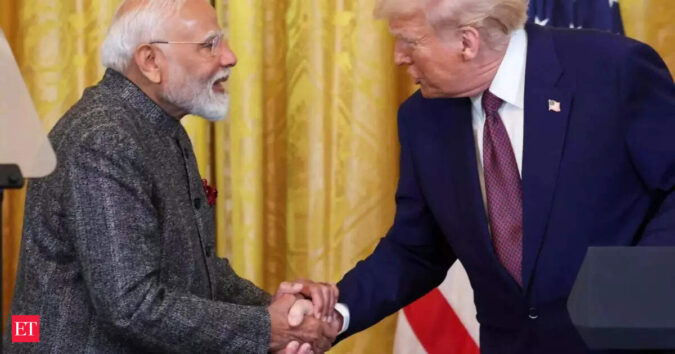
On Monday, Trump announced he’d reached a trade agreement with Modi that would reduce tariffs on India’s goods to 18%, lower than most of its peers in Asia. A punitive 25% duty that the US leader had slapped on India for buying Russian oil was also scrapped. In turn, Trump said, India agreed to purchase $500 billion of US goods, switch to buying Venezuelan oil, and reduce tariffs on US imports to zero. Modi’s government hasn’t confirmed those details and neither side has published any documentation to codify the agreement.“The past year has been one where negotiators, both in the US and India worked feverishly to get us to this point,” Nisha Biswal, partner at The Asia Group and former US Assistant Secretary of State for South and Central Asian Affairs, said in an interview with Bloomberg TV. “It benefits both the US and India that you have an India that is finally really opening up on global trade.”
Publicly, there had been no indication from either side that a deal was imminent. As recently as last week, US Trade Representative Jamieson Greer said India still had a long way to go to convince Washington it was halting Russia crude buys.
On Monday, officials in New Delhi were taken by surprise when Trump posted about the deal on social media. Many senior bureaucrats in the foreign and commerce ministries, even those who had been directly involved in the trade negotiations, were oblivious that a call had been scheduled between the leaders that day. Some were unable to confirm key details related to the tariff announcement when contacted by reporters late in the day.
Behind the scenes, though, New Delhi had been working to get relations gradually back on track. Doval’s meeting with Rubio in September was a signal to Washington that it sees the US as a long-term strategic partner and couldn’t afford to allow ties to deteriorate further.
The prevailing view in New Delhi was that India needed US capital, technology and military cooperation to deter China and meet Modi’s goals of making the South Asian nation a developed economy by 2047. Trump was just a blip over that time frame, officials in New Delhi said, and India needs to stay focused on doing what’s best over the long term.
“New Delhi was never going to sever relations with Washington following last year’s downturn in bilateral relations,” said Chietigj Bajpaee, a senior research fellow for South Asia at Chatham House. “India-US relations remain ‘sticky’ given the plethora of institutionalized and people-to-people linkages between both countries.”
“That being said,” he added, “the irrational exuberance that marked New Delhi’s earlier assessments of the bilateral relationship have faded.”
Relations had spiraled downward ever since Trump claimed credit in May for resolving a four-day clash between India and neighboring Pakistan, a boast that Modi vehemently rejected. In a tense call between the two leaders in June, Modi declined Trump’s request to come to the White House, where the US president was hosting Pakistan’s army chief at the time. In October, Modi skipped a summit in Malaysia to avoid a possibly awkward meeting with Trump.
The arrival of new US Ambassador Sergio Gor to New Delhi in December appeared to kick off more serious efforts to get relations back on an even keel. Gor, a former senior White House official and longtime member of Trump’s inner circle who is also close to Rubio, has repeatedly underscored the importance of US-India ties.
In his first public speech in his new role, Gor cast the tensions between the two countries as disagreements among “real friends,” which he said both sides were sure to resolve. He also announced India would be invited to join a US-led alliance, called Pax Silica, to strengthen supply chains.
A further thaw in ties was evident during a meeting between Gor and External Affairs Minister Subrahmanyam Jaishankar last week, according to people familiar with the matter. Gor said in a social-media post that the two sides discussed “everything from defense, trade, critical minerals, and working toward our common interests,” adding: “Stay tuned for much more!”
Jaishankar is currently in the US, where he’s held talks with Rubio on trade and supply chains.
“This appears to conclude a difficult six-month period for US-India relations,” said Alexander Slater, former India head of the US-India Business Council. “It also adds to recent signals about where India’s economic future is likely headed” and “removes a key impediment to what had been India’s gradual but steady alignment with the West.”
Despite the rapprochement, India has reason to proceed cautiously with Trump, and is keen to assert its strategic autonomy. Modi’s viral moment with Xi and Putin, clasping hands and chuckling together, was meant to show Trump that it has other options, officials in New Delhi said. Modi rolled out the red carpet for Putin in December, showcasing ties with a country that remains an important source of weapons and diplomatic support dating back to the Cold War.
Last week, Modi clinched a free trade pact with the European Union after almost two decades of talks, coming just months after India’s trade deal with the UK — deals that showed India was serious about diversifying its trade relationships in the face of the impasse with the US, according to an official aware of the details.
Later this month, Modi will host Canada’s Mark Carney and Brazil’s Luiz Inacio Lula da Silva in New Delhi, further using Trump’s new world order to forge closer economic and political ties with so-called “middle power” countries.
Still, the US remains a crucial partner for India, both as a market and as a source of investment. The nation ships about a fifth of its exports to the US, a large share of which are mobile phones and electronic goods, sectors that are key to Modi’s manufacturing ambitions. US companies lined up big investment pledges in India in recent months, especially in AI, including a combined pledge of $52 billion by Amazon.com Inc. and Microsoft Corp. in December. Alphabet Inc.’s Google announced $15 billion of investment in data centers in October.
India is also becoming more important for the US financial industry. Goldman Sachs Group Inc. has its biggest office outside of New York in the southern Indian city of Bengaluru, where it provides sophisticated IT and financial technology support to clients around the world.
“The larger geopolitical factors or strategic factors that bind Indian and the US together are still in place,” said Milan Vaishnav, director of the South Asia Program at the Carnegie Endowment for International Peace. “India requires a great amount of capital, of investment, of technology transfer, investments. So the US is critical.”