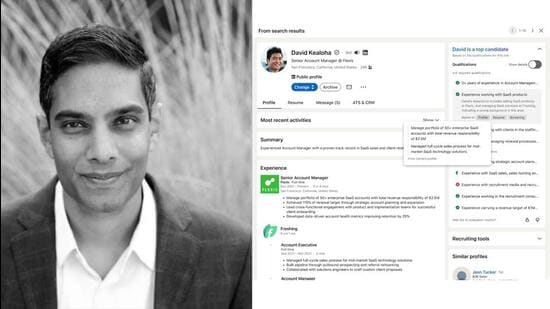
Late last year, LinkedIn made its AI-powered Hiring Assistant, an AI agent for recruiters, available globally in English.
The tool uses as proprietary large language model (LLM) fine-tuned specifically for recruiting. Early data showed that it can personalise and automate pre-screening of job applications, flag skill mismatches and trust gaps, and be tested for risks such as hallucinations and bias.
With AI’s increasing role in many workflows in enterprises, recruiters, too, are using it to speed up hiring while still making considered decisions about candidates.
Earlier this month, LinkedIn announced Verified Skills, which allows professionals to display verified abilities on their profiles, in partnering with AI companies Descript, Lovable, Realy.app and Replit.
In a conversation with HT, Hari Srinivasan, who is vice president of product for LinkedIn Talent Solutions, notes that AI is now fundamentally changing how hiring decisions are being made by giving a more nuanced view of a candidate’s skills beyond traditional markers such as degrees or school.
He added that LinkedIn’s research shows that 74% of Indian recruiters found it harder to find qualified talent over the past year. Srinivasan believes India is a key market for LinkedIn since it is a real-world stress-test for hiring systems at real scale. Edited excerpts.
Q. How does AI meaningfully change the hiring process, what signals is AI surfacing today that traditional résumés and keyword filters consistently miss? What kinds of context—industry, role complexity, geography, company maturity—are hardest for hiring models to reliably learn, even today?
Hari Srinivasan: AI is becoming a force multiplier in hiring because it tackles the two biggest sources of friction in this market: noise and time. Hiring is one of the most complicated marketplaces in the world where you’re considering thousands of potential candidates to get one great hire. Where AI helps most is moving beyond surface-level signals like titles and keyword matches toward deeper evidence of capability – the projects someone has worked on, the skills they’ve demonstrated, and the context behind their experience. That shift from keyword based hiring to evidence-based hiring is what allows recruiters to surface talent they might otherwise miss, while also giving a more nuanced picture of a candidate’s skills beyond traditional proxies like their degree or where they went to school.
What remains hardest for models to learn are the deeply human, situational layers of hiring like the trade-offs a hiring manager is willing to make, or the interpersonal dynamics that drive long-term success. That’s why the best systems keep humans in the loop so AI can surface better evidence, but people still own the judgment. The future isn’t AI versus humans – it’s AI reducing drudgery and surfacing better evidence, so humans can focus on what they do best: judgment, relationships, and long-term thinking.
Q. How do you design AI that widens opportunity and doesn’t end up reinforcing existing gaps in an organisation’s hiring process? And to that point, how can LinkedIn help individuals understand which skills actually matter more?
Hari Srinivasan: AI expands opportunity when it’s built on trust, foregrounds a skills-based approach, and allows humans to stay in control of hiring decisions. That’s core to how we’re building our tools for job seekers and hirers, aligned with LinkedIn’s Responsible AI principles. For recruiters, we designed Hiring Assistant to reduce the repetitive, time-consuming parts of hiring so they can spend more time on strategic, people-centric work. Early adopters view 62% fewer profiles to find a match, achieve 69% higher InMail acceptance rates, and cut the time spent reviewing applications nearly in half. That frees up recruiters to spend more time on the uniquely human parts of the job, like connecting with candidates, aligning with stakeholders, and making hiring decisions. As AI tools become a bigger part of the hiring process, recruiters will learn new skills like prompting AI effectively, calibrating roles, and interpreting the evidence behind recommendations, but it’s their uniquely human judgment that will continue to define great hiring.
For job seekers, our goal is to make the process more transparent and less overwhelming. That starts with helping people understand the skills and experiences a role actually requires, beyond just the job title. That’s why we’re building experiences that help members more easily find the right opportunity — from AI-powered job search that lets people describe the job they want in their own words, to our job match feature that helps members see how well their skills match a job in seconds.
Q. As hiring becomes more data-driven, what new responsibilities do platforms like LinkedIn carry toward job seekers, not just employers? What new technical skills do you think recruiters themselves will need as AI becomes more autonomous?
Hari Srinivasan: As AI transforms work, building and maintaining trust has never been more important. Data can make hiring faster and more efficient, but it only works if people have confidence in who they’re interacting with and how decisions are being made. That’s why we are investing deeply in trust across our platform from real identity to verified recruiters and now to verified skills. More than 100 million members have already verified their identity on LinkedIn, helping create a network built on authenticity and real professional interactions. We’ve also introduced verified skills so professionals can highlight their capabilities in a trusted, credible way and demonstrate proficiency in today’s most in‑demand skills directly on their LinkedIn profile.
For recruiters navigating an increasingly crowded and complex applicant pool, verified skills help surface true capability faster. And for professionals building credibility in a rapidly changing job market, verification gives employers and networks greater confidence in their expertise — helping ensure opportunity is driven by real skills, not just keywords. At scale, this is about building a hiring ecosystem that works with integrity, transparency, and confidence for everyone.
Q. India presents extreme scale, linguistic diversity, and non-linear careers. What edge cases in the Indian market have helped structure global AI-led hiring models, and how do you see this evolving over the next couple of years?
Hari Srinivasan: India is one of the most important markets for us to learn from because it stress-tests hiring systems at real scale. Linguistic diversity, non-linear careers, long notice periods, and salary ambiguity aren’t edge cases here, they are everyday realities. Our latest LinkedIn research shows that pressure clearly today as 74% of Indian recruiters say it has become harder to find qualified talent over the last year and nearly half saying they feel added pressure to explain how AI is being used in the hiring process.
These dynamics are exactly why some of our product innovations have been India-first. Features like Expected Salary and Notice Period were built here because they materially affect hiring speed and talent outcomes in this market – and once they work at India’s scale and complexity, they are easier to roll out globally. We’re also seeing this reflected in customer outcomes. Wipro India, one of the early adopters of Hiring Assistant, has shared that the tool is helping their teams identify niche talent significantly faster, reducing time spent screening profiles and enabling recruiters to focus on engaging the right candidates earlier in the hiring process.
Over the next few years, I expect AI-led hiring models to increasingly absorb lessons from markets like India, embedding calibration, transparency, and trust directly into workflows, so hiring gets faster, fairer and more evidence-based without losing its human core.