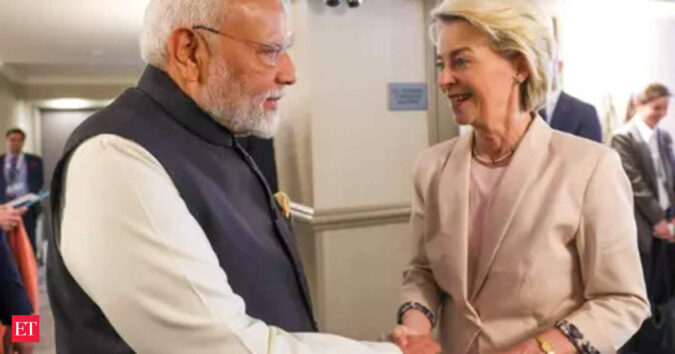
Von der Leyen wants what she called “the mother of all deals.” Prime Minister Narendra Modi should give it to her when she visits this week. Not just because India needs it, or Europe wants it — but because of the effect it’ll have on US President Donald Trump.
Also Read| Mother-of-all deals could turbocharge EU car entry into India
It’s clear why the Europeans are pushing right now. The continent is beset on all sides: by Russian aggression, Chinese coercion, and its own many weaknesses. On top, now its anxieties about American abandonment have turned into alarm at Washington’s intimidation.
India is, in contrast, a vision of stability. It offers a market that’s steadily growing. It poses no existential threat. New Delhi might not align perfectly with Europe’s capitals on climate or on Ukraine, but at least it doesn’t seek to coerce, expropriate or humiliate them.
When von der Leyen arrives as chief guest at India’s Republic Day, Modi will of course lay out the red carpet. He should also cut through the free-trade agreement red tape.
Negotiations were supposed to conclude by the end of 2025. New Delhi, however, spent the last few months looking over its shoulder at the White House. It doesn’t want its concessions to the EU to become the baseline for a new set of demands from America First’s ideologues. Objectively, it also made sense to settle relations with the more volatile partner first.Also Read| India-EU FTA talks near conclusion, pact likely at January 27 summit
But prospects of the US coming to any sort of reliable agreement with India have faded. Trump seems to want New Delhi to abase itself, and credit the president with not just deal-making nous, but also thank him for bringing peace to the subcontinent. That Modi simply can’t do — his nationalist base won’t allow it.
In any case, it was always unlikely that some magic set of concessions will get Trump to withdraw his 50% tariff rate on India, drop his long-held view that the country is undeservedly getting something for nothing, and embrace the benefits of partnership and integration. Something else is needed to jolt negotiations between these two countries out of the rut.
Concern in New Delhi about how the White House will react to an India-EU deal is justified. For protectionists, every trade agreement that isn’t signed with them is signed against them.
Everything we know about Trump suggests he would see this as open defiance: A continent he has just mocked and pressured ganging up against him with a country he is seeking to corner. His reaction could be, let’s say, intemperate.
Modi should welcome that, not fear it. He should sign not despite American pressure, but because of it.
Trump respects strength, or at least the appearance of it. Europe and Brazil get bullied; China and Russia do not. Faced with an unfriendly US, India has found it has worryingly little leverage. If it’s looking for ways to demonstrate to the US that it won’t back down, signing one of the biggest bilateral deals in history seems like a perfect fit.
Modi’s voters, too, are looking for strength. They may not be interested in the minutiae of incompatible phytosanitary standards or data privacy regulation. But they know how to react when their prime minister takes a stand — like dealing with Europe at this precise moment, when it has been the focus of Trump’s ire. They will see it as yet more evidence that India can manage a crowded, unfriendly world on its own terms.
What’s on the table now, whatever it is, won’t be perfect. The deal may be incomplete, with some agricultural products excluded; it may not give Indian carmakers the protection they want, and European activists will probably worry about labor and environmental provisions.
But the longer the wait for an agreement, the higher the chance that this moment of possibility will pass. And the more expansive the deal, the likelier that the European Parliament will consign it to some sort of legal purgatory, as it has just done for the agreement with Latin America. In negotiations, perfectionism is the same as paralysis.
Close a deal with Europe, and the US will be forced to recognize that India has options and can act on them. And, incidentally, it will provide the Indian economy with a new direction for energy that has been frustrated by trade barriers erected by America against China.
A dozen press releases over more than a decade have declared this deal would be historic. If so, it’s time to make history.