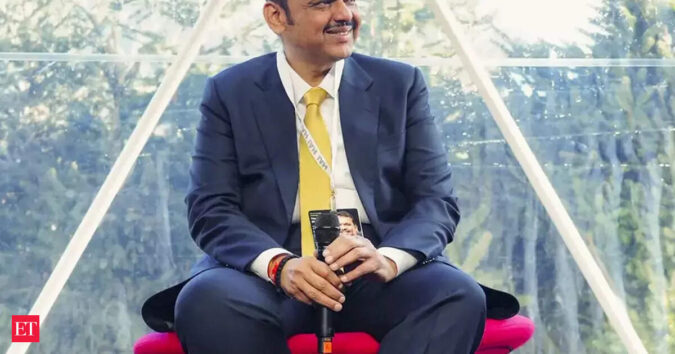
AI is already transforming public administration, Maharashtra chief minister Devendra Fadnavis said at a panel discussion titled ‘AI for Viksit Bharat’ at the World Economic Forum, moderated by Sruthijith KK. “We (Maharashtra government) are now trying to embed AI in our entire processes, in our governance, in our service delivery.”
India’s digital public infrastructure is an equaliser, Fadnavis said. “Now is the time when, with the use of AI, we can leverage this digital infrastructure for greater public good.” Citing the state’s agriculture initiatives, he added: “We have created the AgriStack…entire data digitised-land records, crop records, every single thing, for every farmer.”
Fadnavis also highlighted Maharashtra’s plans to build a 200-acre innovation city, positioning it as a hub to attract AI-led investments, startups and talent.
Bajaj Finserv chairman and managing director Sanjiv Bajaj called AI a disruptive but familiar technological shift. “Whenever there is any discontinuous innovation, and AI clearly is one, there is significant change…there is hype and fear initially,” he said, drawing parallels with earlier transitions from steam to electricity and the rise of the internet. “Over these 200 years, the world has become more productive, more prosperous,” he said. He outlined three stages of AI adoption-productivity, effectiveness and innovation-adding that AI-led call centres in some group companies have already delivered “a 30% improvement in productivity”.

At Bajaj Finserv, AI is already reshaping advertising, customer engagement and lending. “We do a few thousand marketing videos every year, and this is all being AI-created end-to-end,” Bajaj said, citing a Diwali campaign where “in 15 days, we customised almost 300,000 individual ads” across stores. On lending, he said an AI bot now negotiates loans in Hindi, English and mixed languages. “Out of 4.5 million loans a month, we are already doing 30,000-40,000 loans end-to-end with the AI product,” he said.
While AI adoption is clearly accelerating, PwC India chairperson Sanjeev Krishan flagged a sharp gap between deployment and value creation, citing findings from a global report unveiled at Davos. “Only 12% CEOs say that they have gotten returns on both the top and bottom line with the use of AI, and a large part of that is because nobody is looking at it as a tool to revolutionise enterprise,” he said.Krishan argued that disruption from AI is inevitable, but the real challenge lies in preparedness. “Humans will always outpace any kind of technology development…because at the end of the day, we are the ones who are innovating.” The issue is not job loss, but whether people are being equipped with the right skills, he said.
India must urgently rethink its education system if it wants to stay relevant in an AI-driven economy, Krishan said. “The higher education system has to go through a rehaul…if you want to be relevant to what comes next.”
PwC released the ‘AI Edge for Viksit Bharat’ report at ET House in Davos.
Zerodha cofounder and investor Nikhil Kamath cautioned against applying traditional valuation metrics to AI companies.
“There are no revenues in most AI companies really to warrant the kind of multiples that they’re getting,” except for firms such as Alphabet or Nvidia with established businesses, he said. “You can’t value a company in AI today based on the revenue that they’re earning today,” Kamath added, calling current valuations an extrapolation of uncertain futures. “Anybody can bet because nobody knows,” he said.
Kamath said India should avoid replicating western AI models and instead focus on building applications above core models. “The mistake I don’t think we should make is try and replicate what western companies are doing, which have a lot more risk capital at hand,” he said.
He also warned against platform dependence. “The time is ripe today to not get dependent on one platform,” Kamath said, urging diversification. Looking ahead, he added: “Contrarian behaviour and nuance…becomes increasingly important,” noting that originality is hard for models to replicate.