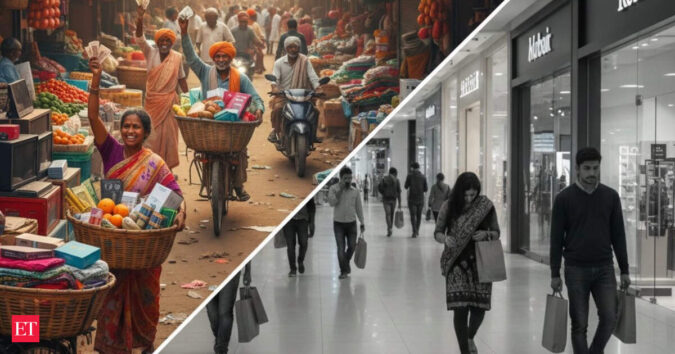
Growth has surprised on the upside, inflation has cooled meaningfully from its post-pandemic peaks, and rural demand, long the weak link, has begun pulling its weight. Yet beneath the headline numbers sits a quieter, more uncomfortable reality: urban India, especially its middle class, is still holding back.
That hesitation matters. Urban consumers drive discretionary spending, from cars and appliances to housing upgrades and lifestyle services.
When they delay purchases, entire value chains slow. As Sitharaman & co prepare Budget 2026, the question confronting the North Block is no longer whether India is growing, but who is spending and who isn’t.
Rural demand has led the recovery, helped by better farm incomes, welfare transfers and easing food inflation. Urban India’s rebound, by contrast, has been uneven and fragile. Mall footfalls have returned, but ticket sizes remain cautious. Housing sales are steady at the premium end, but mid-income buyers are stretching decisions. Automakers talk of enquiries, not conversions. The confidence that usually accompanies falling inflation has been slow to arrive.
That is the backdrop against which Budget 2026 arrives, not as a stimulus Budget, but likely as a test of whether policy can restart the urban consumption engine without losing fiscal discipline.
The stress points are now visible enough to be hard data, not just sentiment.Budget 2026–27: Government plans double-digit hike in rural scheme allocations to boost growth, demand
Urban wallets under pressure
Urban consumption’s weakness is no longer anecdotal. It shows up clearly in consumption data tracked by FMCG companies and retailers. Deloitte’s pre-Budget analysis highlights how stark the divergence has become between rural and urban India.
“Urban consumption recovery has been weaker because urban discretionary spending has slowed sharply, even while rural markets have outperformed. The Deloitte report shows urban FMCG volume growth at only 2.6%, compared with 8.4% in rural India,” Anand Ramanathan, Partner, Retail & Consumer Products Sector Leader, Deloitte India, told ET Online.
What makes the slowdown persistent is not a collapse in incomes, but a squeeze on disposable spending. Inflation in essentials may have eased, but its cumulative impact lingers. Housing rents, school fees, healthcare costs and EMIs have absorbed the relief from lower headline inflation.
Urban consumers, Ramanathan noted, have adjusted their behaviour accordingly.
“Urban consumers have shifted toward smaller packs, value-seeking behaviour, and have become more selective due to sustained inflation in essentials, muted wage growth, and pressure from housing and EMI burdens,” he told ET Online.
Even where spending is happening, it is cautious. Deloitte’s report notes that brands are seeing consumers become “increasingly value-conscious rather than outlay-conscious,” pushing upgrades and premium purchases into the future. Discretionary categories such as apparel, beauty and consumer durables have felt the brunt of this shift.
This helps explain why India can post strong GDP growth while private consumption growth remains patchy. Rural India is spending more. Urban India is spending carefully.
Budget 2026: Not just big guns, the real test of Bharat’s defence will be dictated by its modern muscle
Why Budget 2026 matters more for cities than villages
Unlike rural demand, which responds quickly to transfers, MSPs and food inflation, urban consumption is shaped by taxes, credit costs and price structures. That gives the Union Budget far more leverage, while also raising expectations.
According to Ramanathan, the policy toolkit for reviving urban demand is already well understood. “Budget 2026 can counter these pressures by reducing effective tax burdens, stabilising inflation through supply-side measures, and cutting compliance costs faced by businesses to improve passthrough pricing,” he told ET Online.
Deloitte’s Budget Expectations report repeatedly returns to one idea: affordability improves not just when incomes rise, but when friction in the system falls. GST rationalisation, faster refunds and lower working-capital blockages can reduce end prices without explicit subsidies.
“The Budget Expectations report recommends measures like rationalising GST 2.0, simplifying refund systems, unlocking working capital, reducing inverted duty structures, and providing income-tax certainty. These actions would help reduce end-consumer prices for urban buyers while improving formal sector employment,” Ramanathan said.
That matters for urban India, where spending decisions are more sensitive to monthly cash flows than to headline growth.
Also read: Budget 2026 could be the gear shift India’s auto industry is waiting for
Is there room for middle-class tax relief?
One of the most closely watched aspects of Budget 2026 will be whether the government tweaks personal income tax again after changes in 2025. Deloitte’s reading of the macro environment suggests there is space to do so without jeopardising fiscal stability.
“The Budget Expectations report indicates clear macroeconomic headroom. India’s GDP grew 7.8% in Q1 FY25-26, inflation has moderated to 2.6%, and global commodity prices, especially oil, are projected to fall to $52–62 per barrel in 2026,” Ramanathan told ET Online.
More importantly, last year’s experience offers evidence. “The report also highlights that income-tax rate reductions in 2025 materially lifted consumption in both urban and semi-urban markets,” he said.
That strengthens the case for targeted, middle-class-focused relief rather than broad giveaways. Tweaks to slabs, higher standard deductions and smoother refund processes can improve cash flows quickly, particularly for salaried households that dominate urban consumption.
The impending rollout of a new Income-tax Act from April 2026 adds another layer of urgency. “Tax certainty and simplifying tax laws are crucial priorities for the new Income-tax Act,” Ramanathan said, arguing that predictability itself acts as a consumption catalyst.
Also read: Will Trump be the uninvited guest at Sitharaman’s Budget table?
Big-ticket spending: Where policy meets psychology
Few areas illustrate urban caution better than big-ticket purchases. Cars, appliances and housing are long-cycle decisions, deeply influenced by EMIs and price visibility.
“Big-ticket urban purchases have slowed due to high EMIs, inverted duty structures, and uncertainty in indirect taxation,” Ramanathan told ET Online.
Deloitte’s report outlines granular fixes that could move the needle. In automobiles, unresolved issues around accumulated input tax credit continue to lock up dealer capital. “Budget 2026 could allow refunds or credit transfers to reduce dealer working-capital costs, helping lower prices,” Ramanathan said.
Electric vehicles face a different distortion. Inputs attract higher GST than the final product, raising costs. “Allowing IDS refunds for capital goods and components would reduce prices and improve affordability for middle-class buyers,” he added.
For appliances and electronics, similar issues persist. Input-service tax credits excluded from refund formulas and rigid value-addition norms raise production costs. Addressing these, Deloitte argues, would lower sticker prices without fiscal outlay.
Housing, meanwhile, remains a barometer of middle-class confidence. “Middle-income housing demand is tied to mortgage affordability. Macro signals create room for Budget 2026 to expand tax deductions on home-loan interest, or reduce GST burdens on under-construction homes,” Ramanathan said.
A persistent criticism of consumption-focused policy is that it risks favouring affluent urban households. Deloitte’s analysis suggests that need not be the case.
“Tier-2 and Tier-3 cities account for around 60% of e-commerce transactions, meaning broad-based relief via GST cuts, logistics improvements, and digital public infrastructure reaches far beyond top-tier affluent consumers,” Ramanathan told ET Online.
Targeted measures matter. Housing interest deductions, simplified TDS for homebuyers, lower GST on mass-market durables and middle-bracket income-tax tweaks direct benefits toward households where spending has slowed the most.
Equally important is the role of MSMEs. “The MSME section quantifies that MSMEs employ over 100 million people and contribute 30% of GDP. Supporting MSMEs lowers product costs, stabilises urban employment, and thus supports middle-income households more than the top 5%,” Ramanathan said.