Complimenting these efforts was an accommodative monetary policy which provided sufficient resources needed for growth while maintaining price stability- thereby maintaining profit growth for corporates. Unsurprisingly, India’s economic growth has continued to show a level of resilience that few anticipated at the start of the year. That said, there are caveats, and certain sectors still continue to operate below their full potential.
Click here to check latest developments on Union Budget 2026
Manufacturing: India’s Achilles wheel?
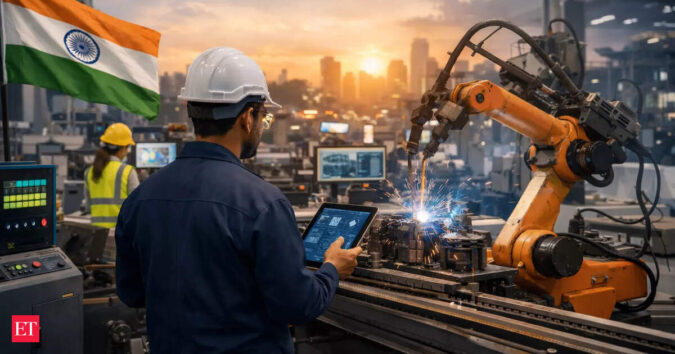
Despite steady growth in India’s GDP over the last few years, manufacturing sector growth has not picked up commensurately. In fact, since 2022, average growth in India’s manufacturing sector has been consistently lower than the growth in GDP in both nominal as well as real terms.
Moreover, the manufacturing sector’s contribution to India’s GVA, at around 16-17%, is much lower than that of other countries at a similar or even lower level of development. This, hence, begets the question: why has the manufacturing sector underperformed despite an overall positive growth scenario?
Several factors contribute to this gap, including the need for labour and land reforms, regulatory hindrances, lack of skilled labour, and insufficient infrastructural support amongst others. For holistic growth, this sector needs to scale up and realize its untapped potential. Achieving this will require strong policy support, and the upcoming Budget offers a critical opportunity to set the stage for such transformation.
Also Read: India’s time for power move to cut reliance on China and others
Budget 2026: Mission Manufacturing
The Union Government has been focused on promoting India as a global manufacturing powerhouse. The flagship Atmanirbhar Bharat initiative and the marquee PLI scheme are some of the notable policies announced in this regard, both of which have delivered significant success.
Under Atmarnirbhar Bharat, India’s defence sector is a prime example of success of the scheme, while under PLI, the electronics and solar battery/panels sector stand out as clear winners. The Union Budget is expected to further prioritize manufacturing to ensure India’s successful integration into global value chains. In this context, it must be mentioned that the Union Budget had earlier announced the creation of a National Manufacturing Mission, which is yet to take off. It is likely that the government will come out with a detailed framework and roadmap for this Mission in the upcoming Budget.
Also Read: Sitharaman & Co will be counting every rupee on the road to Viksit Bharat 2047
Budget 2026: MSMEs and Tariffs
This year’s Union Budget is also set against the backdrop of headwinds in the form of higher U.S. tariffs. The steep tariffs imposed by the U.S., which is India’s major export market, pose significant risks, as the export basket to the U.S. is heavily skewed toward manufacturing exports.
The situation is especially alarming because many of these export items are produced by MSMEs. While the government and the RBI have announced several measures to tide over this crisis, and the exports to the U.S. have so far shown resilience, it is likely that the government would provide further support to this sector in the Budget. We can expect some measures aimed at easing working capital requirements and export financing, along with special schemes for MSMEs with high exposure to the U.S. market.
These steps would supplement existing measures and help shield MSMEs in case the uncertainty around the U.S.-India trade deal persists. Sector-specific schemes could also be explored for sectors such as chemicals, gems and jewellery, and textiles, which are most likely to face the brunt of these tariffs due to the presence of cheaper alternatives and somewhat elastic demand.
Also Read: Trump tariffs or not, trade power should stay with India
Budget 2026: Fast tracking ease of doing business
Apart from direct interventions, the government also needs to address the long-standing issues with respect to doing business in the country in the Budget. The focus should be on improving land, railway, and port connectivity. This would ease logistics costs and lead to greater cost efficiencies. At the same time, the pace of infrastructure development should be accelerated to ensure smoother movement of goods within the country.
Setting up more export-oriented industrial parks can also be explored, with some form of tax/income incentive for firms that successfully diversify export to alternate markets. There is also an urgent need to address the inconsistencies in India’s customs duty structure, largely due to the presence of inverted duty structure for several products, which continues to hamper production.
Budget 2026: From local to global
As India embarks on its ambitious mission to become a global manufacturing hub, the Budget represents a critical step in propelling this vision forward. Given the volatile global environment, this focus becomes even more important.
Timely interventions-spanning the prioritization of manufacturing infrastructure, support for MSMEs, and a continued thrust on Ease of Doing Business-are the need of the hour, and we can expect the Budget to focus on these areas as well. This will enable India’s manufacturing sector to evolve, scale up, and produce at a global scale while also advancing the goal of Atmanirbhar Bharat. Achieving this is crucial for India to realize its aspiration of becoming a Viksit Bharat.
(The author is an economist at Bank of Baroda)