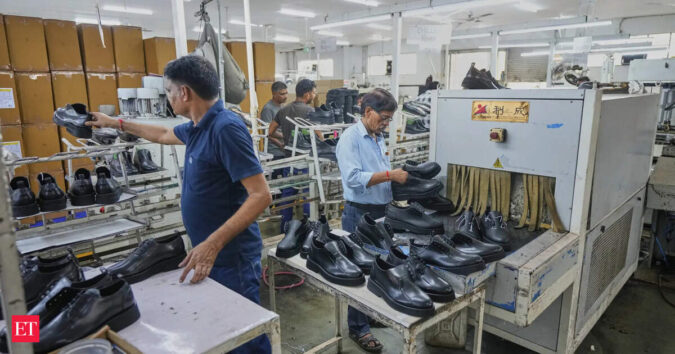
Earlier, the Department for Promotion of Industry and Internal Trade had proposed a production-linked incentive for footwear, but the plan was shelved following a revamp of government policy. Since then, officials have designed a comprehensive package that targets the entire value chain, from raw materials and components to finished products, offering incentives to investors in this labor-intensive industry. While the plan is yet to be officially finalized, discussions are reportedly at an advanced stage, with an announcement expected soon, according to the TOI report.
Read more: Will Trump be the uninvited guest at Sitharaman’s Budget table?
India is the second largest footwear producer. It was a significant player in the leather footwear business until the landscape changed globally and sports shoes and athleisure became the dominant segment, with China taking the lead and Vietnam joining with mega plants.
India is the second largest footwear producer. Among those that are identifiably exported are Maharashtra’s classic Kolhapuri sandals that Union Ministry Piyush Goyal projects has the potential to touch a billion dollars a years.
The industry, especially in terms of the Kolkapuri style, marked a significant moment last year after Prada signed MoUs with two government-run firms on a project to celebrate Indian craftsmanship.
The move came after the multibillion dollar fashion brand was accused of using the Maharashtrain footwear style without giving due credit to India. The scandal that followed led to expectations of higher export and recognition of Indian-made footwear.
Why relief package is needed?
Although several domestic players have become contract manufacturers for foreign companies, particularly from Taiwan, the US tariffs have disrupted investment plans in the sector.
Domestic manufacturers also point to a lack of capacity in producing key inputs, which are largely imported from China. In addition, high duties on raw materials used for soles and other shoe components make domestic production less competitive, forcing manufacturers to rely on imports. Industry executives note that the government has taken a similar approach in the electronics sector, rolling out comprehensive packages that also cover components.
The move comes as the government aims to boost both domestic consumption and exports of footwear, ensuring Indian companies become stronger participants in the global value chain. It also aligns with India’s aggressive free trade agreement efforts, with the European Union and the UK expected to join the list soon. These markets are likely to offer duty concessions for Indian goods, helping absorb any additional production capacity in the coming months.
On the domestic front, the average Indian is expected to increase footwear consumption from about two pairs per year to three, while the international average remains six to seven pairs.
Relief through GST cuts:
In the apparel and footwear segment, the GST for footwear below Rs 1000 was 12% and above Rs 1000 was 18%. Following the historic reforms, the GST for apparel and footwear products from Rs 1000 to Rs 2500 is also at 5% while apparel products priced above Rs 2500 have their GST increased to 18% from the existing 12% (footwear above Rs 2500 was already at 18%).
India’s economy is largely driven by domestic consumption. According to the Ministry of Commerce, private spending accounts for around 61% of GDP, meaning most economic activity comes from people buying goods and services at home rather than relying on exports. For perspective, exports to the US total $87.4 billion, just 2% of India’s overall output. This reliance on internal demand makes India more resilient to external shocks like trade disputes or tariffs.
It helps explain why India is expected to remain one of Asia’s fastest-growing emerging markets over the coming decade, with GDP projected to stay above 6% even as US tariffs weigh on export growth, according to BMI, a Fitch Solutions company.
As per an SBI Research report, combined GST and income tax cuts could inject roughly ₹5.31 lakh crore ($60 billion) into the economy, with ₹1.98 lakh crore ($22 billion) coming directly from GST cuts on everyday household goods. Finance Minister Nirmala Sitharaman informed that the GST overhaul carries revenue implications of ₹48,000 crore. The simplified tax structure, with lower rates, is expected to fuel consumption across sectors like automobiles and FMCG.