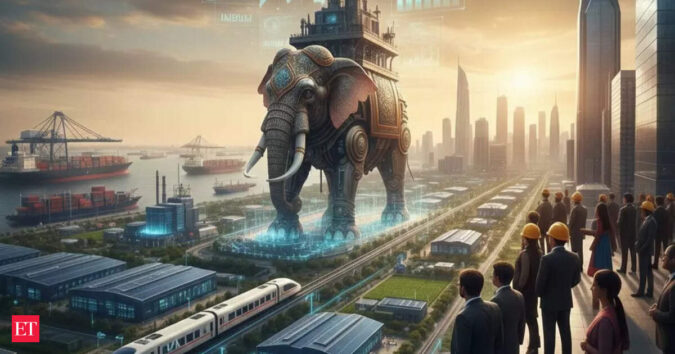
Higher capital expenditure outlays are projected in Union Budget for infrastructure, which includes railways, roads, highways, defence, and transfers to states, collectively representing around 80% of effective capex. This unfolds amidst an environment where private investments, overall, remain uneven and dampened by global uncertainties.
Budget 2026 needs supply-side response
A strong supply-side response in India’s Budget 2026 will be important to attract fresh investments and improve the ease of doing business. As a testament, India’s score as well as ranking on the World Bank’s Logistics Performance Index – which considers, customs, infrastructure, logistics competence and timeliness, amongst other factors – improved post-pandemic, compared to the prior five years.
We expect the total Centre’s capex budget in FY27 to stay around 3.1-3.2% of GDP, up ~7% yoy from FY26, with an emphasis on identifying shovel-ready and greenfield projects. This spending head will also include concessionary support for states (FY26 ~INR3.9trn as grants) to support their capex commitments. In our recent India 2025-2040 macroeconomic report, we outlined our base case for the Centre’s capex spend to expand to INR 15trn over the next decade and a half assuming a conservative CAGR of 11% (matching 2000-2019 run-rate), also considering absorption limitations. States’ capex allocation (capital outlay) also grew sharply, up 13% CAGR between 2019 and 2025. We expect that momentum to continue in the decade ahead, putting the cumulative Centre and states’ capex at INR 22-23trn.
Click here to check latest developments on India’s Budget 2026
Budget 2026 to prioritise strategic sectors
Secondly, strategic sectors would be prioritised, which include defence, semiconductors, electronics, renewable energy, artificial intelligence/robotics etc. Budget allocations towards the defence sector have targeted modernisation and expansion of the indigenous manufacturing capacity, with indications of a double-digit increase in the FY27 Budget. In light of the challenging geopolitical landscape, there is a heightened need to enhance domestic procurement and bolster the security apparatus.
Aggregate share of manufacturing as % of GDP is yet to improve materially, even as certain segments have expanded market share. To boost this further, the Centre might explore rationalisation in custom duties and rework import procedures for intermediate components. Maintaining adequate capital outlay for R&D will help move up the sectoral value chain, besides offering long-term tax incentives, expansion of PLI-like programs (mobile phone PLI concludes this year), credit/capital supply and infrastructure zones. States have undertaken reforms to attract investments, building strong ecosystems in textiles, aerospace, electronics, auto, footwear etc., which highlight the benefits of clustering and scale in production activities.
Also Read: How India can mobilise capital for its next growth leap
A case in point was the recent rollout of the India Semiconductor Mission 2.0 (ISM 2.0), which proposed a doubling in the financial outlay to INR 1.8trn vs INR760bn in 2021. This edition will prioritise chip design (domestically produced processors), capital equipment for manufacturing, access to specialised gases etc., also expand the reach of MSMEs in this space.
After China, India is the only market that provides a combination of a well-sized consumption market and large-scale production, garnering sufficient interest from the investment community for the diversification play. As an imperative, a clear matrix framework on selected product and geography-specific clusters (akin to Assam, Odisha etc.) will also be helpful in channelising executive and administrative efforts to materially improve the economy’s export share as well as defend against diversification attempts by other peer countries.
Union Budget 2026 to solve governance issues
Next, ironing out governance issues will be prioritised via a focus on deregulation and decriminalisation to identify and eliminate redundant or outdated compliance obligations in key sectors, via a bottom-up approach.
While the formation of the official Deregulation Commission announced in last year’s budget appears to be still waiting in the wings, other high-level committees have sought to address these issues, including involving states to address concurrent subjects like land and labour.
We will await further details on the proposed commission, which would ideally have representation from all key stakeholders especially from the private sector and regulators.
Also Read: Budget 2026 key priorities: Skilling youth for an AI-ready future
India Budget 2026 to support local priority sectors
Lastly, ground-up support for the domestic priority sectors is bound to continue – four key priority groups, Gareeb (poor), Yuva (youth), Annadata (farmers) and Naari (women) – referred to as GYAN segments, are likely to be in the forefront of social assistance and development programs. An overarching push towards strengthening human capital will be a prerogative, marked by initiatives around industry-specific training, upskilling, better healthcare and education access.
For markets, budget numbers will be of bigger interest. In the FY26 Budget, the government announced a shift towards the debt to GDP ratio as the primary anchor, i.e., to lower the Centre’s debt to 50% of GDP by FY31 from ~56.1% in FY26. We expect the fiscal deficit to be maintained in a range of -4.2-4.4% of GDP for FY27, marking a small improvement from FY26 goalposts.
Direct and indirect tax changes are also due to kick in, including a broader take up of the new income tax regime and slabs as well as tax increases on tobacco/cigarettes which have already been announced. Data for FY26 indicates a possible deviation from nominal GDP projections and a potential revenue deficit, which will be addressed by potential expenditure rationalisation.
(Radhika Rao is a senior economist and Executive director at DBS Bank)