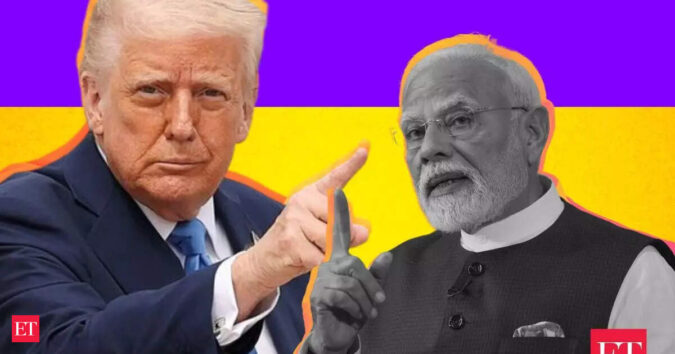
Once projected as a natural alliance between the world’s two largest democracies, ties between New Delhi and Washington have increasingly swung between warmth and confrontation.
Public bonhomie has given way to sharp trade actions, mixed signals on geopolitics, and a diplomacy shaped as much by domestic politics in the US as by shared strategic interests.
When Donald Trump returned to the White House on January 20, expectations in India were cautiously high.
Also Read: In Trump’s transactional world, Japan—not the Gulf—may be India’s smartest capital partner
Prime Minister Narendra Modi’s early visit to Washington on February 12 was read as a signal that New Delhi wanted to regain momentum in the relationship.
Discussions on a bilateral trade deal followed, and talks of doubling trade to $500 billion by 2030 briefly revived optimism.
That phase did not last.
The Trump administration’s inability to deliver on its early promise of resolving the Russia–Ukraine war within its first 100 days altered global alignments.
India–US ties, already strained by unresolved trade disputes, began to fray further.
Public bonhomie to trade hostilities
The contrast with the past could not have been starker.
At the “Howdy Modi” rally in Houston, Donald Trump and Narendra Modi stood before a crowd of over 50,000, trading praise and projecting personal chemistry. Trump described India as a loyal friend, while Modi called him a “true friend in the White House”.
By August 2025, India and the United States were locked in a deep trade dispute, with Washington imposing tariffs of up to 50 percent on a wide range of Indian exports, leaving India among the most heavily tariffed US trading partners.
There was a brief window of optimism earlier in 2025. Prime Minister Narendra Modi’s visit to Washington in February revived discussions on a possible trade deal aimed at doubling bilateral trade and easing market barriers.
That hope did not last. On 30 July, President Donald Trump announced a new 25 percent “reciprocal” tariff on Indian goods, dealing a blow to expectations of a breakthrough.
Days later, the US publicly confirmed a trade and energy partnership with Pakistan, a move New Delhi viewed with scepticism against the backdrop of already strained ties.
Then, on 6 August, Trump signed an order imposing an additional 25 percent penalty tariff on Indian imports, accusing New Delhi of financing Russia’s war in Ukraine by purchasing oil from Moscow.
The move took total duties to 50 percent, coming into effect later that month.
Also Read: 2025: The year RBI used the chopper
The path from public displays of friendship to punitive tariffs was marked by ego clashes, hardened trade positions and the limits of personal diplomacy.
Early warning signs
Tensions had surfaced well before Trump’s return to office. In 2018, he publicly criticised India’s import duties on Harley-Davidson motorcycles as “unfair”. That was followed by the “America First” tariffs of 25 percent on steel and 10 percent on aluminium. In March the following year, India lost preferential access under the US Generalised System of Preferences, affecting billions of dollars in exports.
Another sensitive fault line emerged over India and Pakistan.
Trump repeatedly claimed credit for defusing tensions between the two neighbours after an April 22 attack in Pahalgam that killed 26 civilians, mostly tourists. On May 10, Trump said he and Vice-President JD Vance had intervened to bring about an “immediate ceasefire”.
India pushed back firmly.
“PM Modi told President Trump clearly that during this period, there was no talk at any stage on subjects like India-U.S. trade deal or US mediation between India and Pakistan,” Indian Foreign Secretary Vikram Misri said.
“Talks for cease of military action took place directly between India and Pakistan through established military channels and on the insistence of Pakistan. Prime Minister Modi underscored that India has never accepted mediation in the past and will never do.”
Mixed messages, rising uncertainty
The volatility was on display again on September 5, when Trump posted a cryptic message alongside a photograph of Modi with Chinese President Xi Jinping and Russian President Vladimir Putin.
“Looks like we’ve lost India and Russia to deepest, darkest, China. May they have a long and prosperous future together!” he said.
The remark came amid US frustration over India’s continued energy ties with Russia and unresolved tariff disputes. Within a day, Trump struck a softer tone, stressing the personal bond with Modi.
“I’ll always be friends with (Narendra) Modi… He’s a great prime minister. He’s great. But I just don’t like what he’s doing at this particular moment. But India and the United States have a special relationship. There’s nothing to worry about. We just have moments on occasion.”
Fresh tariff threats over rice
Trade rhetoric soon escalated again. Trump warned of possible new tariffs on Indian rice imports, accusing India of dumping rice into the US market. Speaking at a White House roundtable with farm sector representatives and senior officials, he pressed Treasury Secretary Scott Bessent on India’s trade practices.
“India, tell me about India. Why is India allowed to do that? They gotta pay tariffs. Do they have an exemption on rice?”
When told, “No sir, we’re still working on their trade deal”, Trump replied, “But they shouldn’t be dumping. I mean, I heard that. I heard that from others. They can’t do that.”
The comments coincided with the announcement of a $12-billion federal aid package for American farmers and renewed references to a World Trade Organisation case involving India.
Despite the sharp rhetoric, Trump has continued to publicly praise Modi. The US Embassy in India quoted him on X as saying: “India is home to one of the world’s oldest civilizations. It is an amazing country, and a very important strategic partner for America in the Indo-Pacific region. We have a great friend in PM Modi.”
Trade issues also featured in subsequent leader-level conversations, including US demands for greater access to Indian markets for agricultural produce such as corn and soybean. Modi later described one such call as “warm and engaging”.
Strategic imperatives, political unease
US lawmakers and analysts have warned that Trump’s approach risks undermining ties with India at a time when Washington sees New Delhi as central to balancing China.
“Partners like India are therefore indispensable,” Vivek Mishra, Deputy Director of the Strategic Studies Programme at the Observer Research Foundation, told TOI. But he added that this logic is constrained by a resurgent nationalist mood in the US that is sceptical of complex, multi-aligned partnerships.
“This tension reflects a broader uncertainty in US foreign policy—between realism, which acknowledges India’s strategic autonomy, and ideological nationalism, which demands clearer lines of allegiance,” Mishra said.
For India, however, the signal is clear. Even amid trade wars and political turbulence, Washington continues to view New Delhi as a pillar of the emerging global order.
For now, India–US ties remain volatile, shaped by strategic necessity on one side and domestic politics on the other. Whether the relationship can be steadied will depend on how both capitals navigate that contradiction.